
What Changed?
The set took a place in the narrative. The flower wall used to be a supporting role. This time it entered the show notes beside the clothes and pointed to a predecessor’s earlier work.
On 29 September Dazed recorded Glenn Martens’s Margiela SS27. The set used the same florist as Raf Simons’s 2012 Dior couture debut, and the flowers were dying. This page asks whether homage belongs to the subject when the brand’s subject is replication.
This is one page of the Observer Report. I usually record how clothes speak, and this time it was a wall. Anyone walking into L’Élysée Montmartre saw a wall of nearly dead flowers first. The clothes came second. I have been thinking about that order for a while.
From 29 September the reviews began to arrive. Most wrote about Hard and Soft, a few noticed the flower wall. I have collected the original words from both sides and ranked nothing. This house has always treated replication as its subject, and I do not yet know whether this wall is the same subject.
Dazed published Isobel Van Dyke’s Margiela SS27 report on 29 September. Glenn Martens titled the season “HARD and SOFT” and staged it at L’Élysée Montmartre in Paris, where the walls were covered in wilting flowers. Dazed writes that the florist, Mark Colle, also worked on Raf Simons’s 2012 Dior couture debut. One line from the show notes is recorded in 01. The invitation came with a silver peony pin.
The control group sits in 2012. Another Magazine interviewed Mark Colle that year about six floral pieces for Simons’s last Jil Sander season. They were sealed in plexiglass cubes, shipped to the Milan showroom and left to age by themselves. Dazed reads Simons’s flowers as vitality and Martens’s as time passing. Same florist, same image, and fourteen years later the meaning has changed.
Why today: the reviews all landed within 48 hours. DSCENE found the concept better than the silhouette, Whoopsee found two languages merely coexisting, MILLE found technique close to overwhelming the clothes. Three separate reviews stop at one point: what persuades in this collection. This is Martens’s first season fully devoted to Margiela, and homage and his own language now sit side by side on one wall.


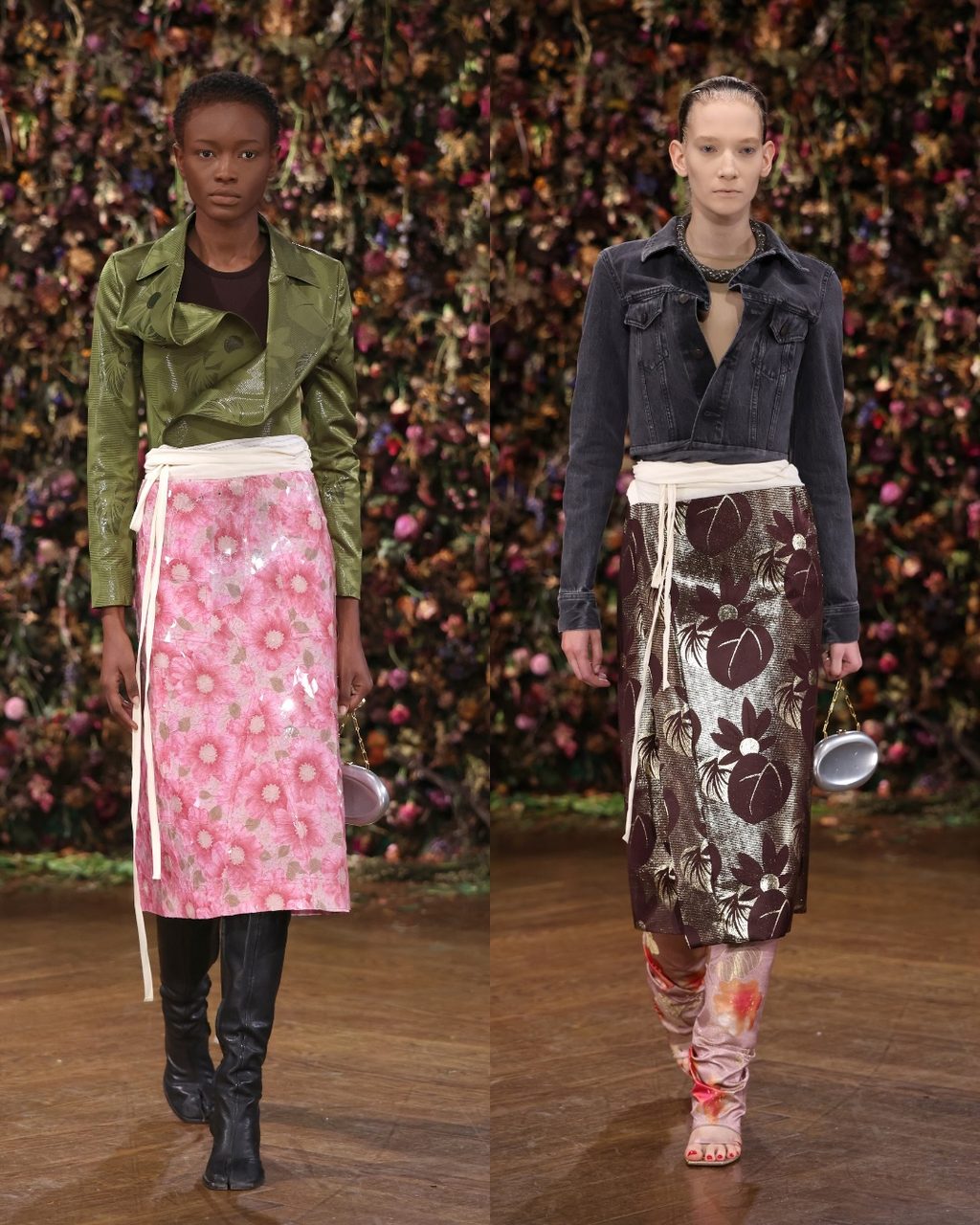
The set concept follows our on-going founding interest in replication and our deep love of fashion.
In this collection, rigidity is introduced into archetypal garments, creating new possibilities for silhouettes; tailoring is enriched with new structural elements; drape is given unprecedented foundations from which it can flow.
The show was mind-blowing... the clothes, the flowers, the music, the colours, the knowledge that it was going to be Raf's last show
the intellectual argument sometimes becomes more compelling than the silhouette in front of us.
quando una collezione deve ricorrere, alternativamente, alla memoria o all'identità personale del suo autore per risultare convincente, significa che il dialogo non è ancora diventato linguaggio
Still, Galliano left very big Tabi-shaped shoes to fill, and there were moments here when the sheer volume of technique threatened to overwhelm the clothes themselves.
a trench coat, pencil skirt or button-down shirt can be just as radical when seen from the right angle.
It is within those contradictions that Maison Margiela continues to feel most comfortable.
Eight quotes: two from the house’s show notes, one from the florist in 2012, five from critics. Martens’s side uses the words replication and rigidity, the critics use synthesis, technique and contradictions. Both talk about structure, and nobody opens with the wall.
The set leans toward trade media. Reddit was unreachable because of connection limits, and no first-hand posts on X or Instagram could be quoted in full, so this column holds no ordinary readers. The narrative map below therefore leans toward critics, to be revisited if first-hand posts appear.
The house’s account sits in the show notes: the set follows a long-running interest in replication, and the clothes split tailoring from drape. The quoted line does not name Simons. Dazed does.
The critics’ consensus is strong technique, slightly short on persuasion. That is the trade’s voice. How ordinary readers see the flower wall is unrecorded, so critics stand in for this box.
Homage may be turning into part of the house’s language. Margiela treats replication as a method, so whether honouring a predecessor falls inside that method is worth following. For now, a guess.
Must homage and self be synthesised at all? Why should a house built on taking things apart be asked to sew them back together? Whoopsee’s test is synthesis, and Margiela’s tradition may not agree.
The set took a place in the narrative. The flower wall used to be a supporting role. This time it entered the show notes beside the clothes and pointed to a predecessor’s earlier work.
Reviews cluster around whether it adds up. The homage is gentle, the clothes are busy, and set side by side the reader must choose which half to watch.
Designers are expected to deliver something of their own. Here the set openly used borrowed flowers, and the edge of originality blurs a little.
A wish to be seen as an heir. Martens took over a famous seat and borrowed Simons’s flowers, as if saying he knows someone stood here before.
Show audiences now read provenance. Who the florist was, which year, which show: trade knowledge that media now put in the first paragraph.
If homage can be done by hiring the same person, will future quotation buy people and scenes outright instead of copying from pictures?
These six themes are the fixed framework INCODER checks each day’s cultural signals against, closer to a pair of glasses than a rulebook. Put them on, and the same event grows different meanings.
The wall’s information sits on a second layer: who the florist was appears only in the body text. Readers who stop early see a wall of dead flowers. Does the layer they cannot reach still belong to the show?
A new designer is always compared inside a predecessor’s shadow. By borrowing a predecessor’s flowers, will Martens’s name become clearer, or harder to tell apart?
Wilting flowers mean vitality in Simons’s hands and time in Martens’s, as Dazed reads it. If one symbol changes meaning with its owner, who does it belong to?
The dying flowers stayed in the room and kept being photographed. If a thing draws most attention while it dies, can that count as a kind of vitality?
The reference travelled through insiders retelling it. When a homage only the trade can read leaves the trade, which version do outsiders receive?
The audience saw flowers first and clothes second. If the set takes attention first and the clothes arrive late, was that order designed?
Start with the assumption. The question presumes homage and replication can be separated. Margiela’s tradition lays replication open: copies, old garments and versions of one garment all serve as material. Martens calls it a “long-running interest”. A wall of dying flowers in that context can be respect or method, and people standing in the room cannot tell which.
A quiet consequence follows: when one gesture can be read two ways, the author’s intent is no longer part of the answer. The flowers keep wilting, the reviews keep arriving, and no response from Simons has been seen. This record has no answer, only an image: the same florist, fourteen years later, placing flowers on another person’s wall.
This report records the state of observation at this moment.
What has been collected is trade reviews and house statements; first-hand posts from ordinary readers are not yet included. The judgments may be reinforced, or overturned.
Observation continues.