There is a kitten asleep on your wrist. Your landlord doesn't allow pets. This week, smells that don't exist got a formula
On 7 September, Dazed published a feature on "fantasy notes": kitten fur, wet concrete, cold metal, pool toy, doll heads. None of these words on a perfume's note list comes from the thing it names. Each is an accord — a set of aroma chemicals a perfumer has assembled into a perception — built so that you smell a scene you may never have lived in, or can no longer get back to. The piece opens with a kitten asleep on your wrist: warm dust, milk, a sunbeam on the sheets. Then you open your eyes. Your landlord doesn't allow pets. You are at a desk, mid-afternoon. The only real thing is a bottle called Calico. This page records how "smellable but non-existent" moved from a perfumer's technique into a product language, and what people are actually buying once a memory can be written down as a formula.
// recurring focus: manufactured sensation, synthetic memory, perception as a constructed product; the accord as a claim about the world; the sense that resists the screen and the industries that try to describe it anyway
This is one page of the Observer Reports. The territory I watch is manufactured sensation — things that have a formula before they have an experience; things you smell, touch, and believe you remember, which someone assembled for you in a lab. This page's sample is perfume, or more precisely the words on a perfume's note list that have no source: kitten fur, wet concrete, cold metal, pool toy.
First, the thing that made me stop. Ellen Atlanta, who wrote the Dazed piece, runs a very short experiment in her opening lines: she makes you believe there is a kitten on your wrist, then tells you there isn't — the landlord won't allow it. The whole article lives between those two sentences. The perfumer Christopher Bull describes his method plainly: when making "wet concrete", he never starts by asking what concrete smells like. He breaks down the experience of encountering it — dust, mineral, damp, rain, something cold and metallic, the earthy note that shows up when something dry goes wet — and then builds that experience out of materials. His own words: "you're not reproducing an object, you're constructing a perception of it." That sentence is his, quoted as spoken. What I want to file is that in September 2026 it can sit on the product page of a $150 perfume and nobody finds it strange.
Second thing. Jackie Mayol, the founder of nostos, said in an interview last December that she is "a self-diagnosed nostalgia addict" — that "the pain of not being able to relive memories makes me sick to my stomach", so being able to get back "even a slice" of them through scent fascinates her. Her brand spent nearly a year on TikTok gathering followers before a single bottle existed; people read it before they could smell it. And Amelia Rose, the perfumer behind Faux Rose, asked a further question: "What if one day we could capture and recreate an exact scent memory that we can keep forever?" This page has no answer for her. It only records that, this week, an industry is seriously writing formulas for things that do not exist, and the people buying them seem to know that perfectly well, and buy anyway.
— OBSERVER 1985 · Observation Archive
00Why This Topic Today
Why today: one article turns "the notes are fictional" into common knowledge, while three brands have already turned fiction into a product line
Facts first. On 7 September, Dazed Beauty ran Ellen Atlanta's feature "What are 'fantasy notes'? Inside perfume's weirdest obsession". The working definition comes from Jackie Mayol, founder of nostos: "A fantasy note is typically an accord made by a perfumer to reflect something that isn't commonly found in traditional fragrance." They are constructed, assembled from materials to evoke imagined, abstract or unconventional smells. The article's examples: nostos's "wet concrete" and "cold metal" (Shiver) and "kitten fur" (Calico); the "pool toy" accord in Vacation's signature scent; and the materials perfumers are now reaching for — "doll heads, latex, credit cards, drugs". It also notes that none of this is new. Amber, one of the most familiar notes in perfumery, has never been extracted from amber; it is a late-nineteenth-century fantasy built from labdanum, benzoin and vanilla. What has shifted is the resolution: the old fantasies (marine, leather, musk) were broad and atmospheric, "more of a vibe"; the new ones are specific to the point of being mistakable for a memory — "a Tuesday from your childhood".
Next, how this line reached today. In 2022 the sunscreen brand Vacation released its own perfume with "pool toy" and "swimsuit lycra" on the note list; Rodrigo Flores-Roux, the Givaudan perfumer who built it, told Who What Wear they "were being cheeky at first" and then "pushed it to an extreme where people really perceive this unique latex, rubber, swimming pool water accord", using azurone, karmaflor and a little tarragon for its chlorinated edge. In August 2024, Who What Wear declared that fantasy fragrances had "never been more on-trend" and credited TikTok: people increasingly buy perfumes they have never smelled, so a brand has one second to give them something to hold on to — and "croissant" sells better than vanilla. Caroline Ornst of DSM-Firmenich put it without decoration: storytelling on the note list gives online shoppers "some point to hook onto". In December 2025, nostos launched three perfumes by Marissa Zappas, with design by Special Offer, Inc., the agency behind Charli XCX's Brat; the Who What Wear writer said she had "fallen for a brand before it even launched", having followed it on TikTok for close to a year.
Then, a few lines from this week's article. Bull on "water" as a note: "Smell memory is deeply personal. Everyone has their own version of 'water': mud after rain, mist on grass, concrete after a sun shower. You're not really building an objective, accurate version of a thing, you're identifying the signals that make it recognisable to someone else." Mayol on why now: "In today's chaotic world, we're all craving a bit of escapism even if just for a quick hit of temporary relief." She adds that people now wear perfume "as expressions of their inner selves and as reminders of the memories that make up their lives"; external validation has slipped down the list. Rose pushes the technology one step further: headspace analysis was developed to record the scent molecules of rare flowers in the wild without cutting them, and in theory it can be pointed at almost anything — a living animal, a fabric, a room. "What if one day we could capture and recreate an exact scent memory that we can keep forever?" The article closes by calling the whole thing an archive: as we push olfactory fantasy to its limits, "we're also building an archive of everything we suspect we're about to lose – the memories, the homes, the seasons – in the one medium that requires IRL intimacies."
Finally, why today. The community side of this signal is quiet. There is no main Reddit thread on "fantasy notes"; the nostos reviews on Fragrantica and Parfumo are scattered and split — "soft and furry in the beginning" against "the most overwhelming burnt rice odor" and "such a snooze fest". The people actually speaking are perfumers and founders: this is a signal whose language was written by the supply side first. This page files it at the moment Dazed calls it an "obsession", Rose phrases "keeping a scent memory forever" as a question that can be asked out loud, and the demand side has not yet formed a collective reaction. A week from now the term will likely be buried under the next launch that "smells like your grandmother's living room", and the sentences that defined it will be hard to find again.
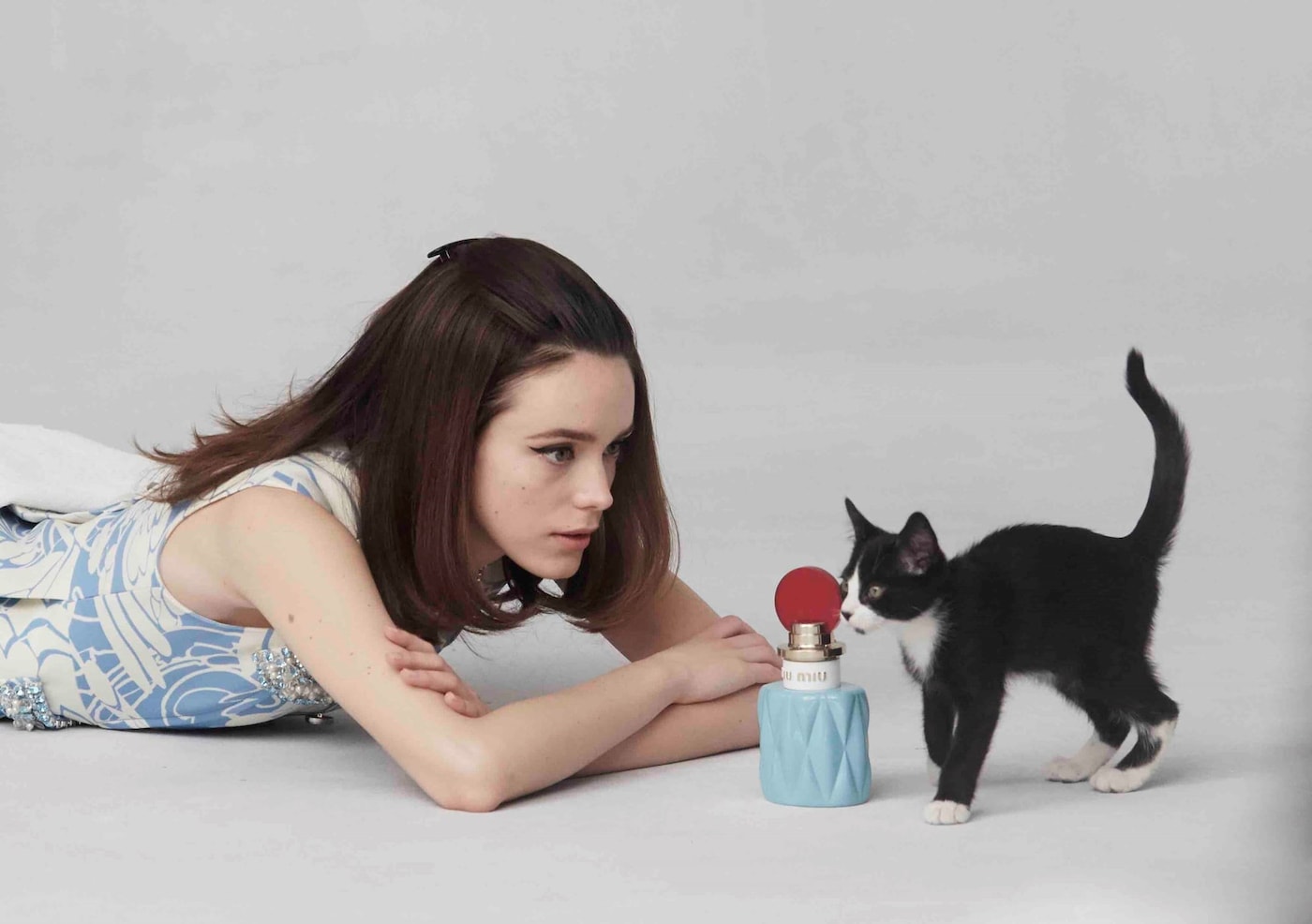
Lead image from Dazed, 7 September 2026, "What are 'fantasy notes'? Inside perfume's weirdest obsession" (Miu Miu L'Eau Bleue Eau de Parfum). The article opens with a kitten that does not exist.
Left: nostos Calico, whose heart notes read "Kitten Fur / Warm Milk / Pillowy Musk" (nostos product image). Centre: nostos brand imagery by Anna Koblish (Who What Wear, 23 December 2025). Right: "Vacation" by Vacation, released 2022, with "pool toy" and "swimsuit lycra" on the note list (Luckyscent product image).
Late 1800s
The "amber" accord is invented: labdanum, benzoin and vanilla assembled into a warmth that was never extracted from amber. One of today's most familiar notes has been a fantasy from the start
2022
Sunscreen brand Vacation releases its signature scent with "pool water, pool toy, swimsuit lycra" on the list. Givaudan's Flores-Roux: "We were being cheeky at first", then "pushed it to an extreme"
Apr 2023
The Substack "olfactory seconds" takes apart a D.S. & Durga note list: five of nine notes "probably-to-certainly do not appear anywhere in the raw materials". Its author, nicole: "This is basically fine… they're here to set the table, paint a picture, and to get you to pay $200 for like $.05 worth of ingredients"
Aug 2024
Who What Wear: fantasy perfumes have "never been more on-trend". The cause named is TikTok — people buy unsmelled perfume, and the note list becomes the "hook". DSM-Firmenich shows Smell-the-Taste and NaturePrint, turning croissants, champagne and caviar into notes
Dec 2025
nostos launches Calico (kitten fur), Teen (high-school summer at the mall) and Shiver (snow melting on a parking lot, wet concrete, cold metal), by perfumer Marissa Zappas. The brand had built a TikTok following for nearly a year before any product existed
7 Sep 2026
Dazed: "What are 'fantasy notes'?" — kitten fur, wet concrete, doll heads. Bull: "you're constructing a perception of it." Rose: "What if one day we could capture and recreate an exact scent memory that we can keep forever?"
01Community Voices
On the record: nine statements from perfumers, a founder, a fragrance house, and a Substack that takes note lists apart
All nine are quoted verbatim, unedited. Four are direct quotes from the Dazed feature of 7 September 2026; four come from interviews in two Who What Wear pieces (12 August 2024 and 23 December 2025); one is from the independent perfumer nicole's Substack "olfactory seconds" (April 2023). The comment sections for this signal are thin — no main Reddit thread, and the Fragrantica and Parfumo reviews are scattered and could not be fully retrieved for this page — so almost every voice here belongs to the supply side: people who make perfume, sell it, or dismantle its note lists. That distribution is part of the record.
Dazed interviewChristopher Bull, perfumer (CBCB)
I wouldn’t start by asking ‘what does concrete smell like?’ I’d break down the experience of encountering it: the dusty, mineral quality of the concrete itself, the dampness, the smell of rain, something metallic or cold, that earthy note that shows up when something dry goes wet. A material can be doing almost none of that in isolation and still be essential once it’s sitting next to the others. That’s the part I find most interesting: you’re not reproducing an object, you’re constructing a perception of it.
Dazed interviewJackie Mayol, founder of nostos
A lot of people are now wearing perfume as expressions of their inner selves and as reminders of the memories that make up their lives instead of for external validation.
Dazed interviewAmelia Rose, perfumer (Faux Rose)
What if one day we could capture and recreate an exact scent memory that we can keep forever?
Dazed interviewChristopher Bull, perfumer (CBCB)
Smell memory is deeply personal. Everyone has their own version of ‘water’: mud after rain, mist on grass, concrete after a sun shower. You’re not really building an objective, accurate version of a thing, you’re identifying the signals that make it recognisable to someone else.
Who What Wear interviewRodrigo Flores-Roux, VP of perfumery, Givaudan
We were being cheeky at first, thinking that it could be cool to include such a note. And then as it materialized, we pushed it to an extreme where people really perceive this unique latex, rubber, swimming pool water accord.
Who What Wear interviewCaroline Ornst, fragrance development director, DSM-Firmenich
A lot of consumers these days are shopping online, so that storytelling really does help give them some point to hook onto and make that online purchase rather than if they were smelling something in real life.
Who What Wear interviewJackie Mayol, founder of nostos
I’m a self-diagnosed nostalgia addict. The pain of not being able to relive memories makes me sick to my stomach, so being able to access even a slice of these memories through fragrance is fascinating to me.
Who What Wear interviewVince Spinnato, perfumer and cosmetic chemist
You can so, so easily manipulate the scents—this is not a bad thing.
So 5/9 of the notes listed refer to things that probably-to-certainly do not appear anywhere in the raw materials of the perfume. This is basically fine, despite all my whining. Like I said, they’re here to set the table, paint a picture, give structure to your experience, and to get you to pay $200 for like $.05 worth of ingredients.
Context. What stands out most across these nine statements may be that everyone speaking knows exactly what they are doing. Nobody pretends kitten fur was extracted. Bull talks about "constructing a perception", Ornst about giving online shoppers "a hook", nicole about getting you "to pay $200 for like $.05 worth of ingredients" — three people in three positions describing the same mechanism, one from the bench, one from the marketing meeting, one from outside. Mayol's two statements supply the other end of that mechanism: the buyer knows too, and it is precisely because the memory cannot be revisited that "even a slice" is wanted.
Then the distribution over time. The Dazed and Who What Wear pieces are two years apart and cover largely the same brands (Vacation, nostos), but the frame has moved. In 2024 the words were "fun" and "personalisation" — croissant has "more of an emotional connection" than vanilla. In 2026 the words are "memory" and "archive" — an archive "of everything we suspect we're about to lose". Same technique; in two years it has gone from a selling point to something closer to consolation. Rose's question about keeping a scent memory "forever" does not appear in the 2024 article at all.
This record does not rule on whether fantasy notes are honest or deceptive. It files one structural observation: there is almost no consumer voice in this signal, only makers describing consumers — "they crave escapism", "they shop online", "they want something unique". The Fragrantica reviews of Calico split loosely into two camps, "soft and furry" against "burnt rice odor hits you in the face"; both describe the same bottle, and neither mentions a kitten. It seems the formula can only fix the signals. Whether they are recognised is still up to each nose.
02Consensus Mapping
Four narratives: official, community, emerging, contrarian
Official Narrative
The industry's account is consistent: fantasy notes are a natural extension of perfumery as an "exercise in translation". Amber was always a fantasy, rose is mostly reconstructed, and the only change is that the fantasy has become more specific. They "deepen the storytelling" and "help consumers conceptualise the world that we're bringing them into" (Mayol); they create "emotional connection" and give online shoppers "a hook" (Ornst); and the technology is ready — headspace and NaturePrint can turn a fabric, a room or a spoonful of caviar into a formula. The key words are escapism and personalisation: in a chaotic world, a scene built for you alone, sprayable on demand.
Community Narrative
The community is quiet this time, and the quiet is worth recording. There is no main Reddit thread on fantasy notes. The nostos reviews on Fragrantica and Parfumo are scattered and divided, and mostly about whether the bottle matches its list — "soft and furry" against "burnt rice" and "snooze fest". What actually circulates seems to be TikTok's "believe before you unbox": the Who What Wear writer says she "fell for a brand before it even launched" and followed it for close to a year. The community appears to treat the note list as text to be read, imagined, then verified; when verification fails, the complaint goes to the perfume, and rarely to the word.
Emerging Narrative
The reading now surfacing moves the fantasy note from selling point to archive. Dazed closes by saying that as olfactory fantasy is pushed further, "we're also building an archive of everything we suspect we're about to lose – the memories, the homes, the seasons – in the one medium that requires IRL intimacies." Rose's question extends that line into the technology: if headspace can be pointed at anything, can "an exact scent memory" be captured and kept forever? If this reading holds, perfume slides from an object about who you want to be toward evidence of where you once were — evidence composed of molecules that stand in for the place.
Contrarian Narrative
The coldest reading comes from inside the craft. On Substack, nicole checks a perfume's nine listed notes against its plausible raw materials and finds five that "probably-to-certainly" aren't there; one, "snake plant", has no distinctive smell at all. She calls this the "Pinterest board" school of note lists — words that set a mood and hide the unglamorous chemical names doing the work. Her verdict is calm: "This is basically fine." The list is there "to set the table", and to get you to pay $200 for five cents of ingredients. Spinnato's "You can so, so easily manipulate the scents — this is not a bad thing" is the same sentence in its marketing register. The contrarian narrative exposes no one here. It simply writes the price down.
03Cultural Signal Extraction
Breaking down the signal: six facets
What Changed?
Fantasy accords moved from atmosphere to scene. Marine, leather and musk were vague feelings; wet concrete, kitten fur and pool toy point at a picture specific enough to be mistaken for a memory. At the same time, "it doesn't exist" migrated from trade knowledge to a line that can sit in a headline and on a product page — Dazed's own subheading asks how you create notes for a smell that doesn't exist.
Why Are People Reacting?
Because most people now read a perfume before they smell it. The note list is the only part of the product that can be perceived on a screen, so those few words have one second to catch. "Croissant", "pool toy" and "kitten fur" carry a picture on the page; "hexenol-3-cis" carries nothing. The strength of the reaction seems to track the concreteness of the word, and to be only loosely tied to the smell.
What Assumptions Are Challenged?
"Notes are ingredients" — most readers assume the list describes what is in the bottle; nicole's check suggests it describes what you are meant to think of. "Memory belongs to its owner" — once "a Tuesday from your childhood" can be formulated and mass-produced, ownership blurs. "Smell is the least digitisable sense" — it still cannot be transmitted, but its description can, and the description is already selling ahead of the scent.
What Desires Are Visible?
Mayol names hers directly: "the pain of not being able to relive memories", and the wish for "even a slice". Rose's reaches further: to keep an exact scent memory "forever". The industry's desire is to turn both into words that can be read online. The buyer's desire is visible on this page only through the makers' descriptions — "escapism", "inner self", "unique"; the buyers' own words are still scarce.
What Social Behavior Is Changing?
"Believe first, verify later" is becoming the default order for buying scent: follow a brand for a year before it has a product, read the list, order, then check whether the bottle matches the word. Brands are also treating the making itself as content — nostos let its audience watch the whole thing come into being on TikTok. And perfume is increasingly described as something worn "as a reminder" to oneself; the note list starts to read like a diary format.
Future Human Behavior?
If headspace really can be pointed at anything, will people start commissioning a perfumer to "record" a room, a person, a season before it disappears? Would that product still be called perfume, or need a new name? And if everyone's "water" is different — mud after rain, mist on grass, concrete after a sun shower — whose memory is a mass-produced "water" note? This page has no answer yet. It only notes that perfumers themselves are already asking.
04INCODER's Eye
Which lenses we read this through: six observation frames
These six themes are the fixed frame INCODER holds up to each day's cultural signal — closer to a pair of glasses than a checklist: put them on and the same trend grows a different meaning.
Information Culture
Perfume is the one product that cannot pass through a screen at all, and it is increasingly bought on one. So the note list becomes the product's stand-in at the information layer: those few words carry the entire signal, and the scent itself is zero until the parcel arrives. Ornst calls the story a "hook". When an industry's information layer and its physical layer are cut this far apart, will the words on the list keep getting more concrete, more scenic, simply because they are the only part anyone can see?
Digital Identity
Mayol says people now wear perfume "as expressions of their inner selves" and "as reminders of the memories that make up their lives"; being smelled by others has slipped down the list. If that is accurate, perfume is shifting from an outward signal into an inward annotation — a label on your own body that only you can read. Except the label's text was written by a brand, its formula assembled by a perfumer, its picture supplied by copy. When the "inner self" is expressed through a scene someone else wrote first, is that self being expressed, or assigned?
Symbolic Systems
"Kitten fur" sits on the list beside "bergamot", in the same format, read the same way — yet one is a raw material and the other is a sentence. When nicole took a list apart she found "snake plant", which has no recognisable smell and is there only "to contribute to an overall mood". The note list has quietly become a mixed language: part of it says what is in the bottle, part says what you should think of, and the format gives no sign of which is which. How long can one language do both jobs without its users noticing?
Dark Vitality
The most alive position in this signal may belong to the independent perfumers working out of apartments: Mayol in New York, building a brand from TikTok and a perfumer willing to freelance; Rose assembling accords from "visual references and tactile inspiration"; nicole writing that note lists are "a lie" while marking the "bullshit" notes in her own formula with asterisks. All of them use the big houses' tools — aroma chemicals, headspace — to do something the big houses can't: treat small, personal, slightly embarrassing memories as raw material. Will this edge be absorbed into the next season of "limited-edition fantasies"?
Networked Society
nostos's followers were there before the product was; what they followed was the process of a brand coming into being. The Who What Wear writer found it "funny to realize how invested I was in a product that technically didn't exist yet". This is a decentralised kind of trust, resting on a year of videos and a note list, with no counter and no blotter in the loop. Its verification is decentralised too — Fragrantica, Parfumo and TikTok each saying "close" or "not close" in scattered voices. When a brand exists before its product, is the community backing a bottle, or a process they watched together?
Perception and Attention
Bull's "you're constructing a perception of it" may be the most direct sentence of the week. His method breaks the experience of meeting wet concrete into a few signals, then uses materials that smell like almost none of it in isolation, so that the whole becomes recognisable once they sit together. Only the signals are ever designed; recognition happens in the person smelling, and differs each time. When perception can be engineered this openly — and the people doing it say so — where does our trust in the act of smelling move to?
05Signal Score
Signal strength
6/10
Scored 6. Points for: this is a rare sample of the supply side explaining its own mechanism — perfumers, a fragrance house, a founder and an independent perfumer describing the same thing across two articles two years apart, with nobody denying it; the direction of the technology (headspace pointed at anything) and the direction of the desire (keeping a scent memory forever) were joined in a single article this week; and "perception is constructed" can now be printed on a product page. Points off: the community side has produced almost no collective reaction, there is no main Reddit thread, and review-site discussion is scattered and could not be fully retrieved; every consumer voice here arrives through a maker's description; and the Dazed piece is a trend feature with no single dated event. The score rises if a commercial perfume is sold on having "recorded" a real room or person, if buyers start rating scents mainly on whether they match the word, or if a brand is asked to label the fantasy on its list.
06Final Question
The deepest hidden assumption
?
We have long assumed that a memory belongs to the person who has it — it may fade or be wrong, but it grows out of that person's own experience. If an industry can write "a Tuesday from your childhood" as a formula, mass-produce it, put it online for you to read before you buy, and if you then spray it on and feel "that's exactly it" — then in that moment, is the memory being recalled, or installed?
Lay the assumption out first. Bull's method already answers half of it: he only ever builds signals, "the signals that make it recognisable to someone else", and recognition happens in the person smelling. That sounds reasonable — every language works this way; words are signals, meaning sits with the reader. But smell differs from language in one respect: it bypasses judgement. When you read "kitten fur", you can decide whether to believe it. When you smell the accord, and it happens to match a set of signals in your memory, you feel "yes" first and think "this is fake" second. That is the whole point of the small experiment at the top of the Dazed piece — make you believe, then tell you the landlord won't allow it. Run in the other order, the experiment fails.
If that order is stable, Rose's line about keeping "an exact scent memory" forever becomes hard to look away from. Headspace was developed to record endangered plants in the wild — capture the molecules of a flower about to vanish so it can be rebuilt later. Pointing the same instrument at a room, or a person, changes little on the technical side. What changes is how the recording is sold afterwards. Mayol says nostalgia makes her "sick to my stomach", so she makes perfume; nicole says note lists are there "to set the table", and then says this is basically fine. Neither is pretending. The suspense this page wants to file may be here: in an industry where everyone knows it is constructed and everyone agrees that is fine, the moment of "that's exactly it" still happens.
The open thread stays on that moment. If a memory can be re-triggered by a set of molecules standing in for it, and at the instant of triggering you cannot tell the source — will people begin, before they lose something, to have it written as a formula in advance? Would that be an archive, or a pre-emptive replacement? This record has no answer yet. It only notes that in the second week of September 2026, an article let you feel a kitten on your wrist, told you it did not exist, and most readers who reached the end still wanted to know the name of the bottle.
Observation remains incomplete.
This report records the present state of observation.
Nearly every voice in this signal comes from the supply side; a collective consumer reaction to "fantasy notes" has not formed, and review-site discussion is scattered and was not fully retrievable. "Keeping a scent memory forever" is at present one perfumer's question, with no corresponding product. These judgements may be strengthened or overturned.