
What Changed?
The meaning of one picture was collectively rewritten fifteen days after posting. The brand changed nothing; the caption stayed. The viewers changed, and once the reading flipped, the original came down.
3 September 2026: Converse posts a Chuck 70 X image. Karina of aespa stands inside a star-shaped spotlight, white skirt, two black high-tops hanging from her hand. The caption reads “the star always finds the frame”. On 18 September, viewers see a Klan hood and a pair of dangling feet. The brand pulls the image and apologises the same day; a congressman asks whether there were any Black people in the room. This page records how one picture was read as two things by two sets of eyes.
This is one page of the observer report. What I follow is what a picture gets read as: what the maker meant to show, what the viewer actually sees, and who gives way when the two do not match. The caption is the maker’s instruction sheet. Most people never read it.
This week a sneaker ad sat online for two weeks and was then, quite suddenly, read as a different picture. The brand’s caption said spotlight; viewers saw a hood and a pair of hanging feet. What I want to record is the fifteen days in between, and the sentence “we understand why”.
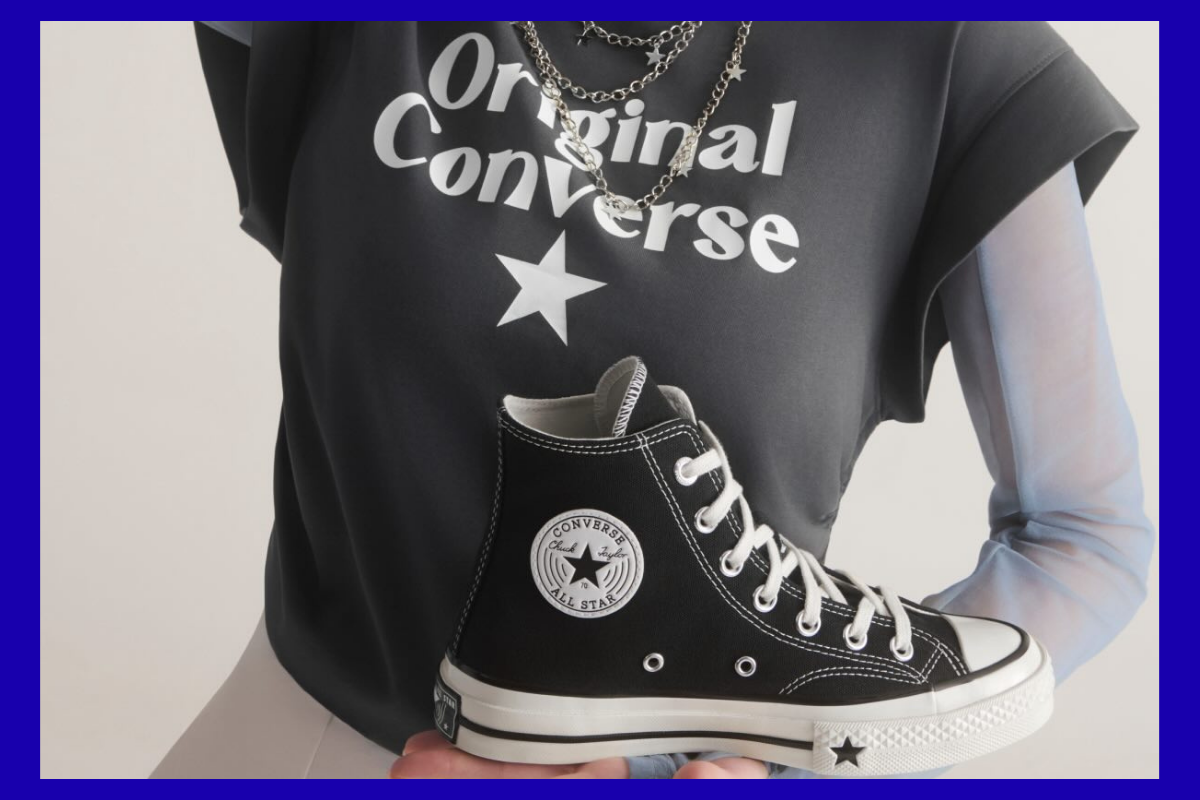
First, the document. On 3 September, Converse posted a Chuck 70 X image to Threads and Instagram. Karina of aespa stands inside a star-shaped spotlight in a long white skirt, two black high-tops hanging from her hand, framed from the waist down. The caption: “Under stage lights or streetlights, the star always finds the frame.” On the day it went up, nobody said anything.
Then the control case. On 14 September, Converse’s collaboration with the Copenhagen label Palmes went live: a man on a ladder, holding a pair of sneakers up beside a tree branch. Hardly anyone looked twice. Once the first image had been re-read, someone dug this one out and set it alongside as “the second piece of evidence”. Eleven days apart, the two pictures were read as the same thing on the same night.
Why today. On 17 and 18 September the actress Yvette Nicole Brown asked on Threads whether that was a lynching, and the image began to travel. On the 18th Converse told WWD it understood why the image was “deeply upsetting”, removed it, and apologised. That afternoon Louisiana congressman Troy Carter issued a statement asking whether any Black people were in the room, and if so, whether anyone listened to them. The signal converged on that one day.


All eight are quoted verbatim. One is an actress’s question, one comes from a fitness creator, one is a culture writer’s dissent, one is an unnamed Threads comment, one comes from a food-culture account, and three come from K-pop circles on X.
That’s a lynching, yes?
There is NO REASON why WE should see an advertisement & immediately think of Strange Fruit by Billie Holiday.
Like the caption tells you what is happening, what is being referenced.
Y’all don’t know how to talk about art and that’s the problem.
Yes. the @converse ad IS that serious. this photo doubles down on the messaging. what the fuck.
WHAT THE ABSOLUTE FUCK WERE YOU THINKING?!
This is why I’m [a] Vans person.
this is actually insane wtf karina
aespa’s karina is the model featured in this racist ad, kpop is always at the crime scene
You guys clearly don’t care about issues regarding racism and purely just see it as an opportunity to use it as gotcha moments. I don’t understand why you’re implying that Karina was at fault when she’s just a model and not on the creative team at all
Look first at who is speaking. None of the eight made the photograph. The voices are an actress, a fitness creator, a culture writer and K-pop fans. From the brand there is a single apology; the photographer and the creative team still have no names. Who shot it, nobody yet knows.
Then look at the delay. The image existed from 3 September and waited fifteen days to be read another way. Those who saw it in the first two weeks may have seen exactly what the caption said: a star. One picture, two sets of eyes in sequence. This record does not yet decide which set saw correctly.
Converse’s account runs to four sentences. “We understand why this image is deeply upsetting and recognize that we got this wrong.” Removed, being removed everywhere, will do better. No account of what the picture was meant to show, or who signed it off.
The dominant reading is that this could not have been an accident. Kida Maree: there is no reason an advertisement should call up “Strange Fruit”. Attention moves from the image to the process that approved it.
What is surfacing is the re-read. The Palmes picture, ladder and tree, was fine until it was pulled out as a second exhibit. A brand’s back catalogue seems to have become, overnight, a set of pending cases.
The hardest dissent is Meriweather’s: the caption tells you what is being referenced, and the problem is that people cannot talk about art. Alongside it, aespa fans call this racism used as a gotcha, with the model left holding it.
The meaning of one picture was collectively rewritten fifteen days after posting. The brand changed nothing; the caption stayed. The viewers changed, and once the reading flipped, the original came down.
A white point above a dark hanging object is a combination with a very specific history in the United States. Eyes that have seen that history see it first, and the shoes second.
The assumption that a caption can fix an image’s meaning. Converse wrote spotlight and star; viewers did not read along. The instruction sheet lost to the shape.
What people want is a list of names. Carter asks who shot it, who reviewed it, who approved it. An apology is not enough; they want the chain of approval, link by link.
When one image fails, a brand’s other images are re-opened. The Palmes picture went unnoticed until it was placed side by side. The archive becomes a record that can be audited.
If brands begin reviewing images against the worst possible reading, will white fabric and hanging objects quietly leave the frame? Will composition start routing around history?
These six themes are the fixed frame INCODER holds cultural signals against each day, something like a pair of glasses. Put them on, and the same event grows different meanings.
The image sat quietly for two weeks until one question pushed it into a different stream. Is the meaning of a picture perhaps decided by who reposts it first?
Karina appears only from the waist down, yet her name carries the whole dispute. Fans defend her; critics say K-pop is at the scene again. Is the model’s identity judged before the composition is?
White cloth, a point, a dark object hanging: each element is harmless on its own. Together they line up with a history. Does a symbol’s meaning live only in the combination?
Some filmed themselves burning their own Converse. The gesture costs the brand nothing and makes the person filming visible. Is protest also borrowing the brand’s visibility?
Threads opened it, X carried it, the K-pop community read it again. Three networks each saw a different fault. Does one image now have a separate version in every community?
Meriweather says the caption made it clear. The shape is seen first, though, and the caption always comes second. Can a sentence retrain an eye?
Lay the assumption out. Advertising has rested on one premise: the maker decides what the image means, and the caption holds the last word. Converse’s apology did not defend the picture and did not explain what it was meant to show. It accepted the viewers’ reading outright. The right of interpretation changed hands within a day.
On the other side, Meriweather’s dissent still stands: the caption was right there. Neither reading has gone away; one of them simply got the image removed. Will every advertisement from here on be looked at first through the worst possible eyes? This record has no answer yet.
This report records the state of observation at this moment.
Converse has not explained the shoot or the review process; Karina and her agency have not responded; the original Reddit discussion has not entered this record. The judgments here may be reinforced, or reversed.
Observation continues.