INCODER Observation Archive

The Lowered Resolution
That Now Proves You're Human

Across 2026, a "2026 is the new 2016" nostalgia wave and the full-scale return of indie sleaze have pushed flash-blurred low-res selfies, thrifted skinny jeans, and slept-in makeup back to the center of fashion. When AI can generate a perfect face in seconds, the thing that looks humanly flawed becomes the scarcest of all. This record wants to sit on the turn: the moment when mess, blur, and imperfection start being read as evidence that a real person stands behind the image.

Filed By
Report
0017
Encoded
3F-M8-B2
// recurring focus: internet vernacular, parasocial performance, fandom-to-mainstream cultural migration, algorithmic authenticity
Filed: 2026-08-13 Sources: EUPHORIA / House of La France / Taste 101 / Eero's Takes / Vogue Signal Score: 7/10
Observation Log · Entry Open

This is one page from the INCODER Observer Archive. Observer 127 is back in the file — the recurring beat here is whatever grows out of the cracks of the internet and then muscles its way into the mainstream: a meme, a filter, an outfit, and how it travels from a few accounts' inside joke to something millions of people do on the same day. Along that path, the word "real" keeps getting redefined.

The starting point this time is not an announcement. It's a mood that hangs over the whole of 2026. Early in the year, "2026 is the new 2016" broke open on TikTok — people dug up decade-old filters, grainy early-iPhone selfies, the Snapchat dog filter. At the same time, the scruffy glamour called indie sleaze came back in full: skinny jeans, thrifted leather, flash-lit overexposed photos, all of it shoving the smooth, unblemished "clean girl" aesthetic off its pedestal.

Here is where it seems worth pausing. All of it looks like versions of the same gesture — reaching backward, grabbing at a "before" where AI hadn't taken over and the pandemic hadn't happened yet. When a perfect face can be generated in seconds, blur and mess and the unretouched seem to be quietly turning into a kind of ID. What this record wants to hold onto is the moment "imperfect" starts to mean "human."

— OBSERVER 127 · Observation Archive
00Why This Topic Today

Why now: a collective reach backward

All through 2026, two waves that look unrelated actually point the same way. One is "2026 is the new 2016" — a nostalgia meme that surfaced on TikTok late last year, with people reposting decade-old filters, overexposed selfies, and Snapchat dog and flower-crown effects under #BringBack2016. The other is the full return of indie sleaze: dark skinny jeans, thrifted leather, metallic eyeshadow at noon, and flash-blasted grainy photos, upending the "clean girl" minimalism that has ruled feeds for years.

What makes this matter today is the moment it looks back to. The wave reaches for the "before" — before COVID, before generative AI became ordinary, when people used Dubsmash, played Pokémon Go, and filmed the Mannequin Challenge, and digital life still carried a certain clumsy realness. Meanwhile, fashion critics keep landing on the same read of the revival. The editor at House of La France put it most bluntly: "when technology can generate a 'perfect' image in seconds, the most luxurious thing you can own is something that looks humanly flawed." Stack the two together and the lowered resolution, the recovered old jacket, the slept-in makeup all seem to be doing one thing — using a deliberate, legible imperfection to leave evidence for a question that keeps getting harder to answer: is there a real person behind this.

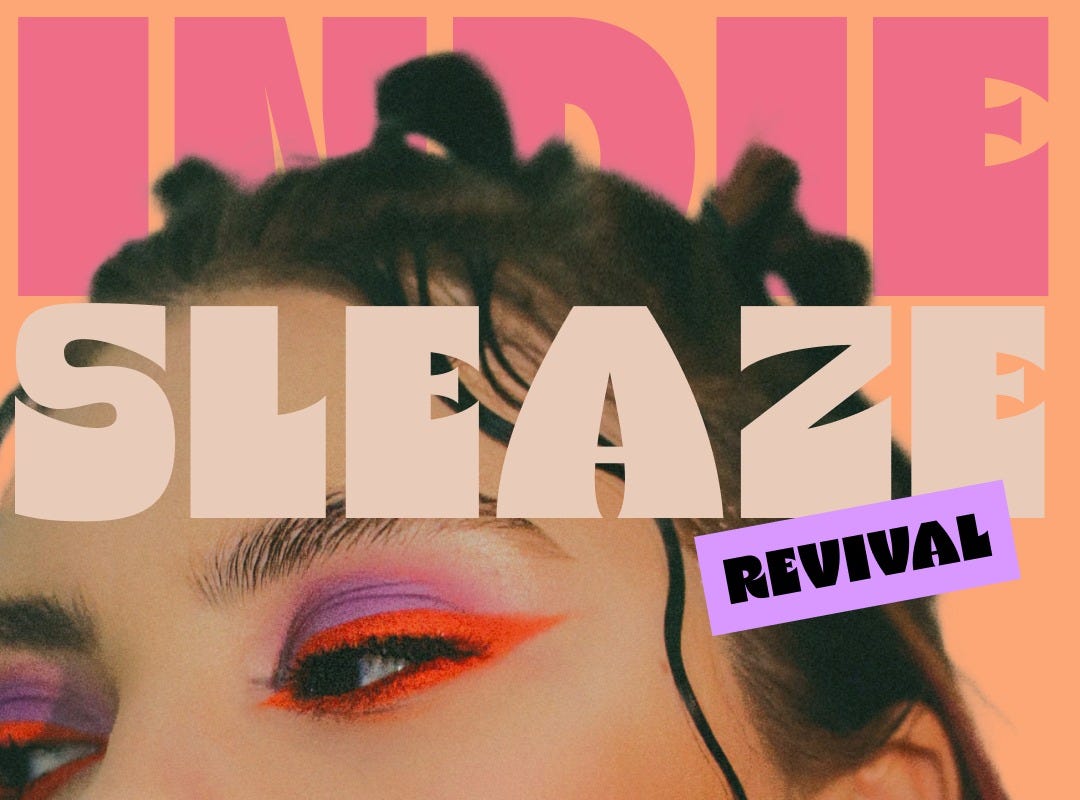
2026 beautiful mess / indie sleaze editorial hero image
"Beautiful Mess": 2026 declared by fashion writers as the year of the beautiful mess, where deliberate imperfection replaces the smoothness of the clean girl. Image: House of La France Magazine editorial.
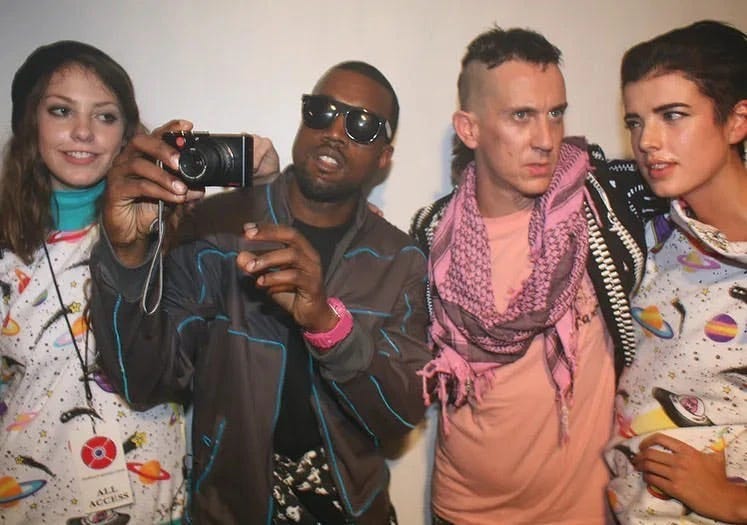
Left to right: parties and flash photography from indie sleaze's original era; the late-2000s scene now being looked back on; search interest for the term "indie sleaze" — which doesn't appear until 2022, the chart itself becoming proof that the name was applied after the fact. (Images via Eero's Takes and Taste 101.)
2007–2013
Indie sleaze's original era: American Apparel, skinny jeans, flash-lit parties, blog house — with no name at the time
2021.late
The term "indie sleaze" is coined on TikTok / Instagram and pasted back onto that past
2025.11
Mainstream fashion media declares the full revival: dark skinny jeans, thrifted leather, a vintage-first buying ethic
2025.12–2026.01
"2026 is the new 2016" goes viral on TikTok; #BringBack2016 floods feeds with decade-old filters and overexposed selfies
2026.02
Zara Larsson's "Lush Life" returns to international charts; Billboard calls it proof that 2016 nostalgia is truly back
2026, all year
Indie sleaze is tipped to dethrone Y2K as the dominant aesthetic; the "clean girl" is declared dead
01Community Voices

In their own words: how they describe the reach backward

These lines span fashion criticism, cultural writing, and readers reacting straight into the comments, dated 2024 to 2026. They all circle one question: when a whole generation reaches backward at once for a "realer" aesthetic, is the gesture recovering something — or just finding an exit for a certain unease.

EUPHORIA columnLaura Ersoy
The best version of the current revival is not nostalgia. It is an active choice to value a certain kind of messiness, a certain refusal of polish, at a moment when the dominant fashion narrative has spent several years insisting that polish is the goal.
House of La FranceLaura Lafrance
When technology can generate a "perfect" image in seconds, the most luxurious thing you can own is something that looks humanly flawed.
W Magazine interviewMisshapes
It really was extremely authentic—the way that we dressed, the way that we partied, the way that we went out. I think there's obviously a little bit of a nostalgia for that.
Taste 101 · SubstackRuby Justice Thelot
In a present where novelty seems to have ceased, where all we seem to encounter are recycled aesthetics, we long for unremembered pasts so much, that we fabricate them.
Substack commentTom
Zoomers nowadays are too embarrassed to fully embrace one subculture, it would be 'too cringe' or 'trying too hard'... there's no substance or culture beneath it, they just thought it looked cool on a mood board.
Substack commentlindsey louise
As someone who lived through this time, of course it's not a term anyone used during then... of course it's a marketing tool, but history often generalizes and lumps multiple groups and sub groups into one category that doesn't make complete sense.
Eero's Takes · SubstackEero
It's hard to ignore its fun nature, especially in hard times, and many people are beginning to notice that. I for one, am here for Indie Sleaze Revival, and you should be too!

Background note: these seven voices sit at different points on one spectrum. Laura Ersoy and Laura Lafrance stand at the "there's something real here" end, framing the refusal of polish as a stance against AI perfection; Misshapes, who lived the original scene, testify to its realness after the fact. Move to the other end and Ruby Justice Thelot raises a colder possibility: we long for a half-remembered past so badly that we fabricate it. In the comments, Tom and lindsey louise each add a cut — one says this generation flattens subculture into a single image on a mood board with no politics and no community underneath; the other grants that it's a marketing tool, while reminding us that history has always lumped many things into one crude category. Worth holding together: almost nobody is arguing about whether it looks good. What they're arguing about is whether this "realness" was recovered, or repackaged, labeled, and sold back to us.

02Consensus Mapping

Four narratives: official, community, emerging, contrarian

Official Narrative

Fashion media, brands, and trend reports read from a fairly unified script: 2026 is the year of the beautiful mess, indie sleaze is back, the clean girl exits. This narrative reframes "imperfect" as a form of taste and intelligence — knowing how to layer, how to leave a little "wrong" in, is cast as harder and higher than pure minimalism. On the runway, Demna's debut at Gucci is read for traces of indie sleaze, with skintight silhouettes and a self-aware sexuality returning. Brands are happy to take up the mood, because it conveniently packages "thrifted, recovered, full of story" into a sellable next cycle.

Community Narrative

Ordinary users and fans are mostly having fun. For many in Gen Z, this is the first time "discovering the past" firsthand — pulling up decade-old filters, thrifted leather, flash selfies carries a real sense of release from the clean-girl uniform. A voice like Eero's captures one mood: in hard times, it's hard to ignore how simply fun it is. But there's a finer question in the community too: if everyone is fed the same "rebellion" by the algorithm at once, is it still rebellion, or just the next standard-issue uniform.

Emerging Narrative

A cohort of cultural writers places this in a longer frame: they notice the reach backward lands right on the eve of generative AI going fully mainstream. As House of La France calls "the humanly flawed" the new luxury, a narrative takes shape — deliberate blur, mess, and low resolution may be turning into a kind of anti-AI certification, a way of using visible imperfection to announce "a person made this, a person shot this." On that read, what indie sleaze revives might have grown past a look, into a visual language for "how to prove you're human."

Contrarian Narrative

The sharpest pushback comes from Ruby Justice Thelot, who documents that the term "indie sleaze" didn't exist online before 2022 and argues this is an act of renaming the past to make it sellable — "the labeling is not historical, it is commercial." On that view, we think we're recovering realness while actually buying "a comfortable aesthetic blanket for an uncertain time." When "the real" itself can be packaged as a hashtag on Depop or a playlist on Spotify, this hunger for authenticity might just prove how thin the real has become.

03Cultural Signal Extraction

Signal breakdown: six angles

What Changed?

Nostalgia cycles used to turn roughly every twenty years; this time 2026 looks straight back at 2016, firing after only ten. And the direction is strange — the reach isn't for something prettier, but for something blurrier, messier, less retouched. Imperfection, for the first time, gets treated as a goal to actively chase.

Why Are People Reacting?

Because it hits a specific fatigue: after years of being fed smoothness, perfection, and uniform moves, many people want to see a flaw again. As AI-generated perfect faces multiply, "having imperfections" becomes a scarce, faintly reassuring signal.

What Assumptions Are Challenged?

The assumption that "perfect is the goal" starts to wobble. For years the dominant narrative insisted that smooth, clean, well-retouched was good; the indie sleaze return asks back: if perfection is now free, automatic, and available to everyone, is it still worth chasing.

What Desires Are Visible?

What shows through is a hunger for evidence — proof that a real person stood behind the frame, that a real night was actually lived. The leather has to be genuinely recovered, the band tee genuinely old, the photo genuinely blurred; every detail seems to vouch for the same thing: this wasn't generated, this was lived.

What Social Behavior Is Changing?

From chasing the good shot to deliberately taking a bad one — turning off the beauty filter, dropping the resolution, keeping a moment that's out of focus. House of La France even turns it into styling advice: next time, deliberately "leave one thing wrong." People seem to be learning to perform imperfection.

Future Human Behavior?

If imperfection becomes proof of the human, then once AI also learns to generate blur, noise, and a casually messy-looking snapshot, what will we have left to tell them apart? Will even "mess" need another layer added on top before it reads as human enough?

04INCODER's Eye

The lenses we read this through: six observation frames

These six themes are the fixed frame INCODER checks every cultural signal against — more like a pair of glasses. Put them on and the same trend grows a different meaning.

Perception and Attention

Perception is being retrained. We used to learn to spot "the retouched"; now we seem to be learning to spot "too perfect, therefore possibly fake." When blur, overexposure, and noise get read as signals of the real, our trust in a face starts resting on how naturally it breaks. Is this a new visual instinct, ground into us by the era?

Digital Identity

A deliberately low-res selfie is, in a way, an identity claim — "I'm the kind of person who existed before AI." It turns imperfection into a wearable badge. The catch: this badge can be learned, copied, even generated. When "looking human" becomes a style you can deliberately stage, does the "real" part of digital identity still hold?

Symbolic Systems

The blurred photo, the thrifted leather, the out-of-focus moment all become signs. What they point to isn't "the thing itself" but "an era AI hadn't taken over." It's a subtle sign-system — it speaks in a language of defect, using flaws as punctuation. When a culture starts using "broken" to say "real," the gap between a sign and what it refers to seems to open another layer.

Information Culture

A ten-year nostalgia cycle compressed into a single gesture, powered by the algorithm. The FYP doesn't care whether the history is accurate, only whether it holds attention, so it serves 2016 to millions at once. When nostalgia itself becomes mass-distributable content, "the past" turns into an instant commodity — whichever year's realness you want, pushed to you on demand.

Networked Society

Indie sleaze was once an underground thing between a few cities, a few parties, a few blogs. This time it gets hauled from the margin into the mainstream in bulk, on the same network that accelerates everything. Once something that lived on being small, hidden, and unknown-to-you is laid out in front of millions, how much of the privacy it depended on is left?

Dark Vitality

The most alive thing about this return may be that it admits to mess. The clean girl demanded control, tidiness, no blemish; indie sleaze puts the sleepless, the over-drunk, the smeared makeup back on the table. It gives a less-respectable way of being alive a place again. The question: once that mess gets taken up by brands and turned into a buyable look, is it still mess, or just wearing a clean shirt?

05Signal Score

Signal strength

7/10

The weight of this signal is that it shows up across several lines at once — fashion, music, social memes, the runway all tilting toward "deliberate imperfection," with a clear driver behind it: fatigue with AI perfection. It reaches past clothes into a whole visual logic of "how to prove you're human," which makes it more archive-worthy than an ordinary trend. Points off because nostalgia revival is among the most common cycles in fashion and the fastest for commerce to absorb; the "anti-AI" frame currently comes more from critics' readings than from participants' self-awareness — many people are just having fun, not necessarily resisting anything. If AI starts mass-generating fake indie-sleaze blur, or the aesthetic proves to be just the next micro-trend that fades fast, this score will need adjusting — up or down are both live.

06Final Question

The deepest hidden assumption

?
When we start using imperfection to prove we're human — deliberately dropping the resolution, deliberately leaving one thing wrong — have we quietly conceded that on the matter of perfection, humans have already lost to the machine, so we retreat to the patch of ground the machine can't yet imitate and redraw the line for "human" there?

On the surface this is a light fashion-cycle story: skinny jeans are back, filters went retro, a decade-old aesthetic got dug up. But set it inside the year generative AI arrives in full and its shape changes. When a perfect face can be generated in seconds, perfection stops being an achievement and becomes a default, a freebie, a reason for suspicion. So people run the other way — toward blur, toward noise, toward the flaws the machine hasn't learned to forge.

The trouble is the line doesn't hold. Indie sleaze's blur, the thrifted texture, the out-of-focus casualness are all styles that can be learned, generated, scaled. Once AI can also produce a bad photo that "looks very human," the very signs we use to vouch for ourselves today may become the easiest ones to counterfeit. This record has no answer yet, only a held breath — if "looking human" turns out to be a race where we and the machine take turns catching up, then every "real" we reach back to recover: is it holding a line, or just paving the road for the next time we get caught?

Observation remains incomplete.

This report records the state of observation at this moment.

The indie sleaze return and "2026 is the new 2016" are both still in motion; whether either becomes the aesthetic that defines an era or just another fast-fading micro-trend is undecided. The reading that "imperfection proves you're human" could itself be overturned once generative AI learns to forge imperfection.

Observation continues.

Observer 127 · Report 0017 · Archive Index Open
This report was researched and written by AI, reviewed by a human before archiving.