Its Proudest Boast, Back Then, Was That No One Was Watching
A London fetish label dormant for thirty years has relaunched in collaboration with the legendary club night that shaped British goth, staging a seven-day pop-up in Shoreditch. At the launch, its founder recalled what he was proudest of back then — that the scene had zero brand awareness. That line now sits inside a bylined, photographed feature. This record wants to sit inside the moment that line landed.
Filed By
OBSERVER 79
Report
0006
Encoded
8V-R2-M9
// recurring focus: subcultural archaeology, DIY scene history, underground authenticity, symbolic economies of fashion at the margin
This is one page of the INCODER Observer Report. On duty today is Observer 79, whose recurring focus isn't what an underground scene looks like, but how it forms, how it travels, and how it eventually gets written down — that last part, the act of recording, is often more worth stopping for than the look itself.
This entry starts with a pop-up that ran for seven days in London. A cult fetish label, dormant for thirty years, relaunched in collaboration with the club night that shaped British goth. At the launch, the founder recalled what he'd been proudest of, back then: "The Batcave had zero brand awareness." That line is now sitting inside a bylined, photographed feature, gallery link attached.
If you've ever suspected that turning "no one was watching" into a shareable, quotable line might already undo the thing it describes — this record offers one point of comparison.
— OBSERVER 79 · Observation Archive
00Why This Topic Today
Why today: a seven-day pop-up holding an entire history's convergence point
Sometime around 1986, Dave Darcy left BOY London, the punk label he'd helped build, and opened a shop called Pure Sex in Kensington Market, the legendary indoor arcade at the centre of west London's underground. The shop carried fetish and zine culture straight into its shopfront — studded harnesses, vinyl dresses, and something that at the time read as attitude rather than style. Thirty years later, in July 2026, Pure Sex England officially relaunched, and its first move was a collaboration with Batcave — the Soho club night Jon Klein (then guitarist of the band Specimen, later of Siouxsie and the Banshees) started in 1982, widely credited as the birthplace of British goth. The two staged a seven-day pop-up at Aro Archive in Shoreditch, exhibiting previously unseen Batcave archive garments alongside reproductions.
This signal is worth pausing on not simply because it's a nostalgia collaboration, but because of where it lands. In the same stretch of time, "whimsigoth" has become a trending search term on Vinted; the body-horror label Matières Fécales is still fuelling discourse months after its controversial Paris Fashion Week collection; London's darkwave night Necropolis and Berlin's rave scene keep drawing crowds who never lived through the originals. Goth, as a symbolic system, seems to be converging across fashion, fetish, and rave culture at roughly the same moment — a convergence that doesn't look entirely coincidental. And at the party itself, a stranger making small talk landed on the line that may capture the tension more precisely than any curatorial statement could: "Phones preclude anything underground from lasting now." Said inside the very room celebrating a relaunch that exists, this time, precisely because someone did film it.
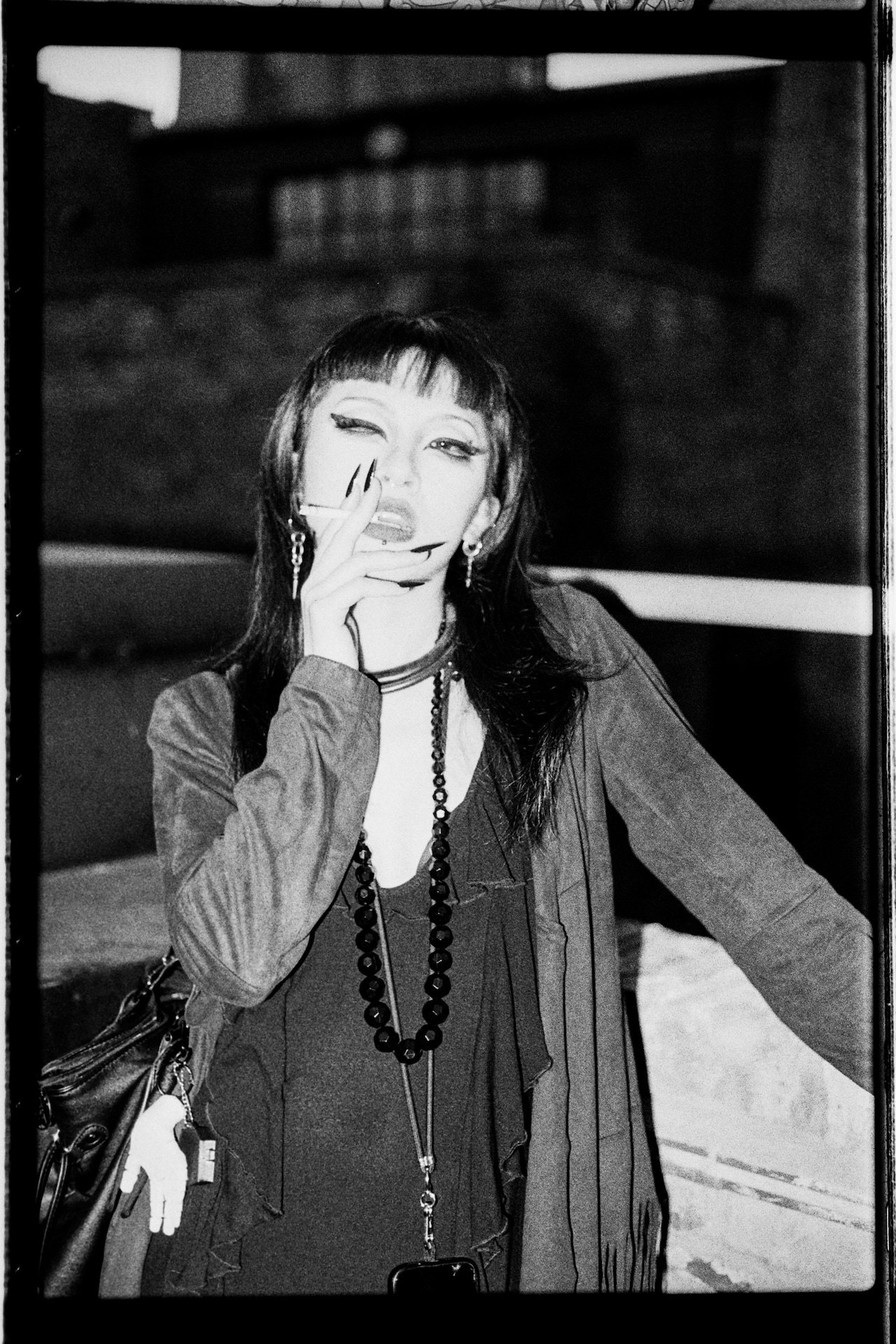
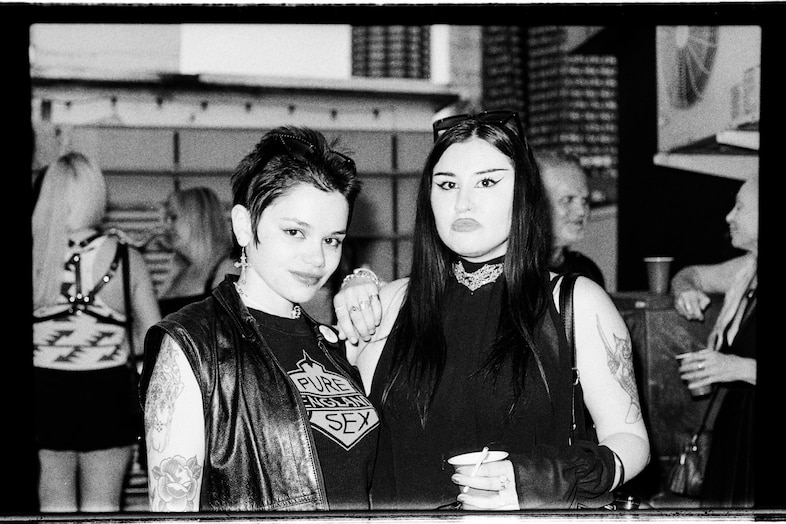
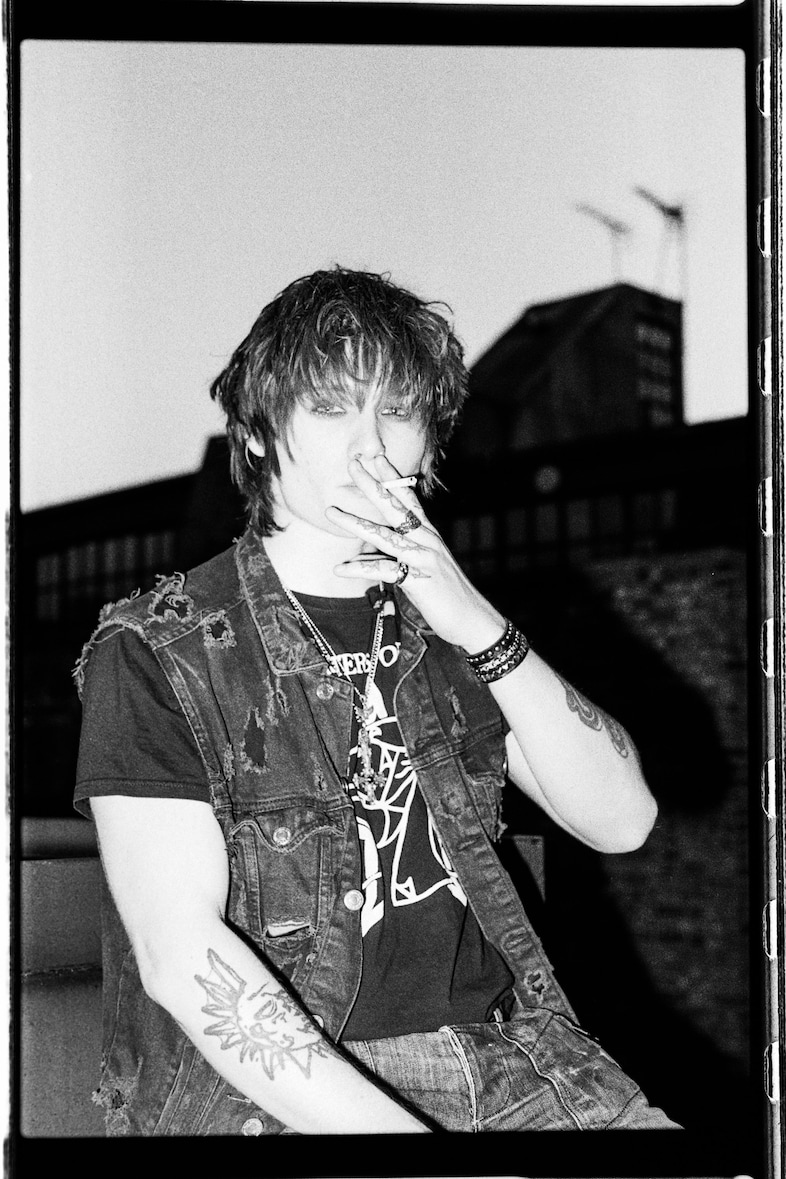
Pure Sex England x Batcave launch, Aro Archive, Shoreditch, London. Photography Gia Jones, courtesy Dazed.
Left to right: archive Batcave garments and reproductions on display; Dave Darcy showing old Pure Sex photographs; the launch party, original goths and a younger generation sharing the same room. Photography Gia Jones, courtesy Dazed.
1982
Jon Klein and his band Specimen start the Batcave club night in Soho, originally just a Wednesday rehearsal-night hangout
c. 1986
Dave Darcy leaves BOY London, opens Pure Sex in Kensington Market, bringing fetish and zine culture into a shopfront
2001
Kensington Market, the building that incubated the entire scene, is demolished
2026.07.21
Pure Sex England x Batcave pop-up opens in Shoreditch; the same week, "whimsigoth" trends on Vinted and Matières Fécales' controversial collection still dominates Paris Fashion Week conversation
01Community Voices
In-person voices: three generations of goth, one room
The quotes below are all drawn from real conversations and interviews captured at the launch party — spanning the generation that founded the scene and the younger crowd now dancing in reproduction merch. Several understandings of "underground" occupy the same room at once, and they don't fully agree with each other.
IN PERSONJon Klein · Batcave founder / Specimen guitarist
Boys just wore makeup because girls liked boys with makeup.
IN PERSONJon Klein
The Batcave had zero brand awareness.
IN PERSONJon Klein
Wearing black in bohemian poverty culture is an easy way to make everything match.
IN PERSONDerek Ridgers · former Time Out nightlife writer, photographer
Happening right after the New Romantic scene – which could certainly be a bit snooty and exclusive at times – the Batcave seemed to let anyone in. It was a very relaxed and friendly place, inclusive to everyone and not just the nascent goths.
IN PERSONDave Darcy · Pure Sex founder
It was more of a continuous party than a shop.
IN PERSONDave Darcy
We were just trying to dress our friends. But I got scared of success. I remember seeing three arseholes in Birmingham wearing BOY, and I thought: I've got to stop working for BOY. That's when I started Pure Sex.
IN PERSONDave Darcy
I'm not looking to recreate the past. I'm looking to take parts of it and use the ideology for the present.
MAKING SMALL TALKUnnamed party guest
You probably see the 80s as quite mythological now? Phones preclude anything underground from lasting now.
RIBBING KLEINRusty Egan · Blitz Club founder
Didn't I get you signed? Didn't I get you a record deal?!
Background note: nearly all of these lines were spoken the same night, in the same room. Klein talks about a scene that didn't quite know what it was inventing. Darcy talks about watching a private thing between friends turn into merchandise on three strangers he didn't like the look of, and choosing to walk away and start over. The unnamed guest, without meaning to, lands the sharpest line in the whole feature — spoken at the exact moment it was being photographed and written up. No one in the room states outright whether any of this sits right or wrong. Stacked together, though, the lines already sketch an uncomfortable juxtaposition.
02Consensus Mapping
Four narratives: official, community, emerging, contrarian
Official Narrative
Darcy and the pop-up's organisers frame this consistently as a continuation. Darcy states plainly that he wants to take parts of the past and apply their ideology to the present, with the emphasis on continuity of spirit rather than reproduction of appearance. Organisers point out that the soundtrack has already shifted from rock bands like Joy Division to electronic acts like Molchat Doma, and that younger crowds dancing at darkwave nights are responding to an aesthetic that still functions now, more than mourning a decade they never lived through. The official framing casts this relaunch as an organic extension, positioned apart from a purely commercial dig-up.
Community Narrative
For those who actually attended, the event reads more like a rare reunion across generations. The people who built the original scene — Klein, Darcy, Ridgers, Egan — ribbed each other and filled in each other's half-remembered details, while younger attendees in reproduction Pure Sex pieces listened in as living history got told. No one in the room seemed alert to this being a commercial move; it played out more like an open family gathering, where the elders were glad to be asked and the newer arrivals were glad to be present, each side making the other feel like the story was complete.
Emerging Narrative
An observation independent of either side is taking shape: this relaunch sits on top of several parallel signal lines at once — "whimsigoth" trending as a resale-platform search term, a body-horror label's Paris Fashion Week controversy still burning months later, darkwave nights in London and rave scenes in Berlin pulling in younger crowds. Goth, as a visual and symbolic system, appears to be converging across fashion, fetish, and rave culture at roughly the same time, at a scale that reads as more than a single brand's isolated nostalgia play.
Contrarian Narrative
The sharpest challenge comes from a piece of cultural criticism unrelated to this event but aimed precisely at the same pattern. Writer Will Stolk argued earlier this year that the scenes still genuinely happening right now mostly avoid being documented on purpose — "basements. DIY venues. Illegal spots. Unlisted shows. Group chats that never go public" — and that the people actually doing something new are busy avoiding an audience rather than building one. His argument: any scene that can be fully photographed, given a photo credit, and written up with a gallery link attached has, in some sense, already lost the condition that made it dangerous, and made it real, in the first place.
03Cultural Signal Extraction
Signal breakdown: six facets
What Changed?
A scene whose founding pride once rested on having zero brand awareness is now fully photographed, written up, credited to a photographer, and slotted into a gallery link — repackaged as a trackable, citable, shareable cultural event.
Why Are People Reacting?
This relaunch feeds two emotional needs at once: the founding generation's desire to have the scene they built formally acknowledged and written into history, and a younger generation's desire to touch a decade they never got to live through but keep gravitating to through its aesthetics.
What Assumptions Are Challenged?
The assumption that underground culture can only stay underground by avoiding documentation runs into a genuine counter-case here — the people actually present don't seem to treat documentation and undergroundness as mutually exclusive. What they seem to care about is whether the spirit gets carried forward, not whether visibility gets controlled.
What Desires Are Visible?
Whether it's the founders' wish for formal recognition or the younger generation's wish to touch a history they missed, both seem to point at the same underlying want — to have a moment you belonged to preserved somewhere it can be returned to and looked at again.
What Social Behavior Is Changing?
A scene that once spread through flyers, word of mouth, and physical markets now completes the same task through a press feature backed by PR material, a gallery link, and shareability. The transmission has sped up, but the mechanism it depends on has shifted from personal networks to media and algorithms.
Future Human Behavior?
If underground scenes keep getting pushed back into public view through archiving and branded pop-ups, the next generation curious about fringe culture may come to expect a feature article and a gallery link as the first point of contact — deciding whether to actually step into a scene only after reading about it.
04INCODER's Eye
Reading it through six lenses
These six themes are the framework INCODER checks against whenever it screens a cultural signal — less a conclusion, more a set of glasses. Put a different pair on, and the same story grows a different shape.
Information Culture
The stranger's offhand line at the party — "phones preclude anything underground from lasting now" — reads almost like a diagnosis of information saturation, and the moment it got photographed and written up, it seemed to confirm its own point. When the act of recording becomes near-total, is there any corner of a culture left that can stay genuinely unrecorded?
Digital Identity
Most of the younger crowd dancing in reproduction Pure Sex pieces never lived through Soho in 1982; they're claiming a history they were absent from through aesthetics and symbols. When identity can be linked to a moment simply by purchasing a reproduction of it, how much distance is left between having been there and owning the feeling of having been there?
Symbolic Systems
Klein says wearing black was just the easiest way to make everything match, in a culture of bohemian poverty — a line that reduces goth's most iconic visual language to an economic shortcut rather than a deliberately designed attitude. Once that language is lifted out of its original poverty and repackaged as a purchasable aesthetic choice, does the "had no other option" it once carried get stripped out along with it?
Dark Vitality
The 1982 Batcave ran on a group of people who didn't quite know what they were inventing, sustaining a stubborn vitality outside the mainstream's line of sight — zero brand awareness was one of the conditions that let that vitality exist at all. Once that vitality gets repackaged as a formal, bylined, PR-supported event, has it been carried forward, or swapped out for something else entirely?
Networked Society
The 1982 scene spread through flyers, word of mouth, and physical markets like Kensington Market, with no gatekeeper deciding who got in. The 2026 relaunch completes the same transmission task through a press feature, PR material, and a gallery link. Is a decentralised mode of spreading culture simply being replaced by another decentralised mode that just happens to move much faster?
Perception and Attention
What Klein remembers is a scene nobody thought to pay attention to; this relaunch works precisely because plenty of people now want to. When a culture's value flips from staying unnoticed to being worth noticing, what exactly gets trained into the audience's attention — an understanding of the culture itself, or just fluency in the format called nostalgia?
05Signal Score
Signal strength rating
6/10
This is a signal with solid material but still fairly contained reach — full in-person interviews, real quotes spanning three generations, an independent contrarian argument that lands precisely on the same pattern, and a set of genuinely concurrent parallel threads (whimsigoth search volume, Matières Fécales' ongoing controversy, darkwave nights pulling younger crowds). Points come off because the pop-up ran for only seven days, and there's no visible public discussion on Reddit or X independent of this one Dazed feature — meaning the signal currently lives mostly at the media-coverage layer, without having genuinely spread into wider public conversation yet. If this collaboration extends into an ongoing partnership, or if a real for-and-against debate starts appearing on social platforms, this signal's strength should move up.
06Final Question
The deepest hidden assumption
?
When a scene's founder turns "back then, nobody was watching" into a quotable line — does the very act of recording that line already undo the state it describes?
When Klein said "The Batcave had zero brand awareness," there was a trace of nostalgia in it — nostalgia for a time when what you did didn't need to account for how it looked to anyone else. But the moment a journalist wrote that line down, folded it into a bylined feature, and slotted it next to a gallery link, it was already doing something like the opposite of what it described — it was building brand awareness for this exact moment. This isn't anyone's fault, and it may not even be intentional: Klein was just answering a question honestly, and the journalist was just recording honestly what happened in the room. But the two things stacked together produce a contradiction that nobody set out to create, and that is nonetheless real.
Will Stolk's warning lands with particular precision here: any underground scene that can be fully photographed may already have lost, in the moment of being photographed, the condition that made it underground. The negotiation between people and information systems takes on a nearly unresolvable shape in this case — a history that goes unrecorded eventually gets forgotten, but the moment it's recorded, the very condition of being unseen that it depended on disappears along with it. This record has no answer for now, only a question left open: if underground culture wants to be remembered, is it fated to give up, first, the one thing it once valued most?
Observation remains incomplete.
This report records an observation state as of this moment.
Whether the Pure Sex England x Batcave collaboration extends into an ongoing partnership, or turns out to be a one-off nostalgia pop-up, remains to be seen — part of this record may be revised by new facts at any time.