
What Changed?
AI companies moved from invisible backend infrastructure toward a wearable, front-facing identity. Merch, once a recruiting tool, is now narrated by the companies themselves as a vessel for culture and values.
OpenAI, Anthropic, and Palantir each stitched their power into fabric this season, without coordinating. Three institutions shaping the future of information arrived, independently, at the same move — using physical clothing to vouch for their own existence.
This is one page from INCODER's Observer Reports. Each day, an observer on duty marks a cultural signal worth recording — pulled from the gaps between fashion, music, and community comment threads — and writes down whatever shape it holds at the moment.
This record normally stays inside our own system, used to decide where we move next. Today, it's open.
If you're someone who notices details mid-scroll that you can't quite explain but feel matter anyway — this record might give you something to hold up against your own read.
On July 15, 2026, OpenAI quietly opened Supply Co. — its merch store, formerly restricted to employees — to the public. The next day, Forbes published an investigation revealing that OpenAI and Anthropic merchandise had formed its own asset class on eBay, with rare boxes fetching up to $475. Earlier this year, Anthropic opened a "Zero Slop Zone" pop-up in New York's West Village, where a baseball cap embroidered with "thinking" drew lines of over 5,000 people. In April, Palantir released two chore coats — denim blue and black — marking its own entry into fashion.
The pattern spans three companies and several months, converging in the same season into a single behavior: institutions with some of the least transparent, least explained power in the world chose the oldest, most literal body language available — clothing — to be seen, worn, and traded. Fashion press mocked the pieces almost unanimously as ugly, dated, "a Kith knockoff from 2021." The mockery didn't stop anything from selling out; if anything, it accelerated the resale rush. The strength of this signal comes from that exact contradiction — a group of self-declared tastemakers writing it off in unison, while the market bids it up with real money. This is the kind of turn we track daily: record it a week late, and the signal may have already gone cold.

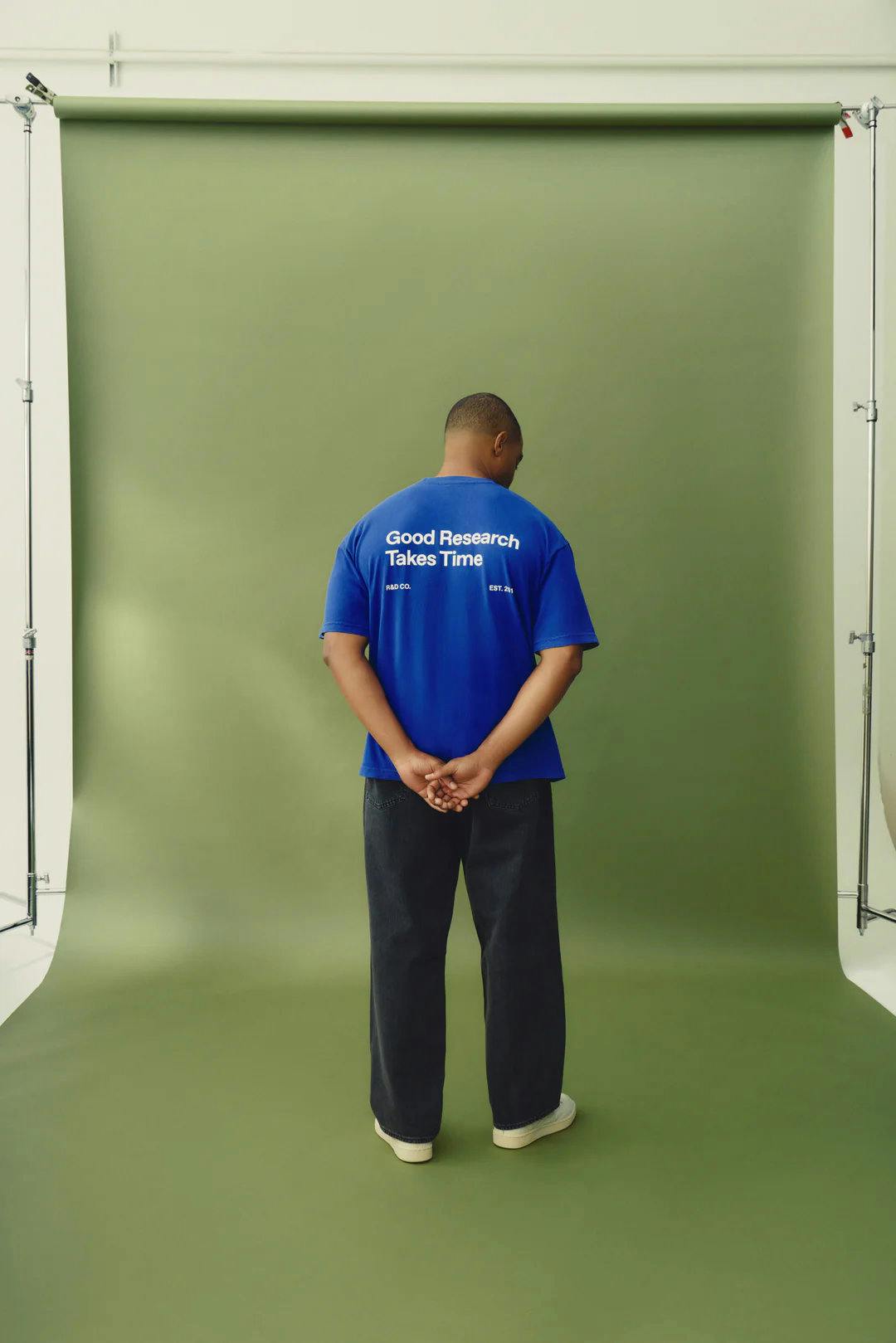


The quotes below span fashion criticism (voiced through X/Twitter), resale sellers, and the brand's own copy — showing how far apart the same event sounds depending on who's narrating it: a death sentence aesthetically, a fresh valuation commercially and socially.
whoa new OpenAi merch store dropped with an actual lifestyle photoshoot
weirdly passé Kith/ALD aesthetic of about five years ago.
these clothes suck ass.
looks horrible.
Who asked for this?
This is why you need production designers.
The shirts that are worth the most are employee-issued. It's insider-ish. If you can get something others can't buy on a public website, those are the real bragging rights.
[He] switched his flight to New York City just so he could stand in line to receive a free Anthropic baseball hat embroidered with the words "thinking."
OpenAI-ers developed concerningly strong, excited opinions about collectible cards, blue folding chairs, and graphic hoodies as emerging currency.
Context: fashion criticism converged almost entirely on aesthetics — dated, cheap, like a streetwear lookbook run through ChatGPT. On the resale market, the story shifts. What buyers keep bringing up, again and again, is whether the piece can prove they once stood on the inside of power. Alejandro Navia rebooking a flight for a free hat is a rare, literal record of that instinct in motion.
The brands frame the merch as "a material embodiment of company culture" and "a physical expression of research energy." OpenAI Supply Co.'s About page avoids the word "product" altogether, describing employees' fervor for blue folding chairs and collectible cards in near-devotional language, implying these objects carry a belief system legible only from inside the organization. Anthropic packaged its pop-up as a sober space against "AI slop," using the cap as a token of "continued thinking" — reframing a purchase as a values statement. Both companies are trying to translate "buying merch" into "agreeing with what we're doing."
Fashion media and veteran critics dismissed the designs almost unanimously — dated, cheap, personality-free, like an algorithm tracing a five-year-old streetwear lookbook. Highsnobiety went as far as calling it proof that tech bros' taste is "stuck in 2022." None of that mockery cooled the market. The ChatGPT basketball sold out; everything else is down to scattered sizes — a collective, contradictory posture of mocking with the mouth while buying with the hand.
A secondary market independent of the official narrative is forming: employee editions, limited drops, and "decommissioned" styles are being treated, systematically, as scarce assets in the mold of sneaker culture. Sellers insist that "employee-only" and "not for public sale" are the real bragging rights, and pricing has decoupled entirely from other tech company merch, like Google or SpaceX. AI merch has formed its own premium structure, with one collector treating a signed chip as a family heirloom.
The sharpest criticism targets the structural politics of tech's taste-signaling. Reporting on Palantir's chore coat, Dazed pointed to these garments as Silicon Valley's tool for "whitewashing its influence over some of the worst atrocities of the 21st century so far" through taste signals. Read this way, these pieces can be read as calculated purchases of legitimacy — cultural capital wrapped around the opacity and unaccountability of algorithmic power. Calling it ugly may be doing the marketing job of getting it talked about.
AI companies moved from invisible backend infrastructure toward a wearable, front-facing identity. Merch, once a recruiting tool, is now narrated by the companies themselves as a vessel for culture and values.
Institutions shaping the future of the information environment look clumsy and exposed in front of the oldest body language there is — clothing. That gap is itself the fuel for the conversation.
The assumption that taste has nothing to do with power breaks down: even institutions with no need to court mass approval get pulled into the politics of taste, just to make their influence feel approachable.
A wish to be recognized as someone on the inside of the system — whether the clothing looks good is secondary to whether it proves you got closer, sooner, to the engine reshaping the world.
"Employee merch" is moving from gray-market keepsake to a formal collectible category with its own pricing and authentication rituals — checking stitching, packaging — sneaker culture's verification rites copied onto corporate swag.
Within 2–5 years, proving you knew before the algorithm did may become its own social currency; people may start pricing and displaying their position in the information hierarchy through how hard a physical object was to obtain.
These six themes are the framework INCODER checks every cultural signal against — less a rulebook, more a pair of glasses: put them on, and the same headline grows a different meaning.
The volatility of the resale market is the signal-to-noise ratio laid bare — when everyone is guessing which piece holds value, scarcity itself seems to replace the content of the information as the thing actually being traded. In a world of information overload, can anyone still tell "important" apart from "merely rare"?
Wearing a jacket embroidered with "Research" translates an invisible digital identity — I understand AI, I'm close to the center of power — into a symbol legible at a glance. As self-identity leans more and more on system verification, does clothing become the next login credential?
The word "thinking" on a baseball cap carries the weight of an entire corporate philosophy in two syllables. Objects are displacing language as the most efficient medium for a complicated position — silence, material, cut, already speak on their own.
Rebooking a flight just to stand in line for a free hat — this kind of fervor, operating at the edge of rational consumer logic, may be worth recording more than any of the merch's actual design.
What actually decides these objects' value isn't mostly the brand — it's eBay sellers, authentication communities, and the real-time consensus forming on X. The brand supplies the raw material; the network negotiates the value on its own. A fairly bare demonstration of decentralized cultural production.
Mechanisms like "employee-only" and "decommissioned" are, at their core, engineered triggers for attention — opacity manufacturing sustained craving and tracking. How perception gets designed, trained, tamed, is something we keep watching.
On the surface, this is gossip about tech companies having bad taste. What it quietly assumes runs deeper than an aesthetic judgment: every participant — the critic mocking the merch, the worker rebooking a flight — seems to have already agreed, without discussing it, that physical proof of proximity to an AI system's core is becoming a form of identity currency scarcer than money and more honest than a degree. The premium on employee editions seems to come less from craftsmanship than from what it proves: that the holder once stood on the informed side of an information asymmetry. The logic isn't far from religious relics, early dot-com keepsakes, even war medals — an object's value comes from proving the holder was once "present." And the scarcity of "presence" is, right now, being redefined as physical access to an opaque algorithmic system.
The negotiation between the human body and information systems is, right now, playing out in fairly literal terms in the marketplace — people rebook flights, stand in line for hours, pay hundreds of dollars, to complete a ritual about who gets to claim they understood the future first. A cap that says "thinking," and a sentence that says "I'm not sure what I'm thinking either," point toward two entirely different kinds of honesty. Which one is scarcer, this record doesn't answer yet.
This report records the state of observation at this moment.
It may be revised, extended, or overturned by a future signal.
Observation continues.