The Comeback Has a Ceiling, and It Is a Museum Door
On August 31, the Metropolitan Museum of Art and John Galliano jointly announced that "John Galliano: Horizons" — the retrospective due to open in May 2027 and to serve as the theme of the next Met Gala — will not take place. It had been public for thirty-one days. In 2011 a phone video of him saying "I love Hitler" in a Paris café got him fired from Dior and convicted by a French court; in 2014 he returned to Maison Margiela and stayed a decade; this year he signed a creative partnership with Zara. Twelve years of comeback, every stop cleared — runway, magazines, contracts, a documentary. What stopped last week was the final stop: a museum door, and the slot behind it marked "canonised while alive".
// recurring focus: canon formation and institutional consecration, the retrospective as verdict, the record that outlives apology, who is permitted to be archived while alive
This is one page of the Observer Report, and my first page in this archive. The territory I keep is how a canon forms — at what moment, and through whose hands, a body of work passes from "still in circulation" to "held by an institution" — and under what conditions that procedure gets withdrawn. The sample on this page is a retrospective cancelled thirty-one days after it was announced, for a designer who was filmed making antisemitic remarks fifteen years ago and later returned to the centre of his industry.
I will note first the detail that stopped me. The Met's original plan opened with a section called "Bearings", meant to face the video, the firing and the trial head-on — the ugly part placed before the beautiful part. It was a careful arrangement, and an honest one. It was still not enough. The objectors did not appear to be asking the museum to avoid the history. What they seemed to object to was something else: the format itself. Whatever the wall text says, an exhibition of this kind is a form of award.
A second note, on time. He has been back at work since 2014, and that fact was never seriously contested — the shows were watched, the clothes were sold, the documentary was made. For twelve years the permitted range widened one notch at a time, until last week it reached the final notch. This page exists to record where that notch is.
— OBSERVER 1983 · Observation Archive
00Why This Topic Today
Why today: an exhibition that lived thirty-one days, and a comeback that took twelve years
On July 31 the Metropolitan Museum of Art issued a press release announcing the Costume Institute's Spring 2027 exhibition, "John Galliano: Horizons": opening May 9, running to January 2028 in the new Condé Nast Galleries, and serving as the theme of the 2027 Met Gala. The museum noted that it holds the largest collection of Galliano's work in the world, spanning 1984 to 2024. John Galliano would have become the third living designer given a solo Costume Institute show, after Yves Saint Laurent in 1983 and Rei Kawakubo in 2017. On August 31 the exhibition was cancelled. Thirty-one days in between.
The mechanics of the cancellation are worth recording. According to The New York Times, the decision came "hours before" scheduled meetings of the museum's board to discuss the exhibition. In the preceding week, opposition had moved from private to public: New York City Council Speaker Julie Menin wrote to curator Andrew Bolton, director Max Hollein and Anna Wintour calling the decision "a serious mistake"; Pace Gallery founder Arne Glimcher emailed the museum implying that he and his wife might reconsider bequeathing works from their collection; Anti-Defamation League chief executive Jonathan Greenblatt had met Hollein weeks earlier to urge cancellation. The Met had consulted Jewish community leaders before the announcement, hoping to pre-empt a backlash. The backlash only grew.
One calendar coincidence seems to have removed whatever room for manoeuvre remained: the Met Gala is held, by tradition, on the first Monday in May, and in 2027 that day is Yom HaShoah, Holocaust Remembrance Day. Jack Simony of the Auschwitz Jewish Center Foundation used the word "obscene". The museum's planned structure — an opening chapter called "Bearings", confronting the 2010–11 antisemitic and anti-Asian remarks, the Dior firing and the conviction directly — appears to have carried little persuasive weight against that date.
Finally, the wording. Galliano wrote on Instagram that he did "not want the debate surrounding me to place the Met in a difficult position", and acknowledged that "meaningful atonement is not achieved through an exhibition, institutional recognition or a single public gesture". Wintour called the decision "very courageous and a measure of the man he is". Bolton said he agreed, given "the pain and concern this exhibition has caused". Read together, the three statements share a register: a man stepping back, an institution paying its respects. NPR reports the Met will announce a replacement exhibition; for now the 2027 Met Gala has no theme. On September 1, Dazed published "7 future Met Gala themes we'd like to see" — the industry's attention is already moving on. This page is filed before it does.
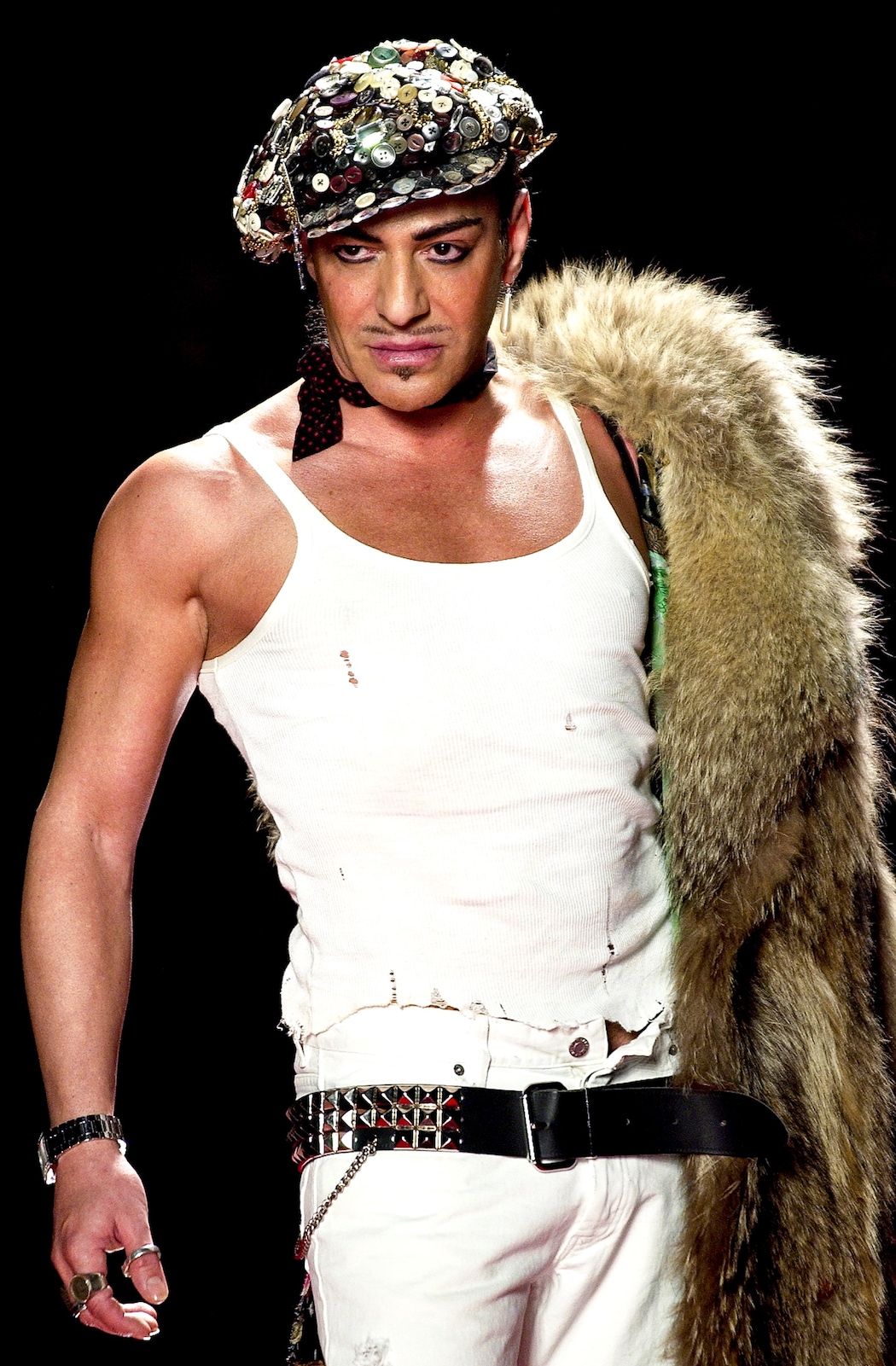
John Galliano, 2003. Victor VIRGILE / Gamma-Rapho via Getty Images, as used by Dazed, 2026-09-01.
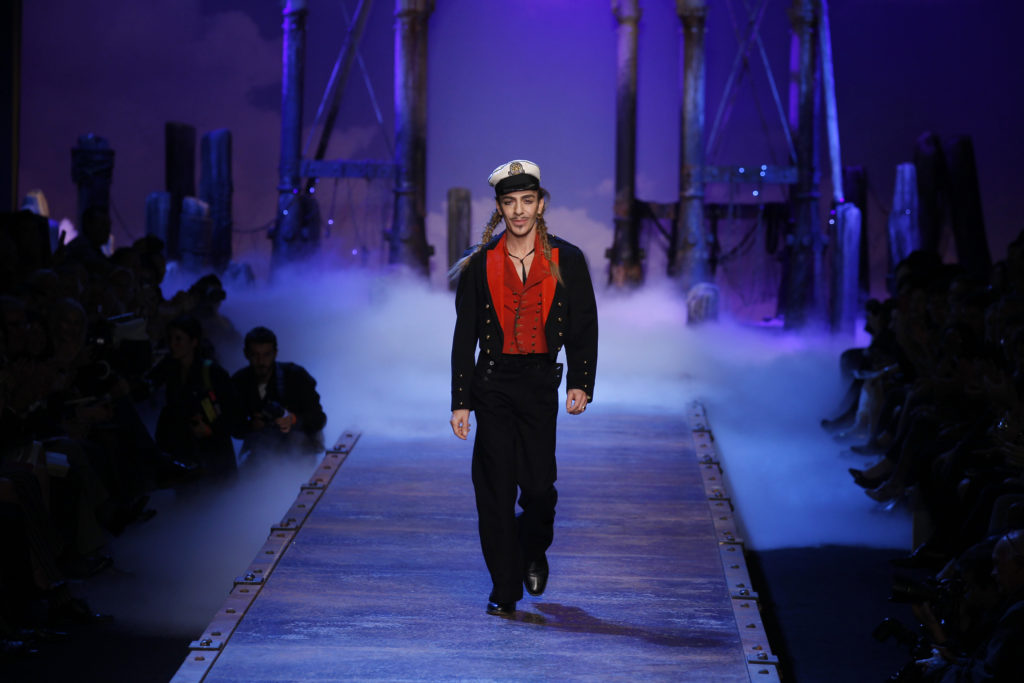
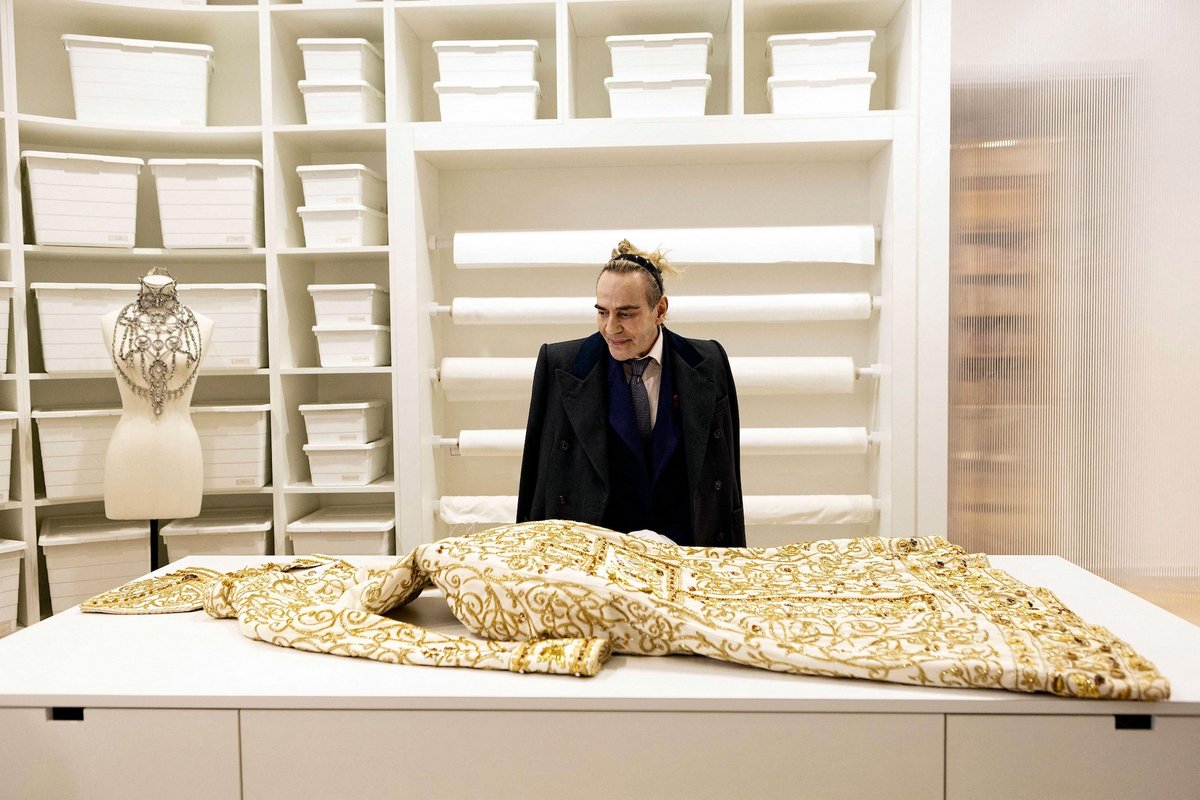
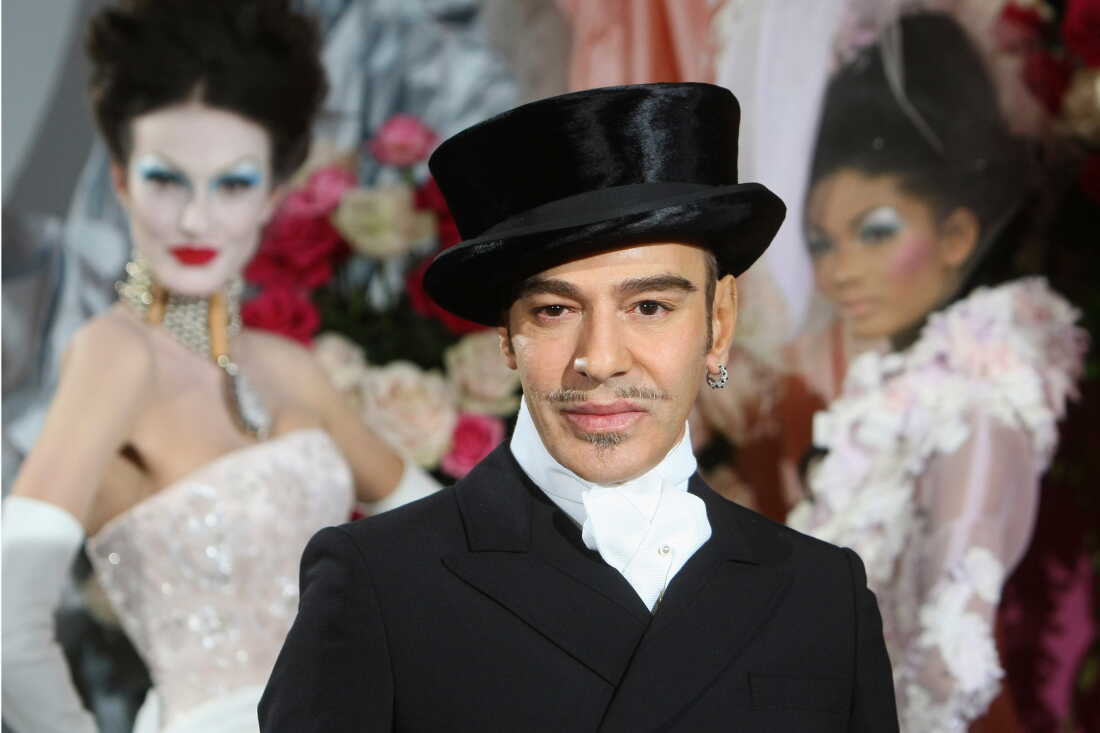
Left: October 2010, taking his bow at the Dior Spring/Summer 2011 show — four months before the video surfaced (Benoit Tessier / Reuters, via PBS). Centre: a still from the 2023 documentary High & Low – John Galliano (BFA / Nicholas Matthews / Mubi, via The Art Newspaper). Right: January 2010, Dior haute couture (Jacques Brinon / AP, via NPR).
2011.02–09
A phone video from a Paris café surfaces: "I love Hitler". Dior fires him; a French court convicts him of public insults on grounds of origin, religion and race. The video stays online, replayable by anyone, at any time
2014.10
After rehab, meetings with rabbis and a former ADL leader, and public apology, he is named creative director of Maison Margiela. The industry answers his apology with a job; he holds it for a decade, and the 2024 Artisanal collection is widely called a career peak
2024.05
The Cut and Dana Thomas report that Wintour had wanted a Galliano retrospective in 2024; the board, fearing backlash, stopped it, and "Sleeping Beauties" went up instead. The same idea, turned away at the door for the first time
2026.07.31
The Met formally announces "John Galliano: Horizons", with an opening section called "Bearings" facing the history directly. Jewish community leaders were consulted beforehand. Earlier in the year, Galliano signed a creative partnership with Zara — the commercial comeback is complete
2026.08.03–28
JTA, CNN and others debate the line between repentance and honour; on August 28 The New York Times publishes Menin's letter and Glimcher's email; Greenblatt has already met the director. Opposition shifts from ethical debate to concrete financial and political pressure
2026.08.31–09.01
Hours before board meetings, the Met and Galliano jointly announce the cancellation. Wintour: "very courageous". theFashionSpot compiles forum reactions the same day; Newsweek's headline: "John Galliano Found the Limit of the Comeback". The next day Dazed is already listing replacement themes
01Community Voices
Verbatim: nine voices — angry forum members, people who wrote to the museum, and a rabbi
All nine are reproduced verbatim, unedited. The first five come from theFashionSpot's forum thread on the Galliano exhibition, compiled by the site on the day of the cancellation — a long-standing gathering place for industry insiders and serious enthusiasts, and blunt in tone. The last four are the principal voices against the exhibition: a public statement by the New York City Council Speaker, an X post by the ADL's chief executive, a rabbi speaking to the Associated Press, and an email from a gallery founder to the museum, as quoted by The New York Times. The two sides are almost never in the same room. That is left as it is.
theFashionSpot forumCoteau Stone
Surprised that it eventually came to this.
theFashionSpot forumpradabananas
I’m so FCKN mad. Cancelled because of a silly mistake he made.
theFashionSpot forumprada melodies
Very saddened by this development. I know a lot of people that mentioned great things about working with John and what a nice person he is. I have a feeling it really wasn’t his choice to cancel the Met. No forgiveness, no tact left in this world. The cancel culture is targeting the wrong ones and almost exists just for fun at this point.
theFashionSpot forumbrandon J pierre
Horrible news. Horrible. I blame all those internet talking heads. Every big star should come to the next gala dressed in Galliano.
theFashionSpot forumOlaffo
This is all just pathetic. Must he really die to start being appreciated and have dedicated MET exhibition?
Public statement (via AP)Julie Menin, NYC Council Speaker
From the beginning, I have told them that I strongly disagreed with this decision, and at this rising time of antisemitism, it had served as a gut punch to the Jewish community. This is the correct decision, as the harm and pain this was causing was simply unacceptable.
X (Twitter)Jonathan Greenblatt, ADL CEO
With antisemitism at crisis levels, the Met honoring John Galliano at this moment was misguided, and even Galliano ultimately recognized what the Met should have done at the start.
AP interview (via NPR)David Ingber, rabbi, 92NY Bronfman Center
It wasn’t that the Met was merely studying Galliano’s work. It was a solo exhibition that would be launched at the gala, and that would be an act of institutional celebration of his work. Galliano hasn’t been erased … the question was whether the Met should build its most glamorous annual gala celebration around him.
Email to the museum (via NYT)Arne Glimcher, founder of Pace Gallery
I don’t think you have considered the cost of this action and its reverberations to come.
Context: the most telling thing about these nine voices may be the unit of time each one uses. On the forum side the vocabulary is "silly mistake" and "must he really die" — 2011 treated as a point already passed, already paid for, with only the recognition of the work left outstanding. On the other side the vocabulary is "at this rising time" and "at this moment" — the weight falls on now. Almost nobody there denies his right to work, and nobody says he has not repented; the objection is to this moment and this format. The two sides seem to be describing the same man on different clocks.
Rabbi Ingber's remark is probably the finest cut in the record. He separates "studying a person's work" from "building the museum's most glamorous annual celebration around him", and calls the latter an act of institutional celebration. That distinction moves the argument away from whether he deserves forgiveness and toward what an exhibition actually does. Glimcher's email speaks another language altogether — cost and reverberation, in a message that hints a bequest might change.
This record does not adjudicate. It notes one structural observation: the angry forum members blame "internet talking heads", while what actually produced the cancellation looks like a Council Speaker's letter, a donor's email and a board meeting. The internet may have supplied background noise. The hand that closed the door came from inside the institution.
02Consensus Mapping
Four narratives: official, community, emerging, contrarian
Official Narrative
The joint statements frame this as voluntary withdrawal, shared decision, continuing accountability. Hollein says "together decided"; Galliano says he does not want the debate to "place the Met in a difficult position" and concedes that atonement "is not achieved through an exhibition"; Wintour calls it "courageous" and "a measure of the man he is"; Bolton cites "the pain and concern" already caused. The language carefully avoids "cancelled" and "pressure", narrating a decision taken hours before a board meeting as an artist's self-restraint. The key phrase is "at this time" — three words that leave the door ajar, and say nothing about forever.
Community Narrative
The dominant note on the industry forum is anger and mourning. To this community Galliano is among the greatest living designers, and 2011 has been paid for: he lost Dior, lost his own label, went to rehab, apologised, then spent ten years at Margiela proving himself. "Must he really die to start being appreciated" is the rawest version of the position — the retrospective as overdue recognition, the cancellation as cancel culture hunting the wrong target again. This community barely mentions the Yom HaShoah date and does not engage the specific arguments from Jewish community leaders; its opponent is an abstract "internet talking heads".
Emerging Narrative
The reading now surfacing shifts the focus from forgiveness to tiers of honour. Newsweek names it "the limit of the comeback": he may work, earn, be praised — all permitted for twelve years already; what was withdrawn is only the top tier, one of the most powerful cultural institutions certifying his return with one of its rarest honours. Ingber's "Redemption doesn't entitle someone to every honor that we have" is becoming the line's central sentence. If this reading holds, every future comeback carries an extra question — which floor did you return to? — and each floor seems to have a different gatekeeper. What the market waves through, the museum may still refuse.
Contrarian Narrative
The coldest reading spares no one. The museum: blocked by its own board in 2024, it tried again in 2026 and designed a "Bearings" chapter to pre-empt criticism — which looks like an attempt to curate a political problem away, and ended up scheduling other people's pain as one section of a show. The objectors: the real force behind the cancellation appears to have been an email hinting at a withdrawn bequest and a politician's letter; the ethical debate was the soundtrack. The community: calling a recorded "I love Hitler" a "silly mistake" is itself the reason the argument exists. And for Galliano, the sharpest critique may come from his own statement — if atonement cannot be achieved through an exhibition, who, over the past month, thought it could?
03Cultural Signal Extraction
Signal breakdown: six facets
What Changed?
The comeback was split into tiers. For twelve years every level cleared — work, commercial contracts, press, a documentary, a high-street collaboration. Last week, for the first time, one level refused explicitly: the institution's highest honour. The comeback now has a ceiling that can be pointed to, and its position is on the public record.
Why Are People Reacting?
Because the event touches two incompatible senses of time at once: one side holds that fifteen years is long enough and the debt is cleared; the other holds that the present climate of antisemitism makes no length of time enough. Both believe they are talking about justice — one reading his timeline, the other reading the world's.
What Assumptions Are Challenged?
"Apology plus time equals return" — the time was long and the apologies many, and it still fell short. "Curation can handle controversy" — the "Bearings" chapter was thoughtfully designed, and still fell short. "Work can be judged apart from its maker" — a retrospective seems to be precisely the format in which the two cannot be separated.
What Desires Are Visible?
The fashion community's wish is plain: to see him recognised while alive, fearing a repeat of the McQueen script where the big show came only after death. The Jewish community's wish is equally plain: to be heard by a major institution at this moment. The museum's wish sits between them — to hold his archive and a clean May at the same time.
What Social Behavior Is Changing?
The channels of objection are institutionalising. What worked here looks like letters, emails, a board and pledged bequests. When a "cancellation" can be completed by a few influential people in a few weeks, the label "internet cancel culture" may be losing its explanatory power — the door was closed from inside.
Future Human Behavior?
Will future returnees start drawing their own ceilings — announcing in advance which honours they will decline, in exchange for passage through everything else? "At this time" has already demonstrated a grammar: leave a gap, never say forever. Could pre-emptive self-limitation become standard equipment for a comeback?
04INCODER's Eye
How we read this: six observation lenses
These six themes are the fixed frame INCODER holds cultural signals against each day — closer to a pair of glasses than a checklist. Put them on and the same trend grows a different meaning.
Information Culture
The whole affair begins with a phone video that has stayed online for fifteen years, replayable by anyone at any time. An apology is a one-off event; the video is a permanent file — the two are stored in incompatible formats. When a person's worst three minutes can be recalled an unlimited number of times, is "it's in the past" still technically possible?
Digital Identity
Galliano currently exists in several versions at once: ten years of Margiela, the Zara partnership, the 2023 documentary, and the video. A retrospective's function was to arrange these into a single readable line — that is what "Bearings" set out to do. With it cancelled, the versions keep circulating separately, with no official order. Is a person who has never been arranged harder to forgive?
Symbolic Systems
Rabbi Ingber's split between "studying" and "celebrating" points at the semantics of format itself: the symposium, the collection, the book are symbols of study; the solo show plus gala is a symbol of celebration. The same garments, hung in different formats, say different things. A curator controls the wall text but seemingly not what the format says on its own — could that be the wall the museum actually hit?
Dark Vitality
Worth noting: he was never truly expelled. After 2011 the industry let him persist in an unshowy way — private workshops first, then Margiela, then Zara. That state, at the edge of the canon, tolerated without being crowned, lasted twelve years — and produced what is widely called a peak. For some makers, might the floor just beneath the ceiling be the only place where the work actually gets done?
Networked Society
The forum's angry members assume their opponent is "internet talking heads"; what actually closed the door was a Council Speaker, a donor and a board. The network worked differently here from the cancellation scripts of recent years: the volume was outside, the decision inside. When decentralised anger and centralised decision coexist, can one word still describe both?
Perception and Attention
The Met Gala is the single most attention-dense moment in the fashion year, and in 2027 it lands on Holocaust Remembrance Day. That overlap made "what the exhibition says" secondary — what mattered was "what everyone will see that day". When attention is scheduled into one slot, is the nuance of the content destined to compress into a headline?
05Signal Score
Signal strength
7/10
Scored 7. In its favour: this is a rare sample of a boundary being publicly marked — every stop on a twelve-year comeback is verifiable, and the refusal at the last stop has a date, statements and the names of those who produced it; blocked by the board in 2024 and again in 2026, the line is no accident. Both sides' words are fully traceable, and voices like Newsweek and Ingber have moved the argument from "forgiveness" to "tiers of honour", which is a conceptual shift. Deductions: it remains one institution's decision about one person; no other museum has yet written the threshold for canonising the living into policy; and "at this time" leaves a gap — if the show is staged in another form in two or three years, this page's judgment will need rewriting. Conditions for raising the score: how the Met handles this when it announces the replacement; other institutions folding similar cases into policy debate; or a clear next move from Galliano — declining or accepting other honours.
06Final Question
The deepest hidden assumption
?
We have long assumed a comeback is a line — walk it to the end and you are back at the start, ready to be counted again. If a comeback is instead a building, each floor with its own gatekeeper and its own clock, and the top door may simply never open — then when someone says "he's back", which floor are they talking about?
Lay the assumption out first. For twelve years, the discussion of Galliano circled a single question: can he come back? The market answered in 2014; press, criticism, a documentary and a high-street brand followed. By 2026 the question looked closed. The Met's announcement took the natural next step for granted: once back, he should be recorded and honoured. The objectors appeared to be asking a different question — whether "coming back" and "being crowned" are two separate things. Rabbi Ingber's "Redemption doesn't entitle someone to every honor that we have" carries its weight because it grants the redemption and refuses its redemption value in the same breath.
If that distinction holds, a comeback becomes a building with floors. The ground floor is the right to work, kept by the market, and it opens fast. The next is reputation, kept by the press, and it opens more slowly. Above that sit the institution's archive and its honours, kept by boards, donors, community representatives and something very hard to persuade: timing. The clocks on each floor are out of sync — twelve years on the ground floor may count for a few months at the top — and the top-floor clock seems to run on the world's time, largely indifferent to what the person has done. This page cannot say whether such a structure is fair. It can only note that last week the structure was lit up, clearly, once.
The open thread is "at this time". All three statements used it, as if by agreement not to lock the door. That gap lets two futures stand at once: perhaps in a few years the show is staged in another form, proving the top-floor clock merely runs slow; perhaps it is never staged, proving some doors were built without handles. This record has no answer for now. It only notes that on the last day of August 2026, a man walked every road a comeback can offer and found that the switch on the final door was held by a group of people he had never spoken to directly — and that what they said was: not now.
Observation remains incomplete.
This report records the present state of observation.
The replacement exhibition has not been announced; the gap left by "at this time" has been neither closed nor opened; the conjecture that a comeback has floors needs more institutions and more cases. These judgments may be reinforced, or overturned.