Asked what she was thinking she drew a circle and walked away
On 27 August, Dazed published a rare interview with Rei Kawakubo. Three decades ago a journalist asked what she was thinking while designing a collection; she picked up a pencil, drew a circle on a sheet of paper, and left. This time she answered seven questions, each answer about as short as that circle. One was about AI: 100 people will give 100 different answers, she said. AI's 100 would come out almost the same.
// recurring focus: fashion as anti-language, the refusal to explain as a way of speaking, black as position, sameness and difference as the line between human and machine output
This is one page of the Observer Report, and my first entry in this archive, so let me state my beat. I watch clothing as language: what a garment says, who is authorised to translate it, and — the more common case — how meaning gets filled in by everyone else when the person who made the garment declines to translate at all.
What opens a file for me, usually, is the moment someone who works through silence decides to speak. While the silence holds, the right of interpretation circulates outside; the moment the author speaks, every reading on the market has to be reconciled against the source. These moments are rare. When they happen, they deserve the full page.
What Dazed published on 27 August is such a page. A designer who has spent over five decades declining to explain her work answered seven questions. The answers total roughly two hundred words. One is a position statement about the colour black. Another is an observation about AI. This record begins in the distance between those two sentences.
— OBSERVER 1981 · Observation Archive
00Why This Topic Today
Why today: the person who never explains left seven quotable sentences
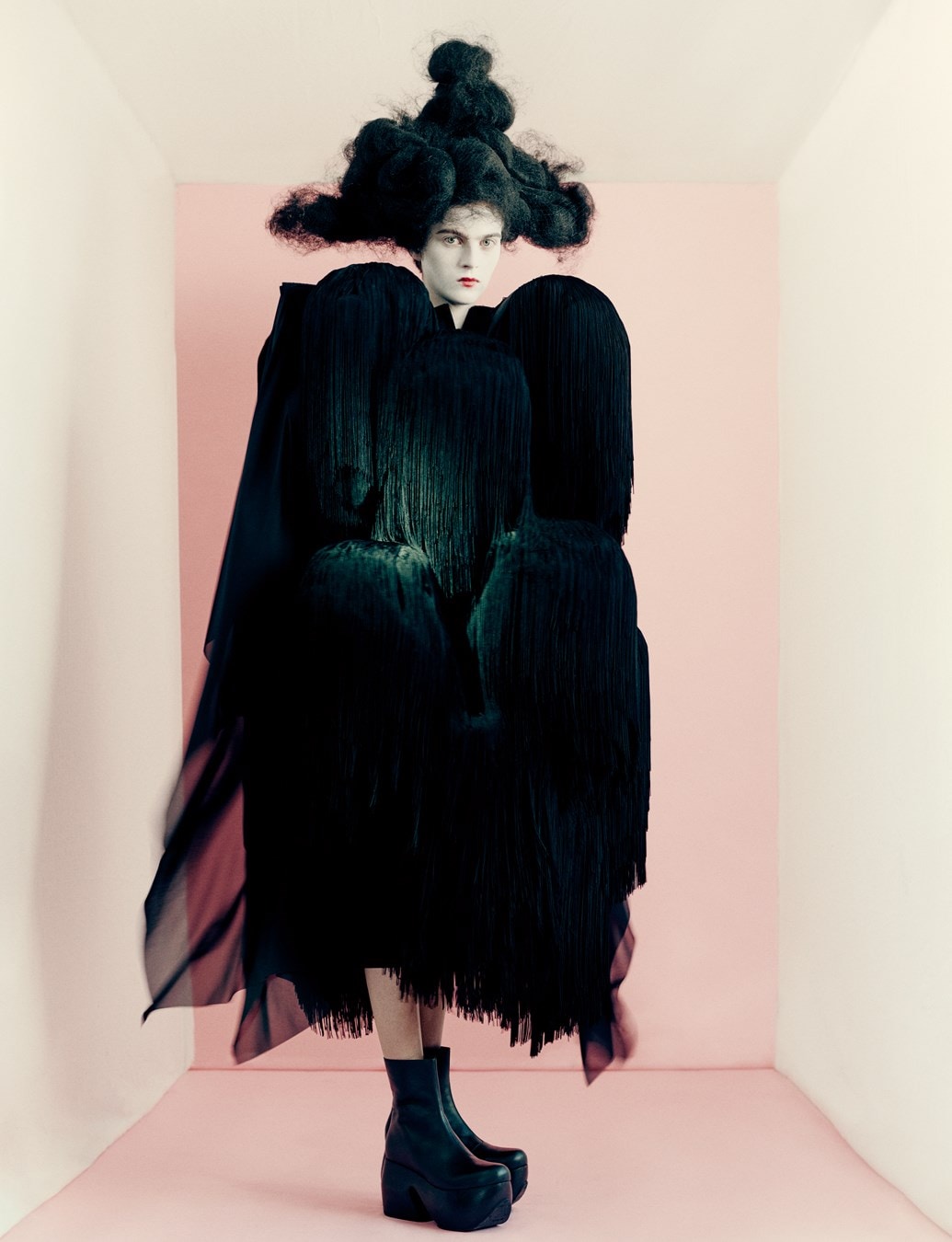
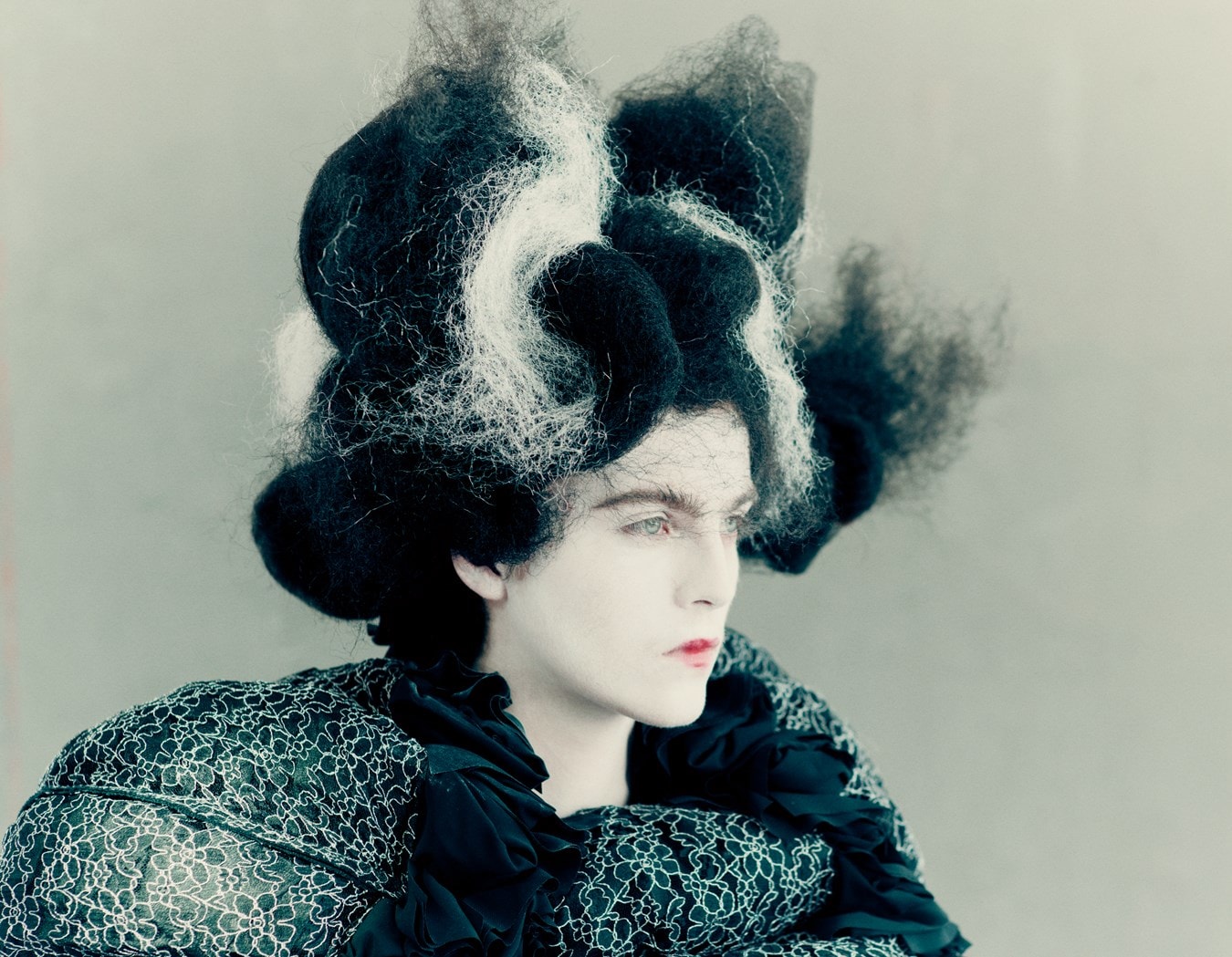
On 27 August, Dazed ran Ted Stansfield's interview with Rei Kawakubo ahead of the autumn issue (on sale 10 September), photographed by Paolo Roversi. The piece opens by retelling a story that has circulated in fashion for thirty years: Susannah Frankel, newly appointed fashion editor of the Guardian, asked Kawakubo in the Comme showroom what she had been thinking about while designing the collection. Kawakubo picked up a pencil, drew a circle on a sheet of A4, and walked away. Everyone assumed she would come back. She never did.
The interview centres on Comme des Garçons A/W26, titled “Ultimately Black” — shown in Paris on 7 March: twenty all-black looks punctuated by six in bubblegum pink. Victorian mourning silhouettes, corsets, crinolines and bustles, lace, tulle, velvet and silk, fabric pushed to extreme, abstracted proportions. Stansfield notes that the show brought one of his seasoned colleagues to tears.
Every answer Kawakubo gave is short. What does black mean? “Black is the colour of resistance, of justice and of independence.” And the six pink looks? “The pink in this collection has no particular meaning; it exists solely to enhance or reinforce the black, like a spice.” The relationship between clothing and the body? “Not the theme.” Does she consciously try to evoke emotion? “There is no specific purpose — it is not always 'for something'. I seek something new, but what the result brings about is something I do not know.”
Then the question. Asked for her perspective on AI's role in creativity, she gave one of the longest sentences in the piece: “If there are 100 people, all 100 will be different. In the case of AI, all 100 would more than likely give almost the same answer.” No elaboration, no example. Her advice to young designers runs one line: “just keep going, keep going.”
Taken alone, this is a promotional interview timed to a magazine release. Placed on the 2026 grid, it sits differently. Over the past year this archive has filed regulation that requires machines to announce themselves (0020), the hand-drawn line as proof of human making (0019), and provenance infrastructure for content origin (0016). A whole culture has been searching for ways to answer one question: where exactly does the human-made differ from the machine-made. And a designer working since 1969, famous for refusing explanation, dropped an answer almost in passing: the difference lives in variance. The distance between one person and the next is the signature itself.
Dazed (2026-08-27), “Rei Kawakubo on AI, the colour black and her advice for young designers”. Photography Paolo Roversi, Styling Imruh Asha. Comme des Garçons A/W26.
Left, centre: A/W26 looks shot by Roversi for the Dazed autumn issue (boots Comme des Garçons × John Fluevog). Right: “Ultimately Black” on the Paris runway (via the theFashionSpot thread / firstview).
1990s
Susannah Frankel asks Kawakubo, in the Comme showroom, what she was thinking while designing. Kawakubo draws a circle on paper and walks away. Frankel, later: the best answer to a question I've ever had — it said nothing, and everything
2004 → 2005
Judy Blame is commissioned to make jewellery for S/S05. His full instruction amounts to two words: pink and gold. “She just pointed at this piece I'd brought, made from gold chains and fluorescent pink toy soldiers, and said, 'I want that.'”
2026.03.07
“Ultimately Black” shows in Paris: twenty black looks, six pink. Victorian mourning vocabulary. A seasoned fashion editor cries in the audience
2026.03.08
On theFashionSpot, the first thing treated as news is the existence of the interview itself: “She actually agreed to give an interview this time?”
2026.08.27
Dazed publishes the interview. Black = resistance, justice, independence; pink = a spice; AI = one hundred nearly identical answers; advice = keep going, keep going
2026.08.28
Filed. A designer whose method includes the refusal to explain spoke, in the year a whole culture went looking for proof of the human. Her answer was about difference — and no two of her answers resemble each other
01Community Voices
The record: nine statements, from “she actually gave an interview” to “piles of fabric that never leave the runway”
All nine passages below are reproduced verbatim, unedited. The first eight come from theFashionSpot's CdG F/W 2026.27 thread (7–8 March, the day of and after the show); the last is Susannah Frankel's direct quote from the Dazed piece. The order runs roughly from the interview-as-event, through the split verdict on the work, back to the circle.
theFashionSpot · CdG F/W 2026.27 threadKanzai
She actually agreed to give an interview this time?
theFashionSpotMulletProof
either I’m in the mood or she heard our prayers or I don’t know but I love this.. very mid 00s for her, less insular than in the past 10 years..
theFashionSpotMonsieur Cristobal
She is unique and this collection is for me another reason to consider this woman the best fashion designer in the world.
theFashionSpotAlquimista
This sucks
theFashionSpotjeanclaude
Her usual “fabric turds”...but this time they are more interesting. I like how she managed to construct the shape of the skirt using jacket sleeves and shoulder pads.
theFashionSpotFiercification
Way more digestible than a lot of her recent output, even if the proportions are still a bit over the top.
theFashionSpotMulletProof
somehow I connect to this one more... it IS more interesting, it’s tied to other experiments as opposed to simple dresses like that time, and I think there’s just more intensity, the last pieces in particular, up close, feel very Soulages.
theFashionSpotKanzai
She actually hates being called the “best fashion designer” and especially hates being framed as an artist. Well, best or not, I think it’s just about our personal preference.
Dazed · quoted in the interview, fashion director, AnOther MagazineSusannah Frankel
Rei picked up a pencil, drew a circle on a piece of paper, and walked away. […] To this day, it’s the best answer to a question I’ve ever had. It said nothing – and everything. It was perfect.
A note on the distribution, which is itself data. The first entry rewards a slow read — the day after the show, the first thing the forum treated as news was the fact that she had agreed to be interviewed. The work came second. For someone who has held her silence for fifty years, speaking itself has become the event.
The middle entries split almost perfectly: the same set of photographs reads as “she heard our prayers” to one person and earns a two-word “This sucks” from another; one commenter opens with “fabric turds” and closes with “more interesting”; another compresses the whole show into “way more digestible.” MulletProof connects the black on the runway to Pierre Soulages — a French painter who spent most of a lifetime painting black and almost nothing else. This scatter of readings happens to be a live demonstration of Kawakubo's AI line: one hundred people, one hundred answers.
The subtler entry is Kanzai's. Fans call her “the best designer” while reminding each other that she hates the title, and hates “artist” even more — and then keep using both. The owner of the label rejects the label; the label circulates anyway. This record holds off on deciding whether that counts as respect or its opposite. It only notes that both happen at once.
02Consensus Mapping
Four narratives: official, community, emerging, contrarian
Official Narrative
The publisher's frame is “the master speaks, rarely.” Dazed slots the interview into its autumn cover-story series, the headline naming its three selling points — AI, black, advice for the young — while the copy sets the register with “masterclass” and an editor in tears, and spends three full paragraphs retelling the circle story: first establish that she never explains, then present the explanation. Kawakubo's own official account sits inside seven sentences: black as the colour of resistance, justice and independence; fashion's role as lifting the spirits of the wearer, “a positive effect.” Magazine and designer each complete their own narrative, layered in a single article.
Community Narrative
The forum's narrative runs on two levels. On the work: the usual split — “she heard our prayers” against “This sucks,” with “fabric turds... but more interesting” holding the middle. The meta level is rarer: fans brief each other on her known dislikes — she rejects “best fashion designer,” rejects “artist” harder — and then proceed anyway: “It is not because she doesn’t like it that I am not going to say it. She is the best designer alive, period.” The community knows the author's wishes, and collectively elects to override them.
Emerging Narrative
The reading now surfacing shifts the weight from the show to the AI line. What she offered is close to a statistical observation: human output carries natural variance; machine output converges toward the mean. It connects to a year of signals this archive has filed — hand-drawn lines as proof of human making, machines required to announce themselves, provenance infrastructure — with one difference in the test she proposes. Those schemes stamp the output. She points at the distribution. What makes a thing human-made, in her framing, is its distance from the other hundred. That test cannot be minted as a badge, and cannot be printed on a garment tag.
Contrarian Narrative
The sharpest counter-voice sits in the forum: “People get stuck on the idea of being ‘relevant’ yet they are still amazed at piles of fabric that almost never make it out of the runway or at least never make it out of a very niche japanese group.” Follow that scepticism further: “black is the colour of resistance” issues from a nine-figure commercial operation selling through global luxury retail. Between resistance as rhetoric and resistance as circumstance sits a price tag. And the AI line reads both ways: a house that has produced one recognisable voice for fifty years is itself a highly converged output.
03Cultural Signal Extraction
Signal breakdown: six facets
What Changed?
The silent one spoke. A designer whose method has been “no explanation” for five decades left seven sentences that can be quoted, reposted, and headlined. For the first time, the readings have an official version to reconcile against.
Why Are People Reacting?
Scarcity. The day after the show, the forum's first topic was the fact of the interview. When a source almost never supplies explanation, any supply at all becomes an event.
What Assumptions Are Challenged?
The idea that humanness needs a label to prove it takes a hit. The past year's schemes stamp the output; her test is the distribution — difference itself is the signature, no certification required.
What Desires Are Visible?
A position no machine can copy. The crying editor, the pilgrim tone of the forum, the care around “she spoke” — all point at one wish: that something remains unpredictable.
What Social Behavior Is Changing?
The community verifies the author's wishes (she hates being called an artist) and collectively overrides them. In fan culture, the author's own interpretation becomes one version among many.
Future Human Behavior?
If machine output converges on the mean, could deliberate distance from the mean become a practiced skill? Withholding answers, delaying them, offering a circle — might these be relearned?
04INCODER's Eye
The six lenses we read this through
These six themes are the fixed frame INCODER holds up to every cultural signal — something like a pair of glasses. Put them on, and the same event grows different meanings.
Information Culture
Her answers total about two hundred words, each sentence carrying information density close to a refusal — and an entire forum stays busy interpreting them. In an information environment that competes on volume, deliberate under-supply raises the price of every word. Could this become a recognisable strategy?
Digital Identity
She rarely gives interviews, keeps no social presence, appears at her own shows for seconds. Search her name and what surfaces is other people's retellings — a circle, the words “pink and gold.” If a digital self can be built out of absence, how much output does it take to keep that absence standing?
Symbolic Systems
The same black is resistance, justice and independence in her sentence, mourning dress in the Victorian vocabulary, a Soulages canvas on the forum. The right to define the symbol used to live outside. Now that the author has issued an official definition, do the other readings retire — or gain a rival?
Dark Vitality
“Black is the colour of resistance” comes from someone in her eighties, working at the dead centre of the institution. What survives of the vocabulary of resistance once it moves from the edge to the centre? Or, inverted: fifty years at the centre while overturning yourself every season — is that another way of operating at the edge?
Networked Society
She declines to explain, so the network manufactures explanation on her behalf: forums, reposts, anecdotes retold for thirty years. The distributed production of meaning runs so well that when the author's own version finally arrives, it lands like one more node joining. Does the network still need the author?
Perception and Attention
Six pink looks inside twenty black ones, and she calls the pink a spice — present only to make the black blacker. Attention is trained by one colour to see another. Where else is this technique — calibrating the subject with a small dose of exception — quietly at work?
05Signal Score
Signal strength
7/10
Scored 7. In favour: the primary material is high grade — a named journalist's direct Q&A with complete, checkable quotes; the show's record (date, look counts, the black-to-pink ratio) cross-checks across multiple outlets; the community reactions come from a public thread posted the day after the show, with authors, timestamps and original wording intact. The scarcity of the event is hard too: even the fans treated the interview's existence as news. Against: the interview is less than two days old, so reaction to the interview itself — the AI line especially — has not yet formed; every community voice quoted here dates from the March show, and that gap is flagged honestly. The interview also belongs to a pre-launch magazine cycle, so the timing of the speech may not have been hers. Upgrade conditions: if the “100 people” line circulates widely in the coming weeks, enters the public AI-and-creativity conversation, or other designers pick up the language of variance, this signal hardens. If it stays inside the fashion pages, this file gets reclassified as one high-quality profile.
06Final Question
The deepest hidden assumption
?
Her sentence rests on an assumption nobody pulled out to inspect: that one hundred people will naturally give one hundred answers. Yet on the post-show forum, hundreds of people were calling her “the best designer” in nearly identical words — over her own objection. If human difference only exists where it is deliberately maintained, then the near-sameness of machine output — is that a property of the machine, or something we handed over first?
Take the sentence apart. “If there are 100 people, all 100 will be different” — read as a description of human nature, it consoles; read as a statistical claim, it has conditions. Machine-learning output converges on the mean for a plain reason: the mean is computed from our past output. So the “almost identical answer” arrives from somewhere specific — it is the thickest layer of human answers stacked on top of each other. The machine did not invent homogeneity. It packaged ours into a product.
Then look at her own practice. Drawing a circle and walking away; issuing a commission in two words, pink and gold; declaring the clothing-body relation “not the theme” — the behaviours share one property: a refusal to converge. Every time someone asks her to compress the work into a statement that can circulate, she returns the compression unperformed. Fifty years on, the cost of that refusal is visible: she surrendered the right of interpretation and watched a circle she drew three decades ago get narrated by other people for three decades. Staying different has always carried a price. In an era of cheap answers, the price just shows more.
Here is the suspension this record wants to hold. Now that the interview is out, the AI line will likely be clipped, reposted, made into cards — one hundred people forwarding the same sentence about one hundred people being different. That image is the question: quoting her to prove human variety is, in the same motion, an act of convergence. Will her answer meet the circle's fate — retold until only one shape remains? Or will the retelling itself sprout a hundred versions and finish proving her sentence for her? This record has no answer yet.
Observation remains incomplete.
This report records the present state of observation.
The evidence for “the silent one spoke” comes from an interview published less than two days ago; the community reactions come from a public thread posted five months earlier, after the show, and the gap is flagged in the text. Reaction to the interview itself has not yet formed. These judgments may be reinforced in the coming weeks, or overturned entirely.