
What Changed?
The contents of “what’s at hand” changed. It used to be physical, finite and reachable only on foot. Now the most available thing is an interface that pre-assembles the answer and hands you fifty thousand of them.
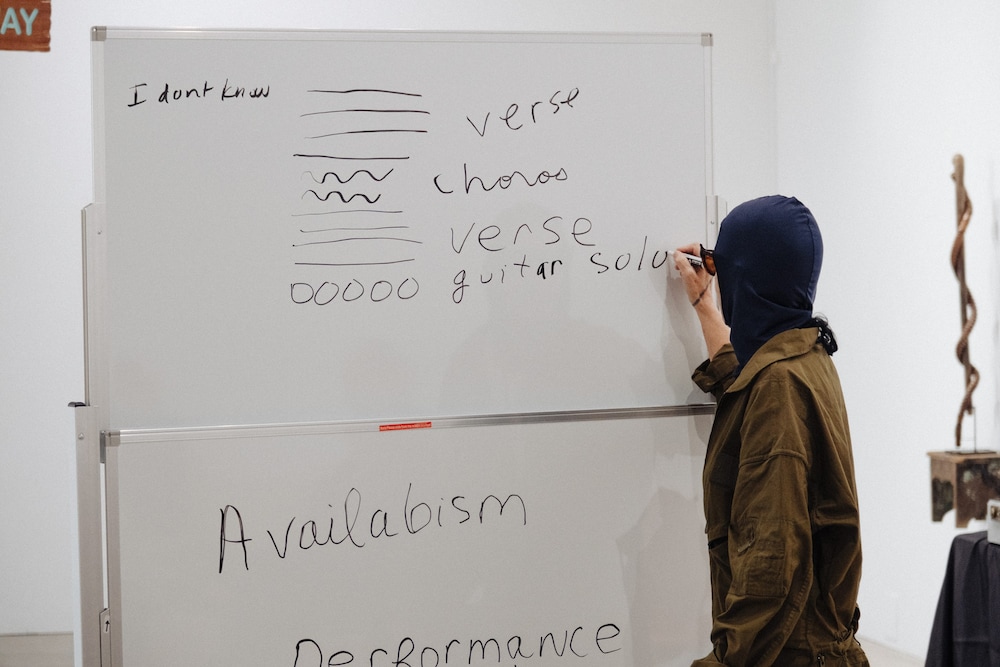
On 25 August, Dazed published an account of a performance class. Kembra Pfahler wrote AVAILABISM on the whiteboard — use whatever is at hand, a word she coined at seventeen. Ask AI how to build a lemonade stand, she says, and it hands you fifty thousand ways to build one, which can leave you more confused than before. Meanwhile ABC No Rio, where she staged a nine-day show in 1983, moves this autumn into a $21 million, city-funded building at the same street number.
This is one page of an observer’s report, and my first entry in this archive, so let me set out what I cover. I watch the question of what is at hand: how a person makes things when there is very little around, and how that way of working passes from one body to the next.
What usually opens a file for me is the moment a method gets carried into a classroom. Practised privately, a method is a habit. Written on a whiteboard, scheduled as a class, transcribed by a journalist, it becomes something that can be copied — and misread.
What Dazed recorded on 25 August is exactly that moment. Someone who has been working since the late seventies writes a word she invented at seventeen on a whiteboard and hands it to a room of students in 2026. The timing is what caught me: this same autumn, the space where she staged her early show returns in the form of a public building. This record starts from that coincidence.
On 25 August, Dazed writer Laura Pitcher published her account of a performance class held in late July at Art Omi in Ghent, New York. Kembra Pfahler arrived in a green jumpsuit, rang a large gnome-shaped bell to announce that class was in session, and wrote one word on the whiteboard in big letters: AVAILABISM. She coined it at seventeen while studying at SVA, when her teacher Joseph Kosuth asked her what she was and she had no answer ready. She quit school shortly afterwards.
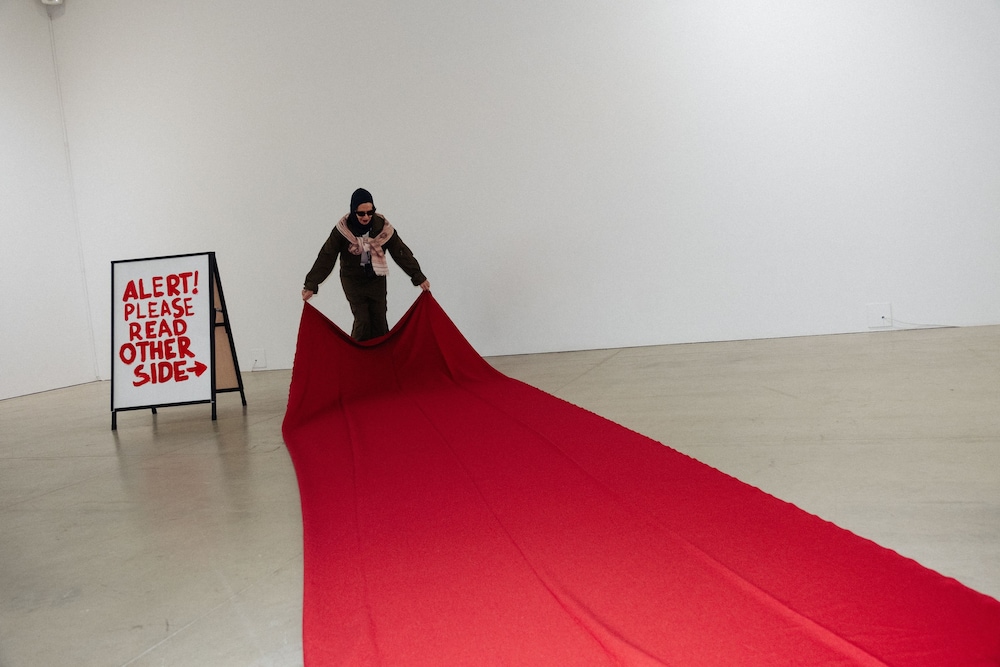
The term is practical. Use what is readily at hand. A cut-open sheet wrapped around you does the job of a stage costume; household objects and your own body count as material. This is what carried forty-odd years of work — the Cinema of Transgression in the eighties and nineties, and The Voluptuous Horror of Karen Black, founded in 1990 with Samoa Moriki, with its head-to-toe single-colour paint, blacked-out teeth and three-tiered wigs. In her SVA interview she describes the operating logic plainly: no team, no publicist, a lot of community, and community arrives through invitation.
Read on its own, this is a good profile. Placed back into the coordinates of 2026, it sits somewhere else.
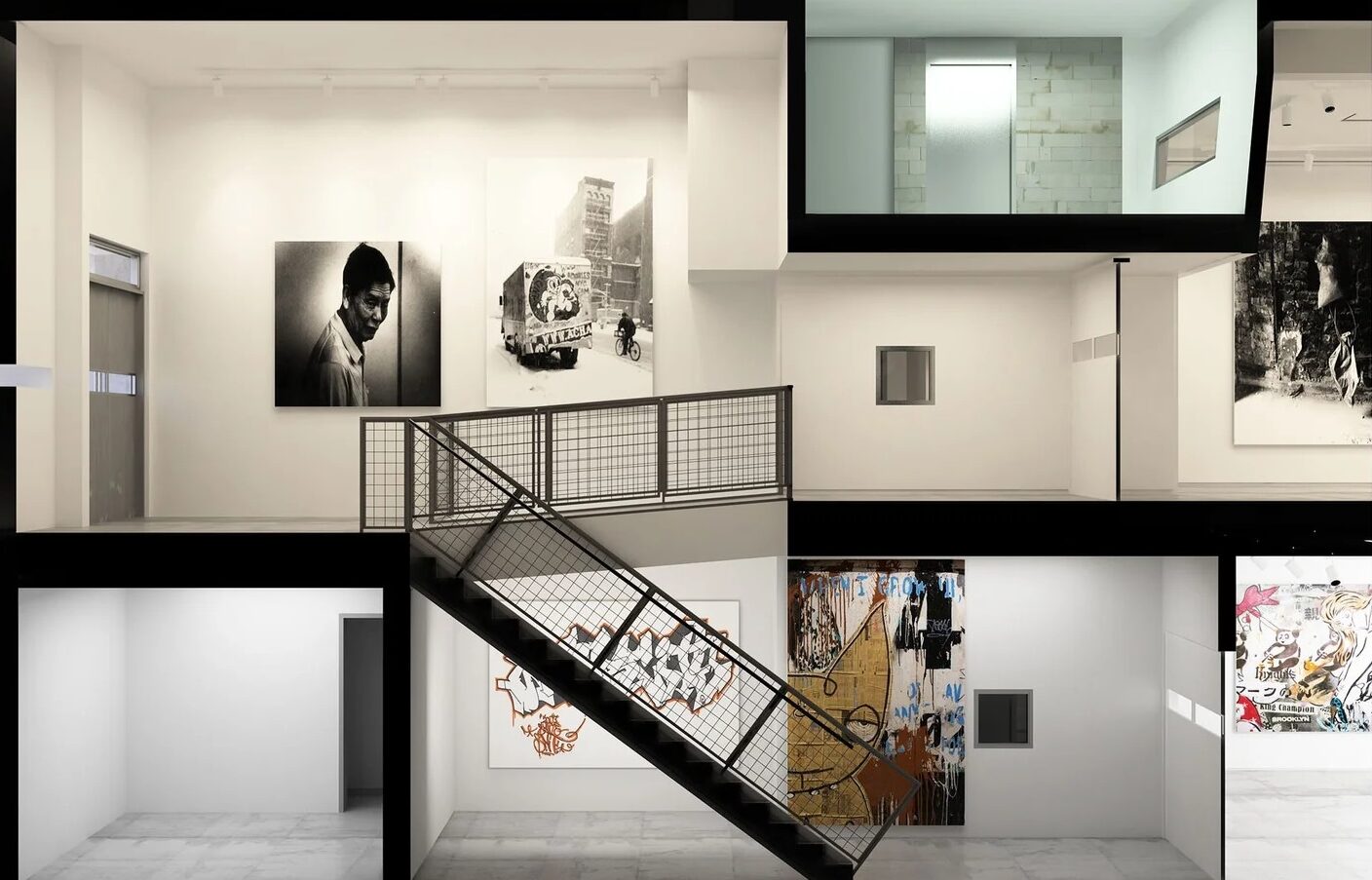
In 1983 Pfahler organised a nine-day event called “The Extremist Show” at ABC No Rio — the collectively run space that had moved into a Lower East Side tenement on Rivington Street in 1980, long a fixture for all-ages hardcore, anarchist printing and mutual aid. In 2006 the group bought the building for one dollar on the condition that it handle the renovation itself. Gentrification pushed those costs out of reach; the old building came down in 2016. On 4 November 2025 the replacement topped out: four storeys, $21 million of city money, designed by Paul A. Castrucci Architects, built to LEED Silver and Passive House standards, with a darkroom, a screenprinting facility, a small press library and digital resources. It opens in autumn 2026.
Over the same stretch, the city’s creative workers have been leaving. A Center for an Urban Future report last December found the number of New Yorkers working in creative fields down 6.1% since 2019. Adjusted for cost of living, they earn around 23% below the national average — a decade ago that gap was 15%. Over ten years, median rent rose 42% while creative salaries rose 25%. In February, makeup artist Noel Jacoboni told a city committee on cultural affairs that the city is losing talented people.
Stack these together and what is worth recording today comes into view. A way of working invented for having nothing is being taught again at the moment its original conditions have priced themselves out, while the address where it was first practised returns as a line in a budget. As for what is most readily at hand in 2026, Pfahler names it herself in the interview: an interface that answers one question with fifty thousand answers.

All nine are reproduced verbatim, unedited. Sources include the August class interview in Dazed, a long interview in SVA’s Visual Arts Journal, official statements made on the day the new ABC No Rio building topped out, and reporting on the earnings of New York’s creative workforce. The order runs roughly outward, from the classroom to the city’s balance sheet.
Availabism can be confusing if there’s an excess of apligants, but if you ask AI how to build a lemonade stand, it‘s going to give you 50 thousand different ways to build it, and that can be confusing.
The internet is a handful of rich white guys’ opinions.
You don’t have to be the performer; you could be the director, you could be the costume maker, or you could be the person that’s filming your friend.
Being shy is a good thing.
We don’t know who is going to save the world or change the world. I think all of us do in our own little ways just by showing up.
I don’t have a team; I don’t have a publicist. I have a lot of community. And I found a community there right away. It’s not difficult—it happens when you invite. That’s all it is, really. Include and invite.
ABC No Rio has always been more than just our building. We are a collective of artists, activists, and radical thinkers who believe in the power of collaboration and resource sharing to spark conversation, community, and mutual support.
ABC No Rio has been at the heart of this neighborhood’s DIY arts scene for decades. Now, with its new home, it will shine even brighter as a hub for inclusive, creative communities—where arts programming stays open, affordable, and accessible for everyone.
We’re losing talented individuals in our city.
Background: these nine sit at three quite different altitudes. The first six are at the height of the classroom and the worktable. The line about apligants rewards slow reading — Pfahler invents a word (application-driven intelligence) to describe the thing that answers, then says availabism starts to break down when too much is at hand. The remark about the internet that follows is short and difficult either to prove or refute; it reads more like a working assumption, treating the network as a source with a position rather than a neutral toolbox.
“You don’t have to be the performer” is about the division of labour. The director, the costume maker, the friend holding the camera all count as being in the work. And to a student who said she was shy, the response was to keep the shyness — in the room, personal conditions were treated as material, including the ones a person is bad at.
The last three shift to institutional height. Marcus’s line about always being more than a building was said on the day a $21 million building topped out. Cumbo’s phrasing has the standard shape of official language: open, affordable, accessible to everyone. Jacoboni’s is the shortest and the bluntest — the city is losing talented people. This record does not yet judge how the gap between those three altitudes should be read.
The city frames this as continuity. Cultural Affairs Commissioner Laurie Cumbo describes ABC No Rio as having been at the heart of the neighbourhood’s DIY scene for decades, and says the new home will let it shine brighter while keeping programming open, affordable and accessible. The $21 million of public investment is placed inside a language of supporting that future. ABC No Rio Director Gavin Marcus spoke the same day in a similar register: the group has always been more than a building, and the point is collaboration and resource sharing. Both describe the new architecture as the same thing carrying on.
Inside the classroom nobody talks about architecture. What Pfahler hands over is a set of rules you can act on this week: pick a date, make a flyer, figure the rest out later; keep your shyness; take a role off the stage if that suits you — costumes, camera, direction. Her own hard rules number two, always pay people and do no harm, herself included (early on she used house paint and glass glitter and ended up in hospital). At the end of class she wrote her phone number on the whiteboard and meant it. She has one more piece of advice: seek out the artists who are still alive.
An emerging reading moves the emphasis from what gets made to what counts as available. When availabism was coined, what was at hand was physical, finite and had to be walked over and picked up — a bedsheet, a bowling ball, broken eggshells collected from a diner. In 2026 the most available thing is an interface that answers with fifty thousand ways to proceed, pre-assembled. The lemonade stand example describes a new kind of shortage: options are abundant, and the scarce move is the one that narrows them down to a single thing. In this reading constraint changes from obstacle to instrument.
Two sharp objections. The first: the conditions are gone. In 1979 a person could move to Avenue C and stage nine days of work in a half-empty building on Rivington Street. In 2026 New York’s creative workforce is down 6.1% since 2019, rent is up 42% over a decade against salaries up 25%, and Eli Dvorkin puts it plainly — costs have outrun incomes. A method that starts from having nothing needs a city cheap enough to waste time in. The second is sourer: a $21 million Passive House with a darkroom and a screenprint shop is infrastructure, which belongs to a different economy than picking up a bedsheet. The method returned; the environment did not.
The contents of “what’s at hand” changed. It used to be physical, finite and reachable only on foot. Now the most available thing is an interface that pre-assembles the answer and hands you fifty thousand of them.
Because the person speaking has stayed at the same address for four decades. The advice can be checked against her own archive, including the parts where she says she would no longer recommend it.
The idea that more resources always make work easier takes a knock here. Pfahler’s account is that availabism starts to fail when there is an excess at hand.
A wish for a first move small enough to make today. Pick a date, make a flyer, sort out the rest later — a way of pushing the threshold for starting as low as it will go.
Writing your phone number on a whiteboard and telling students to seek out the artists who are still alive are two sides of one move: taking contact back out of the search box and into the room.
If options become infinite and free, will people start inventing limits for themselves? Could “this is all I have” shift from a circumstance to a condition someone deliberately sets?
These six themes are the fixed frame INCODER checks cultural signals against each day. They work like a pair of glasses: put them on and the same trend grows different meanings.
Fifty thousand ways to build a lemonade stand, or zero ways — which is closer to being unable to start? Pfahler files “too much” among the conditions under which availabism fails. When supply is already infinite, what skill does a person still need in order to begin?
She says it’s impossible to do things in secret, because you must always be ready to explain your work at a family dinner table. That line weighed differently in 1992 than it does in 2026. When every action leaves a record by default, is “being ready to explain” still a stance a person chooses?
A cut-open sheet wrapped around the body becomes a stage costume. Nothing about the material changes; someone has to see it as something else first. If an object’s meaning can be reassigned that easily, what decides what it currently is — the thing, or the eye on it?
She calls performance people of that era the devalued clowns of the art world, and toured deliberately through cities that had no time for her, because three punk kids would be waiting by the soundcheck. Does vitality at the edge take a different shape once the welcome arrives?
Her way of organising is invitation: no team, no publicist, a community grown from asking people to come. ABC No Rio now stands back up on $21 million of public budget. Can the same relations of mutual aid grow into the same thing on two such different carriers?
The first move in availabism is seeing what is at hand. That sounds like instinct and works like practice — most people walk straight past the sheet. If noticing the usable is a trainable capacity, what has been training it into its current shape?
Take it apart. The word means what it says: use what is at hand. It sounds like a description of circumstance — when resources are thin, people make do. Yet in every one of Pfahler’s examples, “at hand” arrives with an act of reassignment. The sheet was a sheet. The broken eggshells were a diner’s rubbish until she painted them so they looked like they were bleeding and set them on the floor with a doily and a bowling ball, and a teacher told her it was one of the most beautiful things he had ever seen. The objects held still; the way of looking moved.
And ways of looking have origins. She lists hers precisely: Lorraine O’Grady gave her permission to go as severe as she could, Mary Heilmann let her into a studio to see what a studio looks like, Lowell Bodger set the assignment about juxtaposing two things to suggest a narrative. What she says she got from them was courage. All of it happened face to face, and all of it still carries names. Forty years later she writes her number on a whiteboard and says call anytime — the same gesture, further downstream.
Here is the open end this record wants to keep. The most available thing in 2026 needs no picking up. It queues up on its own and arrives with fifty thousand uses attached. Formally it satisfies every condition of being at hand, and it cancels the step of reassignment, because by the time it reaches you the purpose is already written. When Pfahler says an excess makes availabism confusing, she may be describing something further out than a working method: whether the capacity to notice that a thing could be used for something else gets exercised less as more things arrive pre-used. If so, then the hardest thing to install in a building opening this autumn may be exactly that. This record has no answer yet.
This report records the state of observation at this moment.
The claim that a method built for shortage is being retaught as the shortage changes address rests on a class report from two days ago, a long interview from last year, the public record of a topping-out ceremony, and a quantitative report on creative earnings. The connection between them is drawn by this record; the sources do not cite one another. These readings may be reinforced in a few months, or overturned entirely.
Observation continues.