A mask is art on the runway and a fine on the street
On 19 August the Portuguese president signed what local media call the “burqa law”. Covering your face in a public space now carries a fine of up to €3,000. Attached to the statute is a schedule of exemptions: health, professional, artistic, extreme weather, places of worship, diplomatic premises, aircraft. In March of the same year the AW26 runways in London and Paris were full of masks, and McQueen sent models out carrying porcelain replicas of their own faces. Across the Atlantic, legislators in thirty-odd states spent the year pushing the opposite law: officers may not cover theirs.
// recurring focus: surveillance culture, the politics of visibility, documentation refusal, the face as a legal object, who is permitted to be unidentifiable
This is one page of an observer’s file. My stretch of this archive is visibility — who is being looked at, who decides to look, and what it costs a person to step out of frame. Most of what I have filed so far involved people who disappeared on purpose: deleted accounts, refused photographs, lives quietly withdrawn from the feed. Those cases had one thing in common. The choice sat with the person.
This week the direction reversed. On 19 August the president of Portugal signed a law that turns covering your face in public into an offence, with fines running from €150 to €3,000. Visibility moves here from a social condition into an obligation.
What opened this file was the list at the end of the statute. Concealment stays lawful for reasons of health, professional need, artistic work, extreme weather, inside places of worship, on diplomatic premises and aboard aircraft. The same cloth over the same face: art on a runway, three thousand euros on a street. This record starts at that list.
— OBSERVER 1984 · Observation Archive
00Why This Topic Today
Why now: two laws pointing in opposite directions, arguing from the same word
On 19 August, President António José Seguro signed the bill that the far-right party Chega had put forward and parliament had passed on 17 July. It took effect the following day. The statute forbids clothing intended to conceal the face or obstruct its display in public space, with fines from €150 to €3,000. No religion is named in the text; every outlet and rights group calls it the burqa law anyway. Across 2026, legislators in more than thirty US states filed or passed a law aimed in the exact opposite direction: officers on duty may not cover their faces. Both sides argue from the same word. Identification.
The sequence first. On 17 October 2025 Chega’s face-veil bill cleared its first vote in the Portuguese parliament, reported that day by Al Jazeera. The 2021 national census counted 36,000 Muslims in a population of 10.7 million; the number who actually wear a face veil is far smaller. In a December interview with Hyphen, Lisbon-born biology PhD student Zohra Lodhia said she could count the niqab wearers she had met on her fingers, and had never seen a burqa at all.
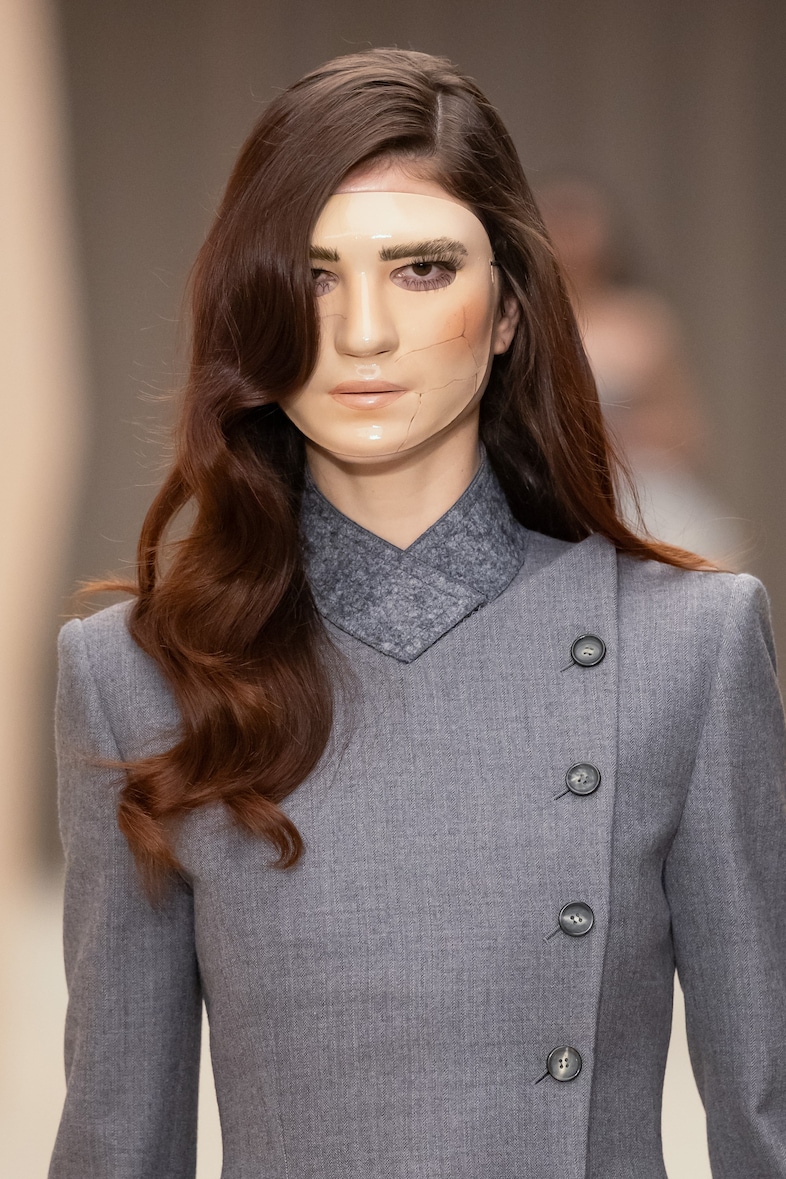
On 12 March 2026, Dazed published an account of the AW26 runways: London and Paris were full of masks that season. Saul Nash titled his collection Masquerade. At Alexander McQueen, Seán McGirr sent models out with porcelain replicas of their own faces, the glaze cracking and flaking at the edges. The Paris label Matières Fécales called its collection The 1% and taped dollar bills over the models’ eyes with no slits cut, blinding them for the length of the walk. The standfirst on that piece asked who can afford anonymity in 2026.
The American legislation ran the other way over the same months. In March, Washington became the first state to bar federal immigration agents from masking. New Jersey governor Mikie Sherrill signed a comparable measure requiring officers to show an identifiable face during certain public interactions. California moved earlier still, and on 22 April the Ninth Circuit blocked its mandatory-identification law pending appeal, holding that it directly regulated the federal government and was likely unconstitutional. Newsweek counts legislation restricting law-enforcement face coverings filed in more than thirty states since last year.
Parliament gave final approval on 17 July; Amnesty International Portugal condemned the vote the same day. The president signed on 19 August and Euronews reported the law in force on 20 August. Stacked together these entries show a fairly clean shift: the face moving from a physical feature into an object whose conditions of display are set by statute. The direction of the statute can be reversed entirely while the justifying word stays the same.
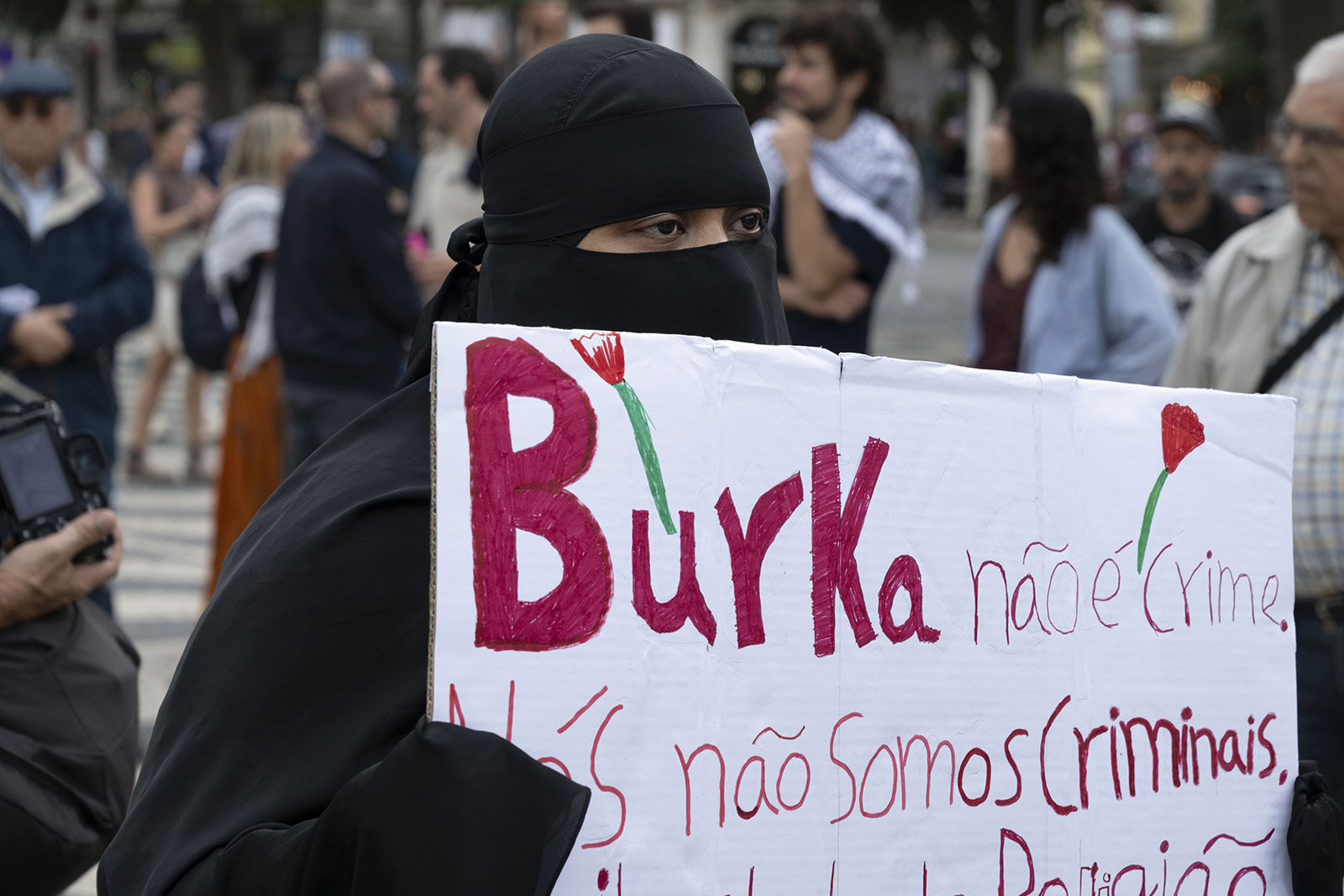
A demonstration in central Lisbon against Portugal’s niqab and burqa ban, October 2025. Photograph by Jorge Castellanos/SOPA Images/LightRocket via Getty Images. Published by Hyphen (2025-12-17).
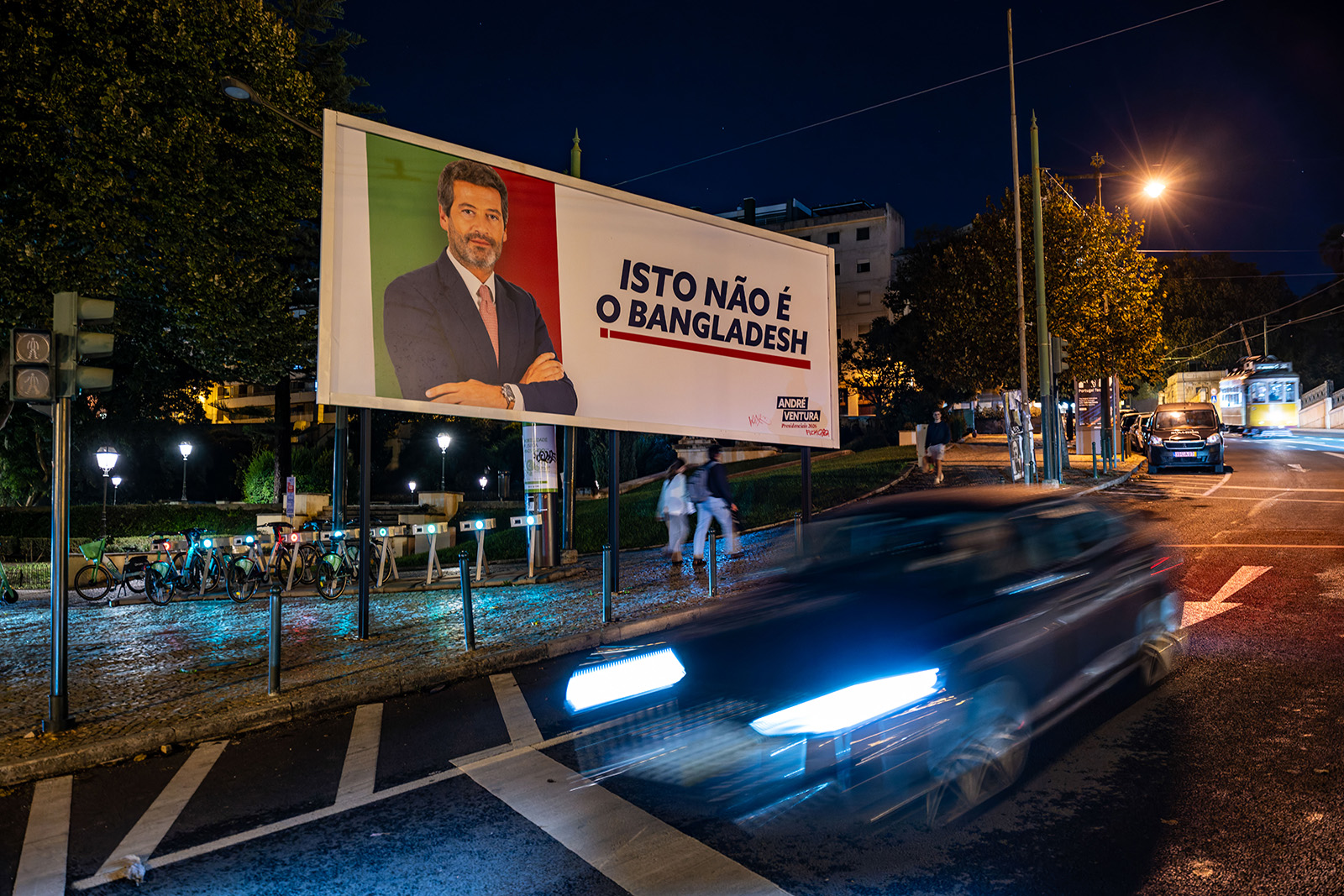
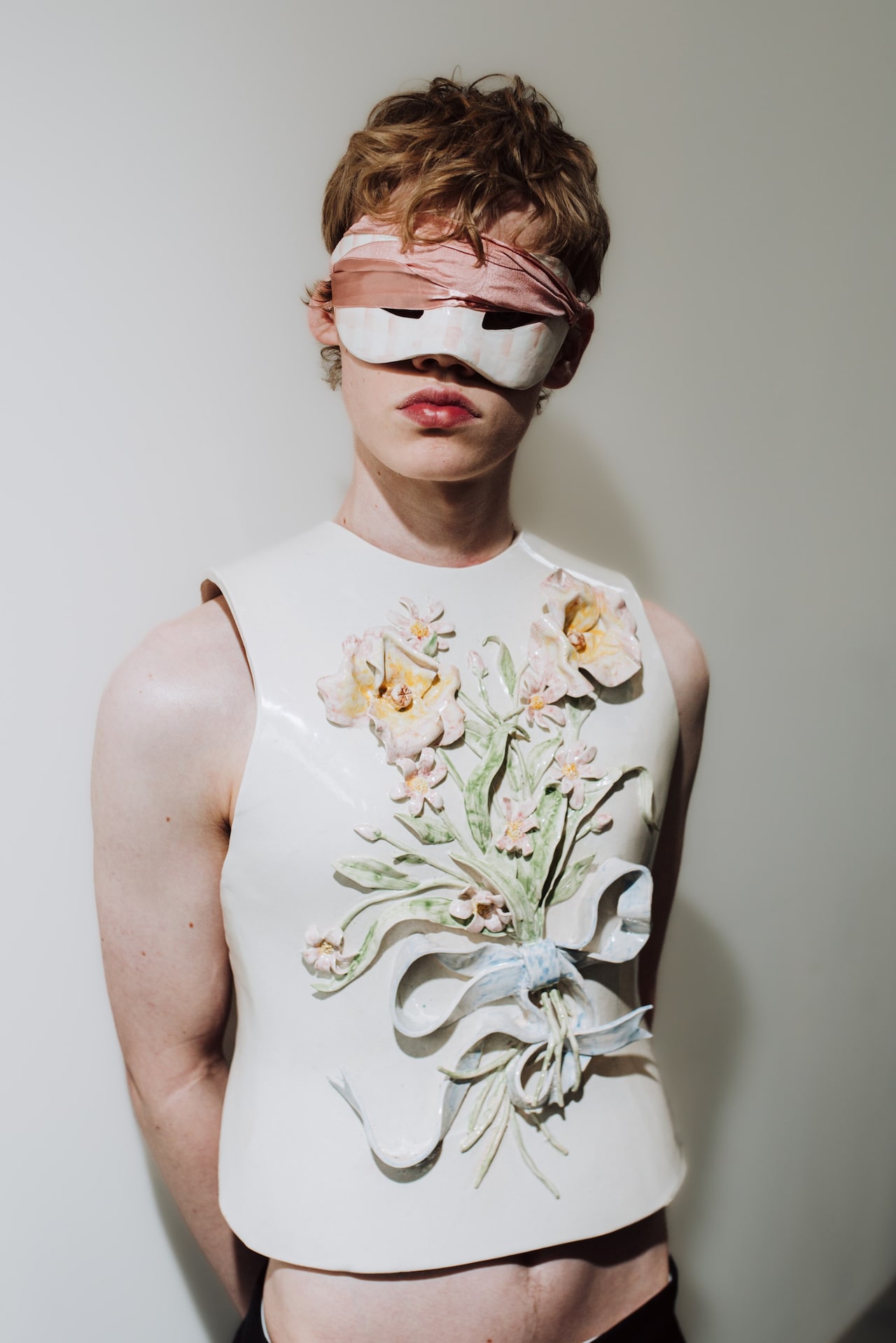
Left to right: a presidential campaign billboard for André Ventura reading “This is not Bangladesh” (Photograph by Horacio Villalobos/Corbis via Getty Images, published by Hyphen); masks on the AW26 runway (Photography Eric Aydin-Barberini, published by Dazed 2026-03-12); McQueen AW26 (Courtesy of McQueen).
2025.10.17
Chega’s face-veil bill clears its first vote in the Portuguese parliament. Left parties vote against; Livre accuses the right of hypocrisy and of running the debate in a biased manner
2025.12
Hyphen reports from Lisbon’s Muslim community. The 2021 census counts 36,000 Muslims nationwide; Zohra Lodhia can count the niqab wearers she has met on her fingers, and has seen no burqa
2026.03.12
Dazed records the AW26 mask season: Saul Nash’s Masquerade, McQueen’s porcelain faces, Matières Fécales’ The 1% with dollar bills taped over the models’ eyes
2026.03–06
Washington becomes the first state to bar law-enforcement masking; New Jersey follows. Newsweek counts comparable bills filed in more than thirty states
2026.04.22
The Ninth Circuit blocks California’s mandatory-identification law pending appeal, holding that it directly regulates the federal government and is likely unconstitutional
2026.07.17 → 08.20
Final approval in parliament, condemned by Amnesty the same day. President Seguro signs on 19 August; in force 20 August. Fines €150–3,000, with a schedule of exemptions
01Community Voices
Verbatim: nine statements, from a Lisbon street to a Paris backstage
All nine are reproduced word for word. They come from Hyphen’s interviews with Lisbon’s Muslim community, from the Chega leader’s remarks in parliamentary debate, from a statement by the executive director of Amnesty International Portugal, from the acting director of US Immigration and Customs Enforcement, and from designer quotes and show notes collected by Dazed at the AW26 shows. The order runs roughly outward from the people the law lands on first.
Hyphen · interviewZohra Lodhia
I can count with my fingers how many people wear the niqab. The burqa? I haven’t seen one.
Hyphen · interviewZohra Lodhia
There is a law already, that within some places, you have to show your face. If you go to the bank, you have to show your face. This [new] law is just to make noise.
Hyphen · interviewZohra Lodhia
I’m not worried as a Muslim woman. I’m worried as a Portuguese person who sees her rights being taken.
Hyphen · interview, Bangladeshi community leaderRana Taslim Uddin
People are thinking that maybe one day Muslims will have to leave.
Hyphen · interview, author of Portugal DecodedDiogo Lemos
If you start talking about the tax system, that’s boring and technical. If you start talking about the burqa ban, that gets the conversation going.
Portuguese parliament · Chega leaderAndré Ventura
We today protect female members of parliament, your daughters, our daughters, from having to use burqas in this country one day.
Amnesty International Portugal · executive directorJoão Godinho Martins
This new law is discriminatory and is a threat to human rights.
US Immigration and Customs Enforcement · acting directorTodd Lyons
People are out there taking photos of their names, of their faces, and posting them online with death threats to their family and themselves.
Dazed · AW26 show notesSeán McGirr
We’re always on; always curating, consuming, performing and being watched. More and more, we crave something intimate, visceral and real.
Context: no two of these nine are discussing the same subject, and all nine lean on the same noun. Lodhia’s three statements move steadily outward — first scale (almost nobody wears it), then the law that already exists (a bank has always asked you to show your face), then a change of standpoint entirely, filing her worry under Portuguese rather than Muslim. Uddin’s single line records the air inside a community. Lemos supplies the mechanics: tax policy empties a room, a veil ban gets the old men in the cafés talking. Ventura lines up the people being protected, from female MPs to “our daughters”, and the women who actually wear a veil do not appear on the list. Martins is the institutional objection. Lyons arrives from an entirely different political direction with a familiar reason: photographed, posted, traced to a family address. McGirr closes the sequence describing exhaustion at being seen, and answers it by handing models their own faces to carry. This record leaves the question of who is closest to the facts open.
02Consensus Mapping
Four narratives: official, community, emerging, contrarian
Official Narrative
The official account turns on identifiability. Portugal’s text names no religion; it prohibits clothing intended to conceal the face or obstruct its display, and in the same breath prohibits anyone from forcing another person to cover their face on grounds of gender, religion, age or origin. On paper it is a neutral statute about safety and autonomy. Chega’s André Ventura framed it in debate as protection, listing the protected from female MPs through to “our daughters”. The American language runs almost identically: officers must be identifiable, because accountability requires a visible face. Both bodies of law rest on one shared premise — an exposed face makes a person answerable.
Community Narrative
The people the statute lands on mostly answer with proportion. Lodhia points out that almost nobody in Portugal wears a burqa, and that the situations requiring a visible face were already regulated; a bank is her example. She calls the new law noise. Amnesty’s João Godinho Martins calls it discriminatory and a threat to human rights, warning that a blanket ban is likely to push the women who choose to cover further out of public life, with harder access to education, employment and public services. Uddin’s line about Muslims one day having to leave records atmospheric pressure rather than statutory detail. The thrust of this version: the text reads neutral, the impact lands narrow.
Emerging Narrative
A newer reading puts the weight on the exemption schedule. Concealment stays lawful for health, professional need, artistic work, extreme weather, inside places of worship, on diplomatic premises and aboard aircraft. Read straight, that list handles edge cases. Read backwards, it is an allocation table specifying which roles may go unread. Matières Fécales named their collection The 1% and taped currency over the models’ eyes for precisely this reason: anonymity carries a price. Dazed recorded a smaller detail in the same piece — Oscar Ouyang found that when he told established models they would be masked, their agents objected. In that industry a face is an asset, and covering it registers as a cost. Same cloth, different room, different accounting.
Contrarian Narrative
The sharpest objections arrive from two directions. One deflates the politics: Diogo Lemos observes that nobody wants to hear about the tax system while a veil ban gets a café talking, which makes a law touching a few dozen people legible as cheap attention engineering rather than religious conflict. The second is harder to file, and sits on the American side. Todd Lyons defends masked agents by citing photographs, posts and threats reaching an officer’s family — the same fear of being identified, sorted into an entirely different legal category depending on who is voicing it. If the legitimacy of anonymity depends on the speaker, how much of the neutral standard survives?
03Cultural Signal Extraction
Signal breakdown: six angles
What Changed?
The face moved from a physical feature into an object whose display conditions are set by statute. Portugal legislates exposure; thirty-odd states legislate against concealment. Opposite directions, identical operation: whether a face is visible becomes a finable matter.
Why Are People Reacting?
The gap between the population affected and the scale of the response is wide. In a community of 36,000, the veil wearers can reportedly be counted on one hand, and the statute reaches €3,000. A gap that size invites its own questions.
What Assumptions Are Challenged?
The instinct that a covered face signals a problem is being used and undone simultaneously by both camps. The legislator demanding that agents show their faces and the legislator demanding that women show theirs are reaching for one sentence.
What Desires Are Visible?
Wanting to be seen and wanting to escape being seen both got more expensive this year. The runway sells the second. McGirr describes a craving for something intimate and real, and answers it by handing a model her own face as an accessory.
What Social Behavior Is Changing?
Covering your face is becoming an act that needs a reason prepared in advance. Health, professional, artistic, weather — those words shift from description into defence material. Deciding which box you occupy before leaving the house is a new daily motion.
Future Human Behavior?
If display conditions get itemised in law, will a middle ground appear between a bare face and a covered one — something legible to a person and illegible to a machine? Would that even count as concealment?
04INCODER’s Eye
Six lenses this archive reads through
These six themes are the standing frames INCODER checks every cultural signal against — closer to a set of lenses than a taxonomy. Change the lens and the same event grows a different meaning.
Information Culture
What the statute wants is a stable identification signal, and a face happens to be the cheapest one available — no card to issue, no reader to install, legible the moment someone walks past. Once a physical feature is administered as public infrastructure, in what sense does it remain a person’s own?
Digital Identity
Oscar Ouyang found that agents for established models did not want them behind a mask. In that industry a face is the unit of account, and covering it reads as a temporary closure. When one face doubles as ID, asset and raw material, how much of the decision to show it still belongs to the person wearing it?
Symbolic Systems
Health, professional, artistic, extreme weather, places of worship, diplomatic premises, aircraft — the exemption schedule works as a grammar, setting out the roles under which a person may go unread. The same cloth draws different verdicts in different rooms. What exactly is being judged there, the cloth or the wearer?
Dark Vitality
Uddin says people have begun to wonder whether they will have to leave one day. That is the arithmetic of the margin: stay quiet, avoid confrontation, price the exit. Lodhia went the other way, founding an association with a friend and taking the argument onto national television. Two survival strategies under one pressure — which one lasts longer?
Networked Society
Thirty-odd states filed near-identical masking bans with no central instruction, and the texts came out looking alike. Legislation propagating this way behaves much like a meme moving across platforms. If law starts replicating at internet tempo, how much local difference survives the copy?
Perception and Attention
Lemos puts it plainly: nobody wants a tax debate, a veil ban gets the café talking. An issue may get selected simply because it is easier to say out loud. Once a legislative agenda tracks discussability, where do the questions that are hard to bring up end up going?
05Signal Score
Signal strength
8/10
Scored 8. What supports it: several independent, checkable records hold this line up at once. The Portuguese law has a dated passage (17 July), signature (19 August) and commencement (20 August), with the fine range and the exemption schedule written into the text. Amnesty’s condemnation is a public document. Hyphen’s reporting preserves the words of the people affected. Dazed’s AW26 account is independent March reporting, written without reference to any of this. The American side is tracked by Newsweek and NPR, and the Ninth Circuit date on California (22 April) is a matter of record. Two statutes pointing in opposite directions while sharing one justificatory vocabulary is a structural finding rather than a national dispute. What holds it back: the link between the runway and the statute is one this archive supplied, and neither side cites the other. Enforcement data is at zero — not a single fine has been counted yet. Veil bans have been a recurring European subject for fifteen years, and this round may prove no more pivotal than France or Austria. What would raise it: a first wave of fines landing in non-religious contexts (protesters, sun protection, pollution masks); another country adopting the same neutral-text-plus-exemption-schedule construction within six months; or the European and American debates beginning to cite each other’s statutes. What would lower it: the constitutional court striking the law down, or enforcement going effectively dormant, in which case the whole cluster gets refiled as an artefact of an election cycle.
06Final Question
The deepest hidden assumption
?
A year of legislation rests on an equation nobody has taken out to inspect: a visible face equals an answerable person. If identification and accountability came apart some time ago — the machine knows exactly who you are, and there is still nobody to hold responsible — then who is a requirement to show your face actually protecting?
The equation comes from a world without cameras. In that world, recognising a face required another person to be present, to remember, and to be willing to say so out loud. Exposure produced genuine social pressure: what you did in front of a neighbour, a neighbour retained. Law inherited the instinct and installed visibility as the precondition for accountability. Portugal’s version says that entering public life means letting yourself be seen. The version moving through thirty-odd American statehouses says that exercising public power means letting yourself be seen. The two sentences have the same shape.
The connective tissue in the middle has been removed. A recognition system identifying a face and a person being answerable for a decision are two entirely separate mechanisms. A protester who shows her face is retained by a database. An officer who shows his may never be reached by any procedure at all. Visibility generates risk on one side and, on the other, perhaps only inconvenience. Lodhia had already flagged the flatter fact: the settings that require a visible face were regulated long ago, and a bank is the obvious one. What the new statute reaches are the moments where nobody was asking for identification in the first place — walking, buying groceries, taking a child to school.
The open thread this record wants to keep is still that exemption schedule. Health, professional, artistic, extreme weather, places of worship, diplomatic premises, aircraft. It reads as housekeeping for edge cases. Reversed, it is a permit list: under these roles, you may go unread. McGirr handed his models their own faces to carry, glaze cracking at the edges. In Paris that image is a work. On a Lisbon street it would be a fine. If a society needs a schedule to specify who qualifies to be unidentifiable, does that schedule get longer from here, or shorter? This record has no answer for now.
Observation remains incomplete.
This report records a state of observation at one moment.
The claim that the face is becoming an object whose display conditions are set by statute currently rests on a law five days old, one rights-group statement, a multi-state legislative count, a March runway report and a set of community interviews from last winter. No enforcement data exists yet, and the link between runway and statute was supplied here. These readings may be reinforced in a few months, or overturned entirely.