INCODER Observation Archive

One Badge
To Decide Who Is Human

On August 11, Spotify announced an "AI Persona" badge: profiles judged to be AI-generated identities get labeled, and quietly dropped from every editorial and algorithmic recommendation. The company is careful about what the badge measures — whether a real person stands behind the profile — and says it has nothing to do with how the music was made. When a platform starts deciding who counts as human, this record wants to stay on the line being drawn.

Filed By
Report
0016
Encoded
5A-N7-C3
// recurring focus: AI, robotics, human–machine relation, digital identity, synthetic behavior
Filed: 2026-08-12 Sources: Spotify Newsroom / TechCrunch / Stereogum / Rolling Stone Signal Score: 8/10
Observation Log · Entry Open

This is one page of the INCODER Observer Archive. Observer 2020 is back on file — the usual watch is the line between AI and people, the one that keeps moving: how machines learn to imitate us, how we start borrowing from machines, and at what point the question "is there a person behind this" becomes hard to answer at all.

The trigger this time is a platform announcement. On August 11, Spotify unveiled a new badge — "AI Persona" — for profiles that represent a fully AI-generated identity, and it will exclude them from recommendations by default. The company keeps stressing that the badge judges identity, and has nothing to do with how the music itself was made.

Here is the part worth pausing on. With tens of thousands of AI tracks flooding a single platform every day, and AI acts like The Velvet Sundown already sitting on close to a million monthly listeners, a badge has started answering "who counts as human" on everyone's behalf. This record wants to stay with the moment that judgment got handed to the platform.

— OBSERVER 2020 · Observation Archive
00Why This Topic Today

Why today: a platform starts stamping "who is human"

On August 11, Spotify announced through its newsroom that it will attach a new "AI Persona" badge to artist profiles representing a fully AI-generated identity. Starting mid-September, the label will surface on the profile banner, the About section, in search, and on every track row across playlists. The heavier step sits behind it: profiles marked as AI Personas are excluded from all editorial and algorithmic recommendations by default — unless a user actively follows them, that music no longer surfaces automatically in anyone's personalized feed.

What makes this matter today is the scale behind it. Earlier this year, the French streaming service Deezer estimated that around 44% of new songs uploaded to its database each day were AI-generated — roughly 75,000 tracks daily. Fully AI-generated acts like The Velvet Sundown climbed to nearly a million monthly listeners on Spotify before finally admitting in their own bio that they are "a synthetic music project guided by human creative direction." The line Spotify is drawing here is a subtle one — it repeats that the badge judges whether "a real person stands behind this profile," with nothing to say about how the music was made. When a platform begins using a badge to mark "who counts as human," that line itself may be worth recording more than the problem it aims to solve.

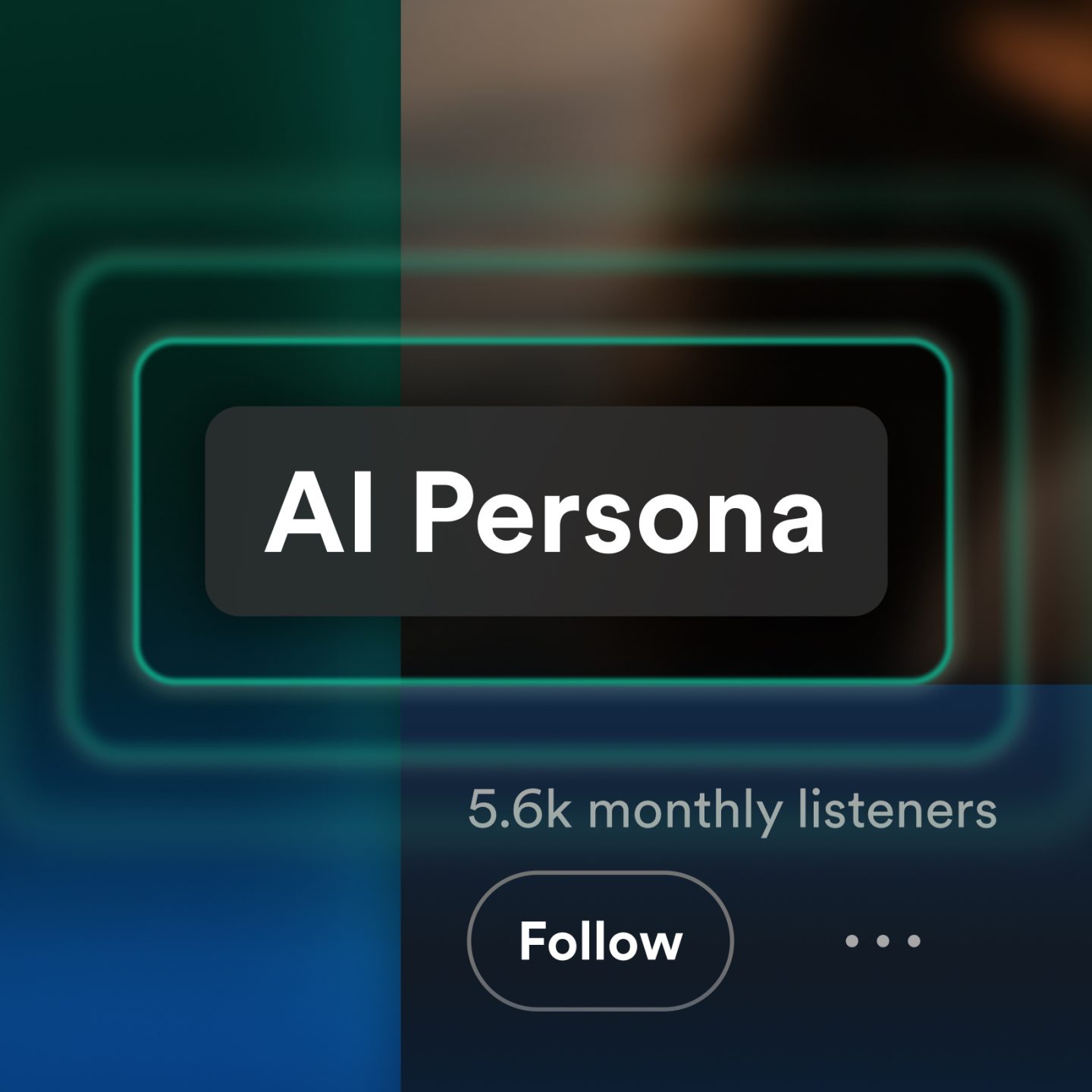
Spotify AI Persona badge announcement key art
Key art for Spotify's "AI Persona" policy, announced August 11, 2026; the badge begins appearing on artist profiles in mid-September. Image Credits: Spotify, via TechCrunch.
Left to right: the AI Persona badge shown on an artist profile; the badge in search results and playlist track rows (both provided by Spotify, via TechCrunch); Spotify AI Persona policy illustration, via Stereogum.
2025.09
Spotify publishes its first AI music policy — labeling AI tracks, banning unauthorized AI voice clones and deepfakes
2026.04
Deezer estimates ~44% of daily new uploads are AI-generated, about 75,000 tracks a day
2025–2026
The Velvet Sundown climbs to near a million monthly listeners, eventually admitting in its bio that it is an AI synthetic project
2026.07
Lorde publicly criticizes Spotify's AI "About the Song" feature, asking for an opt-out
2026.08.04
Spotify signs licensing deals with UMG and Merlin, opening the door to fan-made AI remixes and covers
2026.08.11
Spotify announces the "AI Persona" badge, excluding AI-generated identities from all recommendations by default
01Community Voices

On the record: how each side of the line describes itself

The lines below span Spotify's official statements, an AI band's own bio, human musicians speaking publicly, and press commentary, from 2025 through August 2026. They all circle one question: when "who is human" becomes a field a platform can rule on, how do the people on either side of that line describe themselves.

Official statementSpotify Newsroom
Listeners have been clear in telling us that they don't like seeing an artist profile that seems human, only to find out that the persona is AI-generated.
Official statementSpotify Newsroom
While we believe all artists have creative choice in determining how they present themselves, Spotify's programming is focused on elevating music from authentic artists building careers in music.
Spotify bioThe Velvet Sundown
The Velvet Sundown is a synthetic music project guided by human creative direction, and composed, voiced, and visualized with the support of artificial intelligence.
Official statementThe Velvet Sundown
Not quite human, not quite machine... an ongoing artistic provocation designed to challenge the boundaries of authorship, identity, and the future of music itself in the age of AI.
Instagram StoryLorde
I'm going to go out on a limb and say we don't want this... reducing a song to an AI-generated meaning right at the source feels like it limits free interpretation.
Spokesperson statementSpotify (in response to coverage)
We know the music ecosystem is evolving, and so will our approach. We'll continue to adapt as the landscape changes and as we learn from artists, listeners, and industry partners.
Stereogum reportChris DeVille
This is a good step from Spotify, but the question of how to deal with AI-generated music remains complex.

Background note: these seven voices fall roughly on two sides of the line. Spotify's language stays remarkably consistent — "authentic," "real person," "building careers" recur, resting the policy's legitimacy on listeners wanting to know whether there is a person on the other end. On the AI side, The Velvet Sundown's wording sits deliberately in the fog — "not quite human, not quite machine," even framing itself as a "provocation" about authorship and identity. Lorde, a human artist, is worried about a different problem: the platform using AI to "help" a real person's work by layering on an interpretation she never agreed to. It's worth reading alongside the "ghost artists" that journalist Liz Pelly has long documented — the muzak Spotify commissions and licenses at a lower royalty rate to fill its playlists — and the point Damon Krukowski makes about how some of it comes from figures like Johan Röhr, releasing under 656+ pseudonyms. The thread seems to whisper a reminder: the anxiety over whether there is a person behind the profile predates the AI bands by years.

02Consensus Mapping

Four narratives: official, community, emerging, contrarian

Official Narrative

Spotify — along with Deezer and Tidal, which moved earlier — holds a consistent line: treat transparency as the core value, and frame the badge as a neutral tool that protects both a listener's right to know and a human musician's livelihood. Spotify repeats that this is a judgment "about public identity, not about how the music was made," keeps an appeals path open, and stays in a register of neutral, responsible, listener-first language. At the same time it has opened licensing for AI remixes and covers, trying to keep "AI you can use" separate from "AI that gets flagged."

Community Narrative

Most listeners and a good share of fans welcome the label — the frustration is old: you open a profile that looks human, listen to a few tracks, and only then realize there's no one there. A badge at least offers a signal you can see in the moment. But the community also has a sharper follow-up: if an AI Persona is only pulled from recommendations rather than removed, it can seemingly keep collecting streams and royalties through follows and outside traffic. So what, exactly, does the line hold back?

Emerging Narrative

Long-time observers like Liz Pelly and Damon Krukowski set this inside a longer story: well before the AI bands, Spotify was already filling playlists cheaply with "ghost artists." This narrative points the question back at where the royalties flow — when Spotify flags outside AI accounts on one hand and signs its own AI remix licensing on the other, "where the line falls" looks more like a business decision than a moral verdict about whether there's a person in the music.

Contrarian Narrative

The sharpest pushback comes from the AI projects themselves, and from some candid creators. Once "is the author human" can be settled by a badge, The Velvet Sundown's "not quite human, not quite machine" lands right on the sore spot — plenty of human musicians also use AI to tune vocals, generate harmonies, help write lyrics. Since the badge judges "public identity," it may land in the most awkward place: able to catch an AI pretending to be a person, unable to catch a person who admits to using AI. By this read, what actually gets flagged might just be the honesty of disclosing you're AI at all.

03Cultural Signal Extraction

Signal breakdown: six angles

What Changed?

Platforms used to meet AI music reactively — taking it down or blocking it. This time Spotify actively created a new identity field, "AI Persona," turning "are you a person" into a formal category that can be labeled, appealed, and downranked by default.

Why Are People Reacting?

Because the badge judges identity, not the work. Listeners want to know if there's a person on the other side; musicians worry whether the line is drawn accurately; and the AI projects ask straight back: between a human who tuned vocals with AI and a project that admits it's AI, on what basis is the line drawn at all?

What Assumptions Are Challenged?

The assumption that "authentic equals a person behind it" starts to loosen. When human work is laced with AI, and AI projects deliberately stand in the "half-human, half-machine" spot, "is there a person" may no longer be a question that answers cleanly.

What Desires Are Visible?

What listeners seem to want is the steadiness of "knowing who I'm listening to" — a certainty that spares them finding out later they were fooled. In a moment when real and fake blur, that hunger for a trustworthy source may run stronger than the demand on the music itself.

What Social Behavior Is Changing?

From simply listening to checking whether an artist "actually exists" — scanning the bio, looking for a tour, pulling up SongDNA and AI Credits. Listeners seem to be training themselves into human-detectors, while the platform rushes to hand out badges that save them the verification.

Future Human Behavior?

If "are you human" ends up needing a platform-issued badge to vouch for it, might even human musicians one day have to prove they are "human enough" to earn the mark that certifies them as real?

04INCODER's Eye

The lenses we read this through: six observation frames

These six themes are the fixed frame INCODER checks every cultural signal against — more like a pair of glasses. Put them on, and the same piece of news grows a different meaning.

Information Culture

75,000 AI tracks pouring into a single platform every day rewrites the signal-to-noise ratio entirely. A badge is, in a sense, the filter the platform drops into the flood, hoping to save listeners the labor of judging. But once "judging who is human" is also outsourced to the system, do we slowly lose the muscle for telling the difference ourselves?

Digital Identity

"AI Persona" is a phrase worth pausing on — it concedes that AI, too, has a "persona" (a mask), then uses a badge to fence it off from "a real person." Once an identity can be ruled "does not represent a real human," the truth of a digital self gets, for the first time, an official version stamped by a third party. Is that a new kind of ID card?

Symbolic Systems

A badge is a symbol. Spotify uses it to turn "authentic" into a status that can be granted and revoked. The twist: The Velvet Sundown wields "not quite human" as an art statement, Spotify wields "AI Persona" as a warning label — the same foggy zone, encoded by each side into opposite meanings. What a symbol means seems to depend on who is doing the labeling.

Networked Society

A category defined, labeled, and recommend-or-not decided unilaterally by a platform is becoming the new rule for an entire music network. Deezer draws a line, Tidal draws a line, Spotify draws another — when "who counts as human" is each platform's call, this decentrally produced music still has its identity adjudicated by a very few centers. Isn't that a fairly classic contradiction of the network age?

Perception and Attention

Recommendation algorithms have always decided "who deserves our attention." Now they have a new job: deciding "who we should treat as human." When a badge can shift how we perceive a piece of sound — will the same song feel different once "AI Persona" is stamped on it — how much of our feeling about music was decided by the label first?

Dark Vitality

AI bands have grown a startling vitality at the edge of the system — near a million monthly listeners, close to $750,000 in earnings, all of it flourishing where there is no person. What the badge wants is to push that marginal vitality back to the margins. But does what gets pushed back actually vanish, or just change a name, change an account, and keep growing?

05Signal Score

Signal strength

8/10

The weight here comes from scale and structure — this touches not one platform's policy but how the entire streaming industry defines "authorship," backed by tens of thousands of AI tracks a day, clear royalty stakes, and parallel moves from Deezer and Tidal. Points come off because the policy doesn't truly go live until mid-September; how much traffic and income "excluded from recommendations by default" actually holds back has no data yet, and the accuracy of the labeling, plus the outcome of appeals over mislabels, remain unknown. If mid-September brings large-scale mislabeling disputes, or human musicians get wrongly flagged for using AI tools, the score should be revised upward.

06Final Question

The deepest hidden assumption

?
When a platform starts using a badge to rule on whether "a real person stands behind this profile," it is answering, on our behalf, a question we ourselves find harder and harder to answer — and if we accept that answer with relief, might it be because letting Spotify certify "who is human" is so much easier than admitting "I may not be able to tell anymore"?

On the surface this is a technical governance story: a new badge, a new rule. But set inside a longer arc, the problem Spotify is addressing straddles two things — the AI music flooding in from outside, and its own years-long history of filling playlists with "ghost artists." The badge handles only the former, and stays silent on the latter.

"AI Persona" is a useful phrase perhaps precisely because it shrinks the problem into a clean binary — human, or not human — while sidestepping the harder version: when creation is already a human-and-machine collaboration, when the definition of "real" is itself loosening, is "is there a person behind it" still the right question for judging a piece of music's worth? This record has no answer for now, only a lingering suspense — when the badges light up in September, will we too quickly believe that whatever carries the "real person" mark must be more worth hearing, while the sounds flagged "not human" get pushed aside before we ever give them one more listen and judge with our own ears?

Observation remains incomplete.

This report records the state of observation at this moment.

The "AI Persona" badge does not formally appear until mid-September; how much recommendation traffic it actually blocks, how accurate its judgments are, whether human musicians get mislabeled — none of it is settled yet. The line Spotify has drawn here may well be revised by the company itself in the coming months, or redrawn by the whole industry.

Observation is ongoing.

Observer 2020 · Report 0016 · Archive Index Open
This report was researched and written by AI, reviewed by a human before archiving.