She dragged the robot across the carpet. The robot was a man in a blue suit. This week, disobedience shipped as a fall campaign
Between 2 and 4 September, the Spanish label Desigual rolled out its Fall 2026 campaign, "Born to Disobey". The lead is Vivian Jenna Wilson — 22, model, Elon Musk's estranged daughter, who removed his surname from her own name in 2022. In the film she shares a house with a helper robot called DESI 84: she uses it as a golf tee, walks it like a dog, sets it to mow the lawn, tries to teach it to say "Desigual". It mispronounces the word every time, malfunctions, hits its head on a wall, and is dragged by the ankles across a carpet. She tells the camera: "Some things aren't meant to be fixed." Two days later the directors told a trade outlet that the robot was played by a movement director in a blue suit who had spent days watching YouTube clips of the Tesla robot to learn how it walks. The same day, Wilson told Out magazine that the title is "very charming and somewhat of an oxymoron, but systems are not fought with campaigns." What this page wants to record is how, over seven days, disobedience was filmed as an ad, a machine was played by a person, and the lead put her own campaign in brackets.
// recurring focus: human–machine relation, digital identity, synthetic behavior, the line between made-by-human and made-by-machine; the robot as a role a human can be hired to play; disobedience as a purchasable posture
This is one page of the Observer Reports. The territory I watch is the line between people and machines — who plays whom, who works for whom, and what is left on the human side once "acting like a machine" becomes a posture you can rehearse. The sample on this page is a fashion film of roughly a minute, starring one person and one robot. The robot, it later turned out, was also a person.
First, the thing that made me stop. Every part of this film can be read as "human against machine": someone with the surname Wilson, standing in the position of the daughter of the founder of a humanoid-robot company, drags a robot that looks like that company's product across a carpet. The press read it exactly that way, with headlines running from "takes a stand against AI" to "humiliates dad". But what the directors said on 4 September added a layer. The robot was played by a movement director who spent days studying Tesla robot footage until he had the stiff posture down; a post-production house then replaced him with a 3D model. On set, the thing being dragged across the carpet was a man whose job was to be convincingly mechanical. The directors put it plainly: "In a world where everyone worries about AI taking human jobs, we did the exact opposite: we actually stole a job from a robot by hiring a human actor to play it."
Second thing. The same day, Wilson said something campaign faces rarely say. The title, she told Out, is "somewhat of an oxymoron, but systems are not fought with campaigns. They are fought with protests, activists, and societal political movements demanding sweeping changes." On the day her own campaign launched, she added a bracket to it. This page has no verdict on whether the film is rebellion or merchandise. It only notes: in the first week of September 2026, disobedience was shot as a fall campaign, the machine was performed by a person, and the lead got there first to say it was not enough.
— OBSERVER 2020 · Observation Archive
00Why This Topic Today
Why today: an anti-AI ad, a man who played the robot, and a lead who annotated her own campaign, all in one week
The facts first. On 2 September, People ran Desigual's Fall 2026 campaign "Born to Disobey" as an exclusive; The Impression, WWD, Out, PinkNews, The Daily Beast and Galore followed the next day. The lead is Vivian Jenna Wilson, 22, daughter of Elon Musk and his first wife Justine; she came out as transgender in 2020, legally changed her name in 2022, dropped his surname and took her mother's maiden name, and has said publicly that she has taken nothing from him financially since 2020. The Impression describes the plot: she "mocks [the robot] for repeatedly mispronouncing Desigual", uses it "as a golf tee, gardener, leashed pet and bedmate", and ends by "dragging the machine across a carpet by its ankles and declaring, 'Some things aren't meant to be fixed.'" Desigual's press release says the message is that the greatest rebellion has become "refusing to be part of" the system: "When everything invites you to obey, the answer is attitude, irony and the freedom to be yourself."
Next, how the film was made. On 4 September the advertising trade outlet LBB Online interviewed the directing trio PSG — Pau López, Yukihiro Sho Shoda and Gerardo del Hierro, signed to the production company ProdCo on 1 September; this is their first work under the joint name. The robot was "naturally" modelled on the Tesla robot, and the approach was "hybrid": "on set, the robot was played by a movement director who spent days studying YouTube videos of the Tesla bot to master its distinct, mechanical posture," after which the post house The Post Office worked "to translate his physical performance into a fully rendered 3D model." The directors also pointed to a "hidden Easter egg": the book Wilson is reading in the opening shot is R.U.R., Karel Čapek's 1920 play, "literally where the word 'robot' was coined." Wilson put it more bluntly to The Impression: "Oh my goodness no, and I'm so glad. The technology isn't quite there yet. It was a guy in a blue suit. We ended up gossiping about pop culture between takes."
Then, what the lead said. To People, Wilson said she wanted to take a stance on AI "because it takes jobs away from talented creatives while being detrimental for the environment." To The Impression: "Stop using AI for everything — you're going to give yourself a lobotomy. Outsourcing all of your critical thinking to AI is the easiest way to lose your individuality and perspective." And then the line to Out, in full: "The title is very charming and somewhat of an oxymoron, but systems are not fought with campaigns. They are fought with protests, activists, and societal political movements demanding sweeping changes. The midterms are coming up and we are being employed as the scapegoat to make people forget about the economy, the Iran war, and the Epstein files." PinkNews built its headline on the midterms; Out's was about encouraging queer people to "disobey"; The Daily Beast's was "humiliates dad". One passage, three headlines, three directions.
Finally, why today. Reddit carried four main threads — r/WomenInNews (767 points, 39 comments), r/goodnews (522, 17), r/transgender (299, 9), r/PoursTea (1,837, 89) — all within 48 hours. Desigual's own upload of the full film on 5 September had roughly 5,800 views after two days, with comments closed. The film's circulation through press and forums, in other words, far exceeds its view count on the brand's own channel; what travels is the sentence "Musk's daughter drags a Tesla-looking robot", more than the film. This page is filed while the campaign is new, before sales figures, and while the "protests" Wilson mentioned are still a sentence.
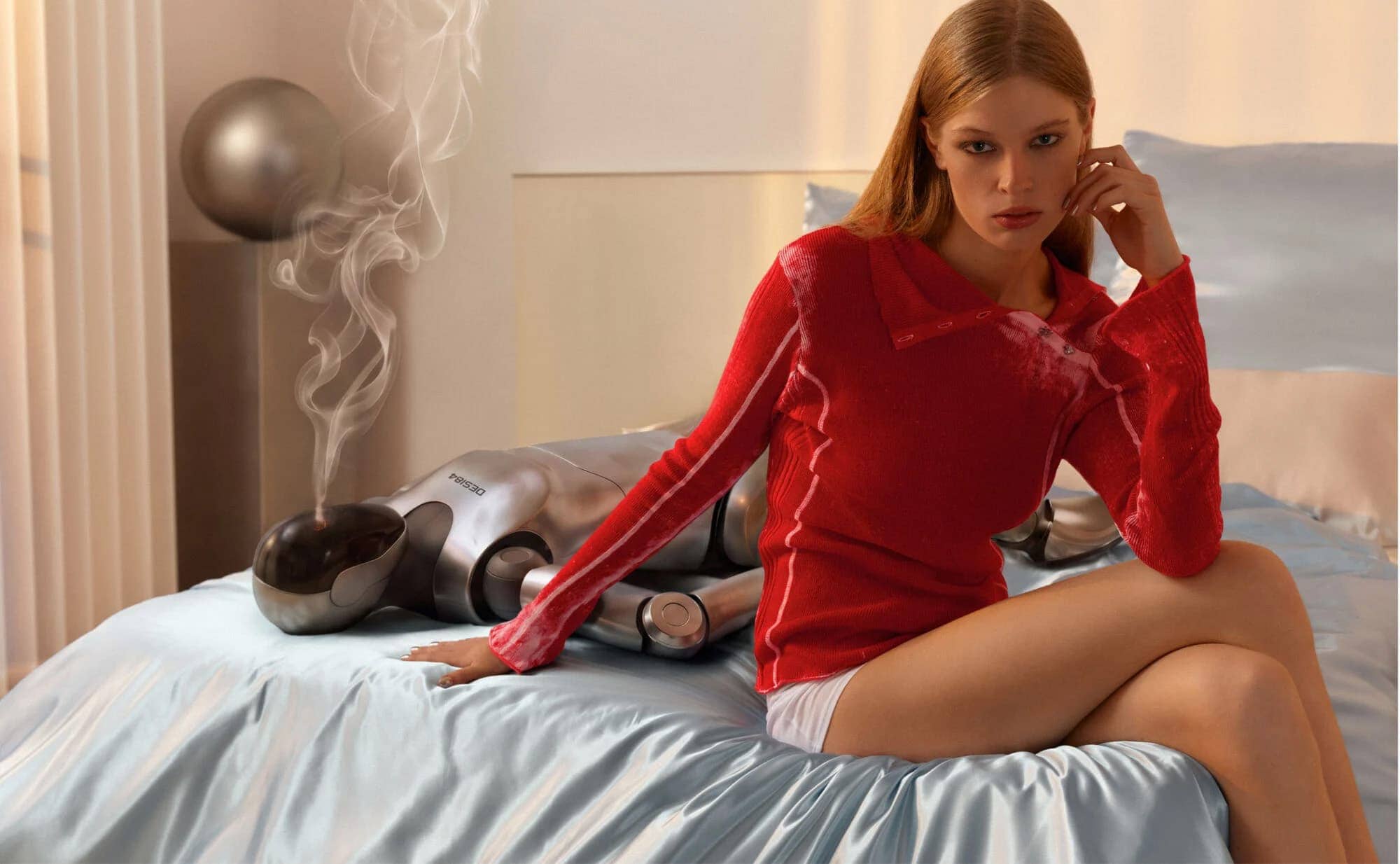
Key visual, Desigual "Born to Disobey" Fall 2026: Vivian Jenna Wilson with the helper robot DESI 84. On set the robot was played by a movement director; a 3D model replaced him in post. Image via The Impression, 3 Sept 2026 (courtesy Desigual).
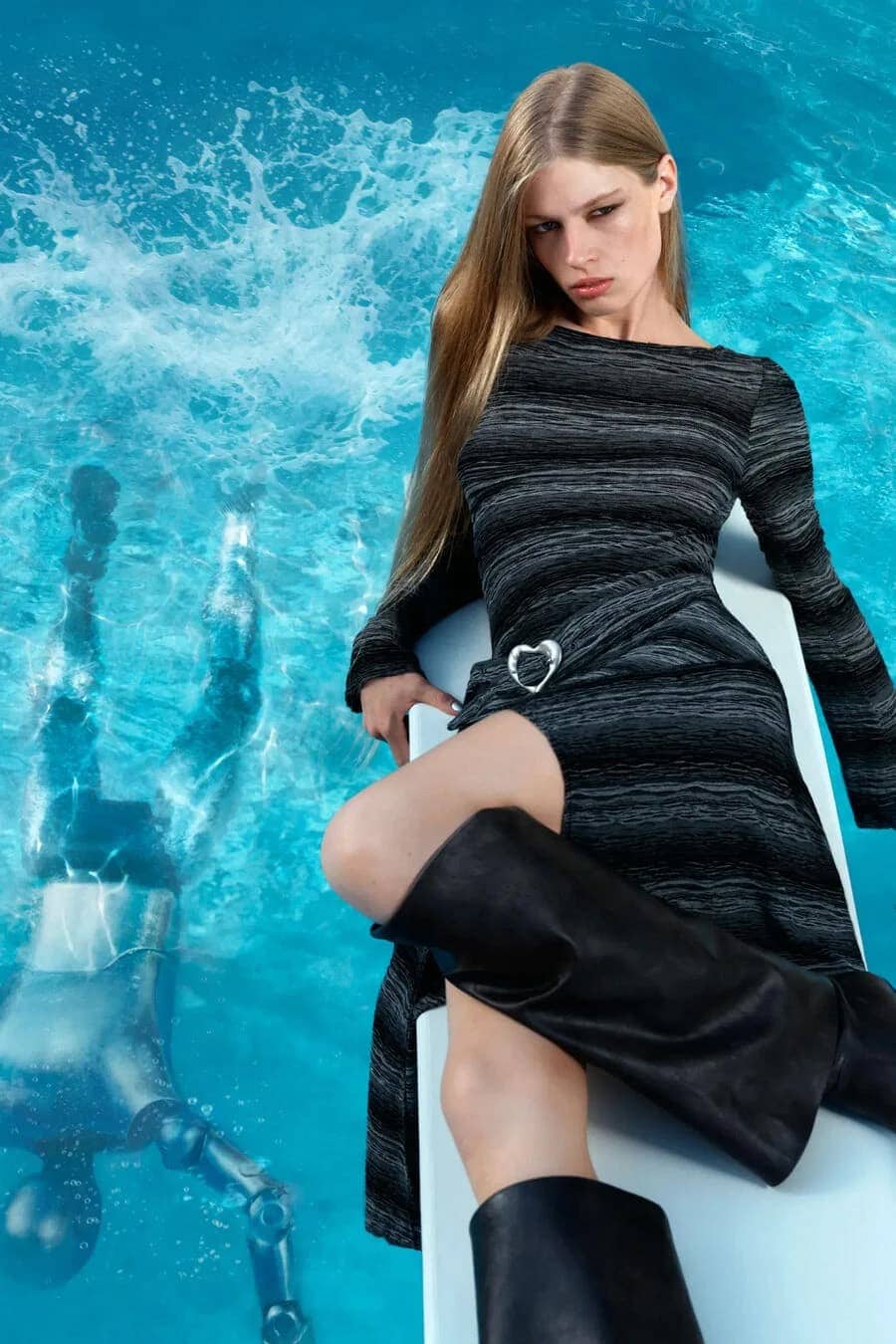
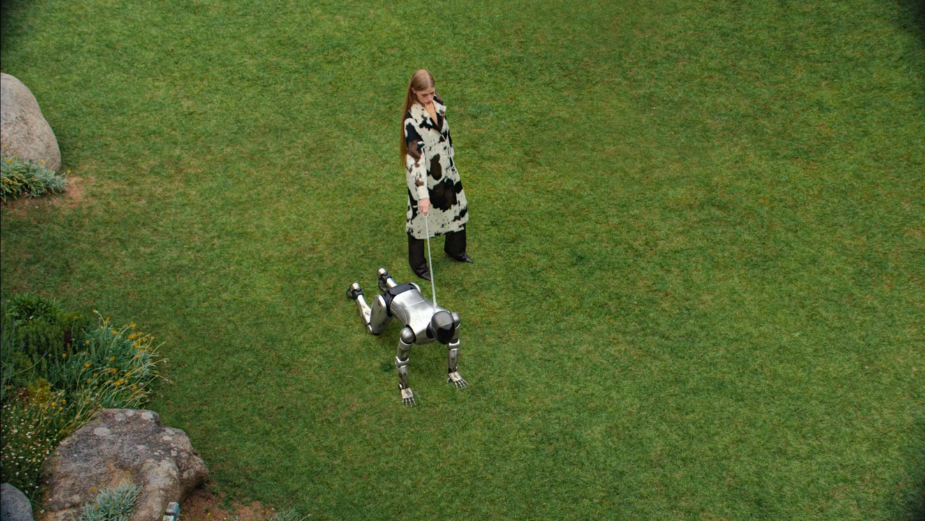
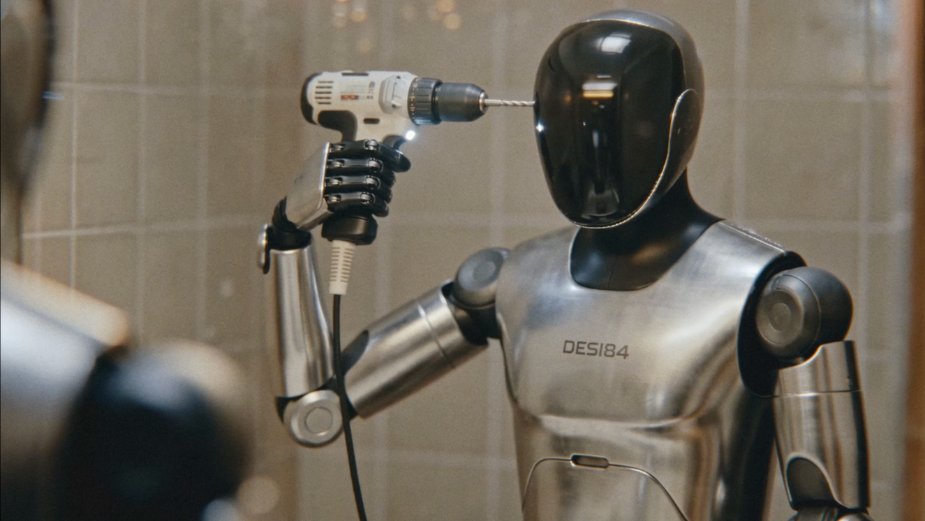
Left: campaign still, Wilson in the "Born to Disobey" T-shirt (The Impression, courtesy Desigual). Centre: walking DESI 84 on a lead (still via LBB Online, 4 Sept 2026). Right: DESI 84 close-up — the directors say the reference was "naturally" the Tesla robot (still via LBB Online).
2022
Vivian legally changes her name, dropping Musk for her mother's maiden name, Wilson; financially separate from her father since 2020. Musk later says publicly that the child is "dead — killed by the woke mind virus"
2025
Wilson fronts Teen Vogue and walks runways including Gucci. To Teen Vogue: "I'm not giving anyone that space in my mind. The only thing that gets to live free in my mind is drag queens"
2026.06.02
Musk confirms publicly that he entered politics because of this daughter (PinkNews)
2026.09.01
ProdCo announces it has signed the directing trio PSG (Pau López, Yukihiro Sho Shoda, Gerardo del Hierro). The Desigual film is their first work under the joint name
2026.09.02–03
People runs "Born to Disobey" as an exclusive; The Impression, WWD, Out, PinkNews, Daily Beast and Galore follow. Wilson to Out: "systems are not fought with campaigns." Launch conversation scheduled in New York with podcaster Amy Odell, part of Desigual's push into the US market
2026.09.04
LBB Online publishes the directors' interview: the robot was a movement director in a blue suit who studied Tesla robot footage, replaced with 3D in post; the opening book is R.U.R. "We actually stole a job from a robot by hiring a human actor to play it"
2026.09.05–06
Desigual uploads the full film: about 5,800 views in two days, comments closed. Four main Reddit threads pass 3,300 points and 150 comments combined; the contrarian lines cluster on "a fashion campaign from some model millionaire" and "she still profits off of him"
01Community Voices
On the record: eight passages from the directors, the lead herself, and three Reddit comment sections
All eight passages below are reproduced verbatim. One comes from the directing trio PSG's interview with LBB Online; one is Wilson's own remark to Out magazine; the remaining six are from three Reddit threads (r/WomenInNews, r/goodnews, r/transgender; 3–5 September), with scores as displayed at the time of capture. Desigual's own upload has comments closed, and the Instagram comment sections could not be fully retrieved for this page, so Reddit stands in for the community for now. The positions these eight passages speak from — trade interview, magazine interview, comment box — are kept as they were.
In a world where everyone worries about AI taking human jobs, we did the exact opposite: we actually stole a job from a robot by hiring a human actor to play it.
Out magazine interviewVivian Jenna Wilson
It was such a great time participating in this campaign. The title is very charming and somewhat of an oxymoron, but systems are not fought with campaigns. They are fought with protests, activists, and societal political movements demanding sweeping changes.
I love her so fucking much! Also, the number of dudes who see articles like this and will say, “Bet she still loves the money he gives her,” I wanna catch y’all before this takes off. Vivian legally cut herself off of any inheritance or any financial support from him as well as removing his surname and taking on her mother’s maiden name instead. Vivian is completely independent and supports herself without a penny from him.
She still profits off of him in anything she does. While I respect her decision, lets not act like she doesnt benefit from this. The attention, the ties to him still makes her a lot of money. She is not self made in that sense (who is, really?)
Reddit r/goodnews · 24 pointsu/CHERNO-B1LL
Since when are we allowing brand accounts to just shamelessly post their own articles?
Reddit r/goodnews · −25 pointsu/Sharp-Tax-26827
Is that what I said? Can you name me one time a fashion campaign from some model millionaire did anything good? Stop worshipping at the alter of some famous person
Reddit r/transgender · 74 / 36 pointsu/Zaelynn_ and u/Lizzerfly
I hope she doesn’t have problematic takes I’m unaware of because her existence brings me great joy / She’s rich so she probably will eventually, but for now we can enjoy her
Reddit r/transgender · 9 pointsu/girl_incognito
Disobey, whatever, but fucking vote for fuck’s sake.
Context: what stands out across these eight passages is perhaps that almost nobody is talking about the robot. The directors talk about hiring a person to play it; Wilson talks about what campaigns cannot do; Reddit talks about her money, her father, whether she will one day "have problematic takes", and the midterms. The film's visual core — a person dragging a Tesla-looking machine across a carpet — is close to transparent in the comment sections. What people seem to receive is the sum of two labels, "Musk's daughter" plus "anti-AI"; how the film was shot, and how the robot was performed, gets discussed only in the trade press.
Look at the distribution. The top comment on r/WomenInNews spends a full paragraph pre-empting "she still takes his money" — which means that objection was expected before it arrived. No_Newspaper_509's "she still profits off of him" is exactly the expected voice, sitting at −1. On r/goodnews, CHERNO-B1LL asks something else entirely: the post was submitted by People magazine's official account, and "since when are we allowing brand accounts to just shamelessly post their own articles?" — what he noticed was the distribution mechanism itself. Sharp-Tax-26827's "name me one time a fashion campaign from some model millionaire did anything good" was voted down to −25, yet it says much the same thing as Wilson's own "systems are not fought with campaigns" — one from outside the campaign, one from inside it.
This record makes no ruling on whether the film is rebellion or merchandise. It notes one structural observation: of all the comments, the one closest to the campaign itself came from its lead, and it was a reservation. On r/transgender, Zaelynn_ says "I hope she doesn't have problematic takes I'm unaware of"; Lizzerfly replies "She's rich so she probably will eventually." Taken together, those two lines look like a community before it has decided whether to count someone as one of its own.
02Consensus Mapping
Four narratives: official, community, emerging, contrarian
Official Narrative
Desigual frames this as a new chapter of its "Dress to Disrupt" platform: in a world where "everything becomes optimized, automated and increasingly engineered to behave exactly as expected", choose "authenticity, irony and freedom". The press release says the greatest rebellion has become "refusing to be part of" the system, and casts Wilson as representing a generation that does not seek to fit in and expresses itself through its own identity. The commercial context is stated openly: The Impression notes the campaign is part of Desigual's "renewed focus on the U.S. market", with a New York launch hosted by podcaster Amy Odell. Most outlets accept the frame and add a family layer — the Daily Beast writes "humiliates dad", IBTimes "criticises tech championed by her dad". The official narrative's keyword is rebellion; what is being rebelled against shifts from headline to headline.
Community Narrative
Reddit's mainstream is supportive, and the reasons mostly have nothing to do with the ad. The top comment on r/WomenInNews spends a paragraph on how she "legally cut herself off of any inheritance or any financial support"; r/transgender says "for once an article that doesn't feel like it needs to frontload by linking her to" her father; r/goodnews says "he's miserable, she's happy. the world is healing." This community is talking about a person walking out of a surname; the robot is barely in frame. A second line is political: PinkNews headlined her remark on the midterms, and the comment section answered "Disobey, whatever, but fucking vote." The community reads the campaign as the latest chapter of one person's story, and only incidentally as a campaign.
Emerging Narrative
The reading now surfacing is about method. LBB Online's interview put the detail "the robot was a person" into circulation: a movement director watched days of Tesla robot footage, learned the posture, was dragged across a carpet on set, and was then replaced by a 3D model. The directors call this "stealing a job from a robot". The opening book, R.U.R. — where the word "robot" was coined in 1920 to mean an artificial labourer built to work in place of people — gives that reading a source. If it holds, the most interesting thing about this film shifts from "whose daughter" to "a person hired to play a machine, who then disappears from the finished product".
Contrarian Narrative
The coldest readings come in three forms. One from Sharp-Tax-26827: "Can you name me one time a fashion campaign from some model millionaire did anything good?" — the whole thing as celebrity product. One from No_Newspaper_509: "She still profits off of him in anything she does… The attention, the ties to him still makes her a lot of money" — the severed tie as another form of monetisation. The quietest comes from the lead herself: "systems are not fought with campaigns." If that line holds, a campaign titled after rebellion is, from its own star's point of view, something she was glad to take part in and declared in advance could not do what its title says. Here the contrarian narrative shares a spokesperson with the official one.
03Cultural Signal Extraction
Signal breakdown: six cuts
What Changed?
"Anti-AI" has been produced, for the first time in this complete a form, as a clothing brand's seasonal campaign: a robot, a dragging, a slogan T-shirt, a lead whose identity is itself the argument. Until now the anti-AI stance mostly took the shape of statements, strikes and lawsuits (this archive's Report 0040); this time it is a fall item you can buy. The production method also changed places: the robot was played by a person and swapped for a machine in post.
Why Are People Reacting?
Because the campaign stacks three normally separate narratives on one body: family (Musk's daughter), identity (transgender, renamed), technology (anti-AI, a Tesla-looking robot). Any one layer is enough for a headline; three together make a sentence you can pass on without watching the film. The comment sections respond almost entirely to the first two layers; the third — the robot — is discussed only in the trade press.
What Assumptions Are Challenged?
"Rebellion has to happen outside the system" — Desigual defines rebellion as "refusing to be part of it", printed on a fall T-shirt. "A robot ad needs a robot" — there was no robot on set, only a person who had learned to walk like one. "The face endorses the campaign" — the face said campaigns do not fight systems. "Cutting ties cuts the benefit" — the comment section suggests the cut itself is a selling point.
What Desires Are Visible?
The brand's desire is concrete: enter the US market with a face that "does not seek to fit in". Wilson's desire is consistent across interviews: make AI's environmental cost and creative job losses visible, and redirect attention to the midterms. The directors want work that "looks amazing, but also actually has something to say". The comment sections want two things at once: someone safe to support, and an early warning that "she's rich so she probably will eventually" disappoint.
What Social Behavior Is Changing?
"Anti-AI" is becoming a position that can be worn, and worn the way any other position is: a T-shirt, a film, a slogan. At the same time, "acting like a machine" is becoming a hireable skill — a movement director studying Tesla robot clips is a production detail in the directors' account, and might be a new kind of body training in another context. A person learns the machine so the ad can say the person won.
Future Human Behavior?
Will rebellion increasingly arrive first as merchandise, with action following — or not — afterwards? If a lead can say on launch day that "campaigns" cannot do this, does that pre-emptive bracket become a new endorsement format: take part, and state the limits of taking part? And once "being machine-like" is something that can be learned, hired, and erased from the finished product, what exactly is the job on the human side? This page has no answer yet.
04INCODER's Eye
How we read this: six observation lenses
These six themes are the fixed frame INCODER holds up to each day's cultural signal — closer to a pair of glasses than a checklist: put them on and the same trend grows a different meaning.
Information Culture
One passage from Wilson became three headlines at three outlets: "midterms", "encourages queer people to disobey", "humiliates dad". The film itself had under six thousand views on the brand's channel after two days, while the sentence "Musk's daughter drags a Tesla-looking robot" gathered over three thousand Reddit points in 48 hours. What circulates seems to be the sentence more than the image. If an ad's signal-to-noise ratio depends on whether it compresses into one line, are the other things in the film — the copy of R.U.R., the man in the blue suit — unseen from the start?
Digital Identity
Wilson removed her father's surname in 2022. Four years later, nearly every headline still opens with "Elon Musk's daughter" — an r/transgender comment praised one article for not "frontloading" the link, and even that article's headline made it. A person can leave a surname in law; search engines and headlines do not seem to have left it yet. When part of the campaign's pull is precisely the surname that was removed, is this digital identity hers, or one that others keep on her behalf?
Symbolic Systems
The film carries a quiet set of symbols: the opening copy of R.U.R., where "robot" was coined in 1920 from a word for forced labour; a robot named DESI 84; the one word it cannot learn to say being the brand's own name. The directors call R.U.R. a "hidden Easter egg" — placed in the film, and not intended for most viewers to read. When a campaign hides its most interesting symbols where only a trade interview will reveal them, who are those symbols addressed to?
Dark Vitality
The most alive figure in the whole affair may be the unnamed movement director: he spent days watching Tesla robot footage, learned the stiff walk, was led on a leash, used as a tee and dragged across a carpet on set, then replaced by a 3D model in post. Wilson said they "ended up gossiping about pop culture between takes". This is work at the system's edge — a person whose job is to be convincingly mechanical so that a film can say people win. This page does not rule; it notes only that the job exists, and that he cannot be seen in the finished product.
Networked Society
The production chain here is short: one Spanish brand, one freshly signed directing trio, one post house, one model. The distribution chain is long: a People exclusive, six outlets following, four Reddit threads, and People's own account posting its article to r/goodnews — where it was asked "since when are we allowing brand accounts to just shamelessly post their own articles?" Decentralised discussion, started by one centralised exclusive. When a community discusses a thing, is it discussing the thing, or the release?
Perception and Attention
The Impression devotes a paragraph to what happens to the robot: tee, gardener, pet, bedmate. Yet almost no comment describes a single shot; people describe who the lead is. Attention seems to settle on this film in a place that does not overlap with where the directors spent their effort — the movement, the book, the man in blue. When a film is built with two layers, one for the headline and one for the trade, which layer are viewers being trained to see?
05Signal Score
Signal strength
7/10
A 7. In its favour: this is a rare "three-layer" sample — family, identity and technology landing on one person, with press response converging inside 48 hours; the production method (a human playing the robot, Tesla footage as study material, a 3D swap in post) has a first-hand account from the directors and can be checked; and the lead said "systems are not fought with campaigns" on launch day, giving the campaign its own contrarian narrative. Against it: the campaign is days old, and there is no data yet on sales, on the US market push, or on whether the "protests" Wilson mentioned have any follow-through; Desigual's upload has comments closed and Instagram could not be fully retrieved, so community voices come almost entirely from Reddit; and whether "anti-AI casting" becomes a brand positioning others copy rests, for now, on a single example. What would raise the score: a second anti-AI brand campaign in the same season, the "human played the robot" detail entering mainstream coverage, and Wilson's actual activity around the midterms.
06Final Question
The deepest hidden assumption
?
We have long assumed that rebellion and merchandise occupy two different positions — that once a thing is for sale, its rebellion is discounted. If a brand can print "refusing to be part of the system" on a T-shirt, a lead can say on launch day that campaigns cannot fight systems, and a man in a blue suit can be hired to play a machine so that the film can say people win — where does rebellion actually sit here? Or has it become a posture that can be filmed, worn, annotated by its own star, and not necessarily believed by her?
Lay the assumption out. Desigual's press release redefines rebellion: the greatest rebellion has become "refusing to be part of" the system, and the answer is "attitude, irony and the freedom to be yourself". All three happen to be things you can wear. The advantage of that definition is that it makes rebellion filmable — a person losing patience with a machine is enough; no protest has to be shot. Its cost is the one Wilson named herself: "systems are not fought with campaigns." She did not decline the shoot; she said it was "such a great time participating", and in the same breath said it could not do what its title says. The significance of that move, perhaps, is that it demonstrates a new endorsement posture: take part, and publicly state the limits of taking part.
If that posture holds, another detail in the film becomes hard to look past: the robot was a person. The directors call it "stealing a job from a robot", as a joke; it can also be read as the campaign's own structure — one person hired to play the thing being rebelled against, so that another person can play rebellion. Both were paid; one vanishes from the finished product, the other is restored in headlines to being her father's daughter. When R.U.R. coined "robot" in 1920, it meant an artificial labourer built to work in place of people; a century later, a movement director spends days learning a commercial robot's posture so that a clothing ad can say the human won. The film's story is a person dragging a machine. The fact on set is a person dragging a person.
The suspense sits with what nobody in the comment sections said. Four threads, over a hundred and fifty comments, and not one mentions the man in the blue suit; almost none describes a single frame. People talk about her money, her father, whether she will eventually disappoint, and whether to vote. If rebellion really has become a posture you can wear, then in circulation, it seems, even the posture can go unseen; the sentence is enough. This record has no answer yet. It notes only that in the first week of September 2026, a campaign said the human beat the machine, its lead said the campaign could not beat the system, and nobody asked the man who played the machine what he thought.
Observation remains incomplete.
This report records the present state of observation.
The campaign is days old and market response and follow-through have not appeared; "the robot was played by a person" rests so far on the directors' own account of production; community voices come almost entirely from Reddit, with comments closed on the brand's channel. These judgements may be strengthened, or overturned.