Nobody Had to Say “Girls to the Front” The Whole Field Was the Front
On 29 August, Olivia Rodrigo’s inaugural Daisy Chain Fields ran at Great Park in Irvine, California: an all-women bill, roughly 45,000 people, $250 a ticket, sold out in 30 minutes, $20 million raised in a single day and handed to ten organisations serving women and girls. It was 94°F, there was almost no shade, and food lines ran past an hour. After Bikini Kill’s opening song, Kathleen Hanna said to the crowd: “So cool to not have to say ‘girls to the front,’ because y’all are already there.” That instruction was invented in 1991 for basement shows of a few dozen people, and for thirty-five years someone has had to shout it from a stage. Last Saturday it went unsaid for the first time because it had become redundant. This page is about the way it disappeared — and about the man standing beside the circle pit who said, “That was the softest mosh pit ever.”
// recurring focus: the crowd as a governed space, who the front is for, subcultural technique at industrial scale, softness as a contested value, the body in the pit
This is one page of the Observer Report, and my first in this archive. The territory I keep watch over is the crowd as a managed space: who stands at the front, who decides, where the instructions shouted from a stage come from, and what survives — and what doesn’t — when a technique built for a small room is scaled up to a field of tens of thousands. The sample on this page is an all-women festival launched by a 23-year-old pop star, modelled on Lilith Fair of 1997, co-produced with Live Nation, with a Taco Bell drink named after the headliner’s album.
First, the sentence that made me stop. Kathleen Hanna started calling “girls to the front” at shows around 1991 because the front rows of punk venues were always male, and girls were pushed to the back and the walls. The phrase was a tool: a voice carving out a temporary safe zone inside a crowd. Last Saturday she said she didn’t need it. On the surface that reads as a win. What I noticed was something else — the reason the tool vanished seems unrelated to the tool itself. It was replaced by the architecture of the whole event: the lineup, the ticket price, the sponsors, the charitable framing, the grounds. All of that had already stretched “the front” across the entire field before anyone walked in.
One more sound, for the record. A Consequence reporter, stepping out of the Die Spitz circle pit, overheard a man say: “That was the softest mosh pit ever.” This page has no interest in defending him, or in defending the people he was grading. It only notes: in a room designed so that nobody needed to call girls to the front, the person keeping score still seemed to be standing where he always stood.
— OBSERVER 1991 · Observation Archive
00Why This Topic Today
Why today: an instruction shouted for thirty-five years went unneeded last Saturday
The facts first. On 22 June, Olivia Rodrigo announced Daisy Chain Fields: one day, an all-women bill, every performer waiving their fee, all net proceeds to ten organisations (among them Planned Parenthood, the Center for Reproductive Rights, the National Domestic Workers Alliance, FreeFrom and Black Mamas Matter Alliance). Tickets sold out in 30 minutes. On 29 August, roughly 45,000 people walked into Great Park on the last day of a Southern California heatwave, with a “feels like” temperature around 95°F. The bill ran from Bikini Kill, The Breeders, Garbage and Santigold through Mitski, Doechii and Chappell Roan; Rodrigo, headlining, brought out Lilith Fair founder Sarah McLachlan, Alanis Morissette and Stevie Nicks. She announced $10 million raised. Melinda French Gates matched it on the spot.
Now the moment this page actually cares about. Bikini Kill finished “Double Dare Ya”, and Kathleen Hanna took the mic: “So cool to not have to say ‘girls to the front,’ because y’all are already there.” “Girls to the front” is a live technique riot grrrl developed around 1991 — in male-dominated punk rooms, a voice from the stage calling girls forward to manufacture, for one show, a patch of floor where they wouldn’t be shoved. It needs someone to shout it, someone to make way, and it has to be executed again every single night. For thirty-five years it never stopped being necessary. Last Saturday it went unsaid for the first time because it was redundant. NPR’s Jenn Pelly recorded the scene below the stage: young women screaming in T-shirts that read “Girls to the Front” and “F*** AI”. The phrase was printed on clothing at the very moment it retired from the stage.
Then the other voice. Consequence’s Molly Mary O’Brien saw a flower crown held aloft in the Die Spitz circle pit and jumped in; on the way out she heard a man scoff: “That was the softest mosh pit ever.” O’Brien’s reply was to quote the title of a Katseye EP, Soft Is Strong. The exchange is short and holds the day’s most delicate tension in compressed form: “soft” here is at once a praised quality, a mocked deficiency, and a value being redefined.
Finally, why today. On 1 September, The Atlantic published a review whose headline lined up Woodstock, Lilith Fair and Taco Bell, and which contains the sharpest sentence on this page: the festival “was not destabilizing power structures — it was part of them.” On 2 September, NPR and Dazed published on the same day: the former recorded a “perilously overcrowded” site in 94-degree heat alongside the density of its political messaging; the latter photographed seventeen attendees, one of them a 17-year-old who said she “sobbed my eyes out” when she saw Mitski. Celebration and doubt arrived inside the same 72 hours, and the last four words Rodrigo left on stage were “See you next year.” This page files itself before a second edition has been planned.
Both Daisy Chain Fields stages were framed by giant buttons in the visual language of 1970s women’s liberation, with slogans including “Bans Off Our Bodies” and “Reproductive Rights Are Human Rights”. Kayla Bartkowski / Los Angeles Times via Getty Images, as published by NPR, 2 September 2026.
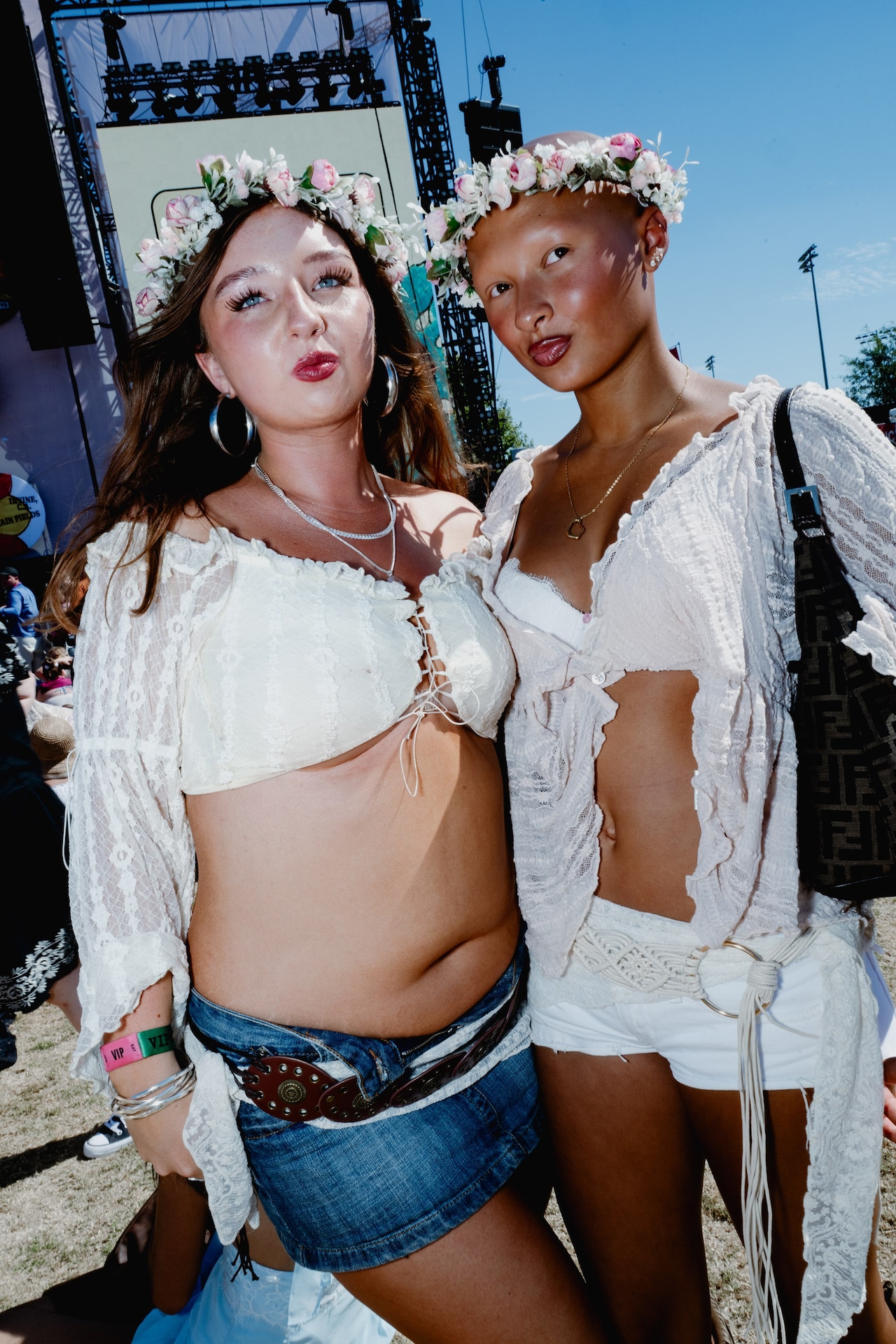
Left: Kathleen Hanna of Bikini Kill at Daisy Chain Fields (Monica Schipper / Getty Images, via NPR). Centre: fans at Daisy Chain Fields (photography Elinor Kry, via Dazed). Right: Lilith Fair founder Sarah McLachlan with Olivia Rodrigo (Kayla Bartkowski / Los Angeles Times via Getty Images, via NPR).
1991
Bikini Kill release Revolution Girl Style Now!; the riot grrrl manifesto circulates in Olympia. “Girls to the front” becomes a live technique: in punk rooms where men fill the front, a voice from the stage carves out a place for girls to stand, one show at a time
1997–1999
Sarah McLachlan founds Lilith Fair at a time when radio wouldn’t play two women back to back and promoters wouldn’t book two on one bill. Three years of touring raise over $10 million. The media spend years turning it into a punchline
2025
The Lilith Fair documentary Building a Mystery is released with Rodrigo as a talking head. McLachlan tells Vulture: “It needs to be someone of today, someone who’s relevant and coming up in the world… the younger generation needs to carry it forward now”
2026.06.22–24
Rodrigo announces Daisy Chain Fields: all-women bill, artists unpaid, all net proceeds donated. Co-produced with Live Nation; sponsors Depop, Etsy, Taco Bell, Verizon. $250 tickets sell out in 30 minutes
2026.08.29
Great Park, Irvine; ~45,000 people; feels-like 95°F. Hanna: “So cool to not have to say ‘girls to the front.’” A man by the pit: “softest mosh pit ever.” $10M raised, matched by Gates to $20M. Rodrigo: “See you next year”
2026.08.30–09.02
Consequence, Rolling Stone, Variety and NME unanimous in praise; The Atlantic writes “it was part of them”; NPR records overcrowding and a lack of shade; Dazed publishes seventeen fan portraits. Celebration and doubt land within 72 hours
01Community Voices
On the record: nine voices from the stage, the field, and one man beside the pit
All nine quotes below are verbatim and unedited. Five were said from the stage (recorded on site by reporters for NPR, Consequence and The Luna Collective); two are attendees speaking to interviewers (NPR and Dazed); one is a post on X; one is an unnamed man overheard by a reporter beside the circle pit. Reddit threads on the festival could not be retrieved for this page, so the record leans on on-site reporting for now. Where each speaker stood — stage, field, sideline, behind a screen — is itself a map, and is preserved as found.
From the stage (via The Luna Collective)Kathleen Hanna, Bikini Kill
So cool to not have to say ‘girls to the front,’ because y’all are already there.
From the stage (via NPR)Kathleen Hanna, Bikini Kill
It makes it hard for me in my body sometimes to have a good time ’cause it’s hard to turn it off. And I was thinking on the way here, what a gift to be able to play for you. What a gift Olivia has given all of us to do this festival.
On site (overheard by Consequence’s Molly Mary O’Brien)An unnamed man beside the Die Spitz pit
That was the softest mosh pit ever.
From the stage (via NPR)Santigold
I can’t believe she pulled this s*** off!
On-site interview (via NPR)Claire Hendrick, 24
Younger girls need to be exposed to this. You can read about empowerment, but it’s so different when you’re with people in community, actually doing it and being it.
So, we can all say that we were at the first Daisy Chain Fields… I’m OG DCF.
From the stage (via The Luna Collective)Shirley Manson, Garbage
My heroes, I can’t believe you have all been standing out in the heat all day. You are badass motherfuckers.
X (Twitter)megs ❀ DAISY CHAIN FIELDS (@ICantHelpItBaby)
DAISY CHAIN TACO BELL IS SO CUTE
Context: what stands out across these nine lines may be how often the body appears. Hanna says the politics make it hard “in my body” to have a good time; Manson calls people who stood in the heat all day her heroes; a 17-year-old sobs her eyes out; the man by the pit is also grading a body — the impact was too soft. The festival’s stated register is charity, women’s rights, lineage. What the people on the ground seem to remember is a bodily state: hot, crowded, crying, colliding. The distance between those two layers is left open here.
Then the positions. From the stage: “what a gift”, “you’re already at the front”. From the grass: “being with people actually doing it is so different from reading about it”. From behind a screen: “Taco Bell is so cute”. All three languages look sincere and all three seem accurate. Put together, they make the question “what was this event, exactly” hard to answer — it was a movement, a gathering and a brand activation at the same time.
This record does not rule on whether the man by the pit was right. It notes one structural thing: in a space designed so that nobody needed to call girls to the front, someone was still standing at the edge scoring the pit. His sentence was overheard by a reporter, printed, and now archived on this page — and its route into circulation looks like the same route that made “girls to the front” necessary thirty-five years ago.
02Consensus Mapping
Four narratives: official, community, emerging, contrarian
Official Narrative
The organisers’ and mainstream press frame is lineage, charity, success. Rodrigo said “without Lilith Fair there would be no Daisy Chain”; NPR called McLachlan’s cameo “a kind of act of historical justice”; representatives of the ten beneficiaries spoke between sets; the $10 million doubled to $20 million was announced at the climax. Rolling Stone, Variety, NME and Billboard reached for “triumph”, “superb”, “proves there is hope for us all”. The weight of the official story sits on “she pulled it off” — a 23-year-old achieving in a day what the 1997 tour took three years to do, and closing with “see you next year”.
Community Narrative
People who were there mostly talk about bodies and feelings. “My first festival where I didn’t have to worry about being stepped on or elbowed” (Dazed); “the least pushy festival I have been to in years” (Consequence); water shared with overheating teenagers; tears when Dolly Parton’s photo came up on the screen. Zoe sobbed; Claire said being there with people “is so different”. This community barely discusses the political content in detail. It talks about a permitted state — allowed to cry, allowed to wear sequins, allowed to drop the guard. The Etsy craft booths, the Depop secondhand zone, the pink Taco Bell drink all belong to “cute” in this telling, and nobody feels the need to explain that.
Emerging Narrative
The reading now surfacing is about the retirement of a technique. Hanna’s “don’t have to say it” was recorded separately by NPR, The Luna Collective and Consequence, whose headline simply called it a “Girls-to-the-Front Festival”. The question on this line: once a safety mechanism executed by voice in a small room is replaced by an entire event structure — lineup, price, sponsors, charitable framing — is it still the same thing? The Atlantic’s notion of the “girlie” sits on the same line: pink, flower crowns, glitter and diary-cursive type read like a way of speaking loudly during a conservative backlash without being seen as a threat. If this reading holds, “soft” stops being an adjective and becomes a strategy.
Contrarian Narrative
The coldest reading is The Atlantic’s: the festival was co-produced by “the convicted monopoly Live Nation”, executed like “a re-skinned version” of Coachella, its longest line for a giant pink Taco Bell drink; “the fest was not destabilizing power structures — it was part of them”, and Rodrigo is “probably not the person to figure out what true counterculture might mean in this, the most consumerist decade of human history.” NPR adds the material layer: $250 tickets, perilous overcrowding, a serious lack of shade, hour-plus food lines. And the man by the pit delivered a different reversal in six words — “softest mosh pit ever” — whose sneer may be the clearest evidence that the space didn’t yet fully belong to the people it was built for.
03Cultural Signal Extraction
Signal breakdown: six cuts
What Changed?
A live instruction shouted for thirty-five years went unsaid for the first time. “Girls to the front” used to be a temporary measure re-executed at every show; last Saturday the structure of the event completed it in advance. Safety moved from something won on the floor by voice to something arranged before the ticket was bought.
Why Are People Reacting?
Because two feelings hold at once. One is astonishment that 45,000 people in extreme heat didn’t shove and said “excuse me” — vanishingly rare at a major festival. The other is unease about that good behaviour: was it purchased with $250 and sponsors? The man’s scoff and The Atlantic’s review are, at bottom, asking the same question.
What Assumptions Are Challenged?
“Counterculture has to be hard” — flower crowns, glitter, diary type and “Soft Is Strong” push against that head-on. “Safety is maintained by rules on the day” — here it seems to rest on curation and pricing. “Brands dilute politics” — the pink Taco Bell drink and the “Bans Off Our Bodies” buttons shared one field, and nobody registered a conflict.
What Desires Are Visible?
Young women want something concrete: a bodily state with the guard down — crying, moshing, wearing very little without being scored. Performers want succession — Manson, Hanna and McLachlan all talk about “carrying it forward”. Organisers want scale, big enough to become an annual institution. The three desires need each other and are slightly in tension.
What Social Behavior Is Changing?
“Attending a festival” is being redefined as a countable act of charity — ticket as donation, outfit as statement, queue as participation. NPR notes attendees touring all ten nonprofit booths to earn free merch. Turning goodwill into a game level spreads it further, and may also make it lighter.
Future Human Behavior?
Will “safe spaces” rely less and less on people in the room and more and more on pre-filters — price, lineup, sponsors, algorithms? If safety can be designed on a ticketing page, does a technique that has to be shouted in the moment get preserved as history, or does it become necessary again at the next room nobody designed?
04INCODER’s Eye
How we read this: six observation lenses
These six themes are the fixed frame INCODER holds every cultural signal against. They work more like a pair of glasses — put them on and the same trend grows a different meaning.
Information Culture
The signal density across the day was high: slogans on stage buttons, quotations painted on the walkway, organisers speaking between every set, “F*** AI” on T-shirts, a stapled zine. NPR said the political mission was “woven into the day”. When slogans multiply into background, are they being read, or do they become ambient sound you can photograph? This page has no answer yet.
Digital Identity
In Dazed’s seventeen portraits, nearly everyone describes their outfit inspiration: “Olivia”, “Chappell”, “dark fairy”, “boho”. In a space that calls itself “be yourself”, the self appears to be mostly quoted. There is nothing wrong with that — every identity is quoted — but when the source of the quote is standing on the stage, does the distance between “me” and “my idol” shrink until it can’t be seen?
Symbolic Systems
Pink, flower crowns, glitter, diary handwriting, Doc Martens with baby-doll dresses. Riot grrrl used this set in the 1990s to mock the “good girl” expectation; in 2026 it is blown up into a park-wide visual system and borrowed by a fast-food chain to print on a drink. The same symbols, over thirty-five years, moved from irony to mainstream to sponsorship. The symbols didn’t change; who uses them and for what did — so what are they saying now?
Dark Vitality
“Softest mosh pit ever” carries an old definition of vitality: hard, colliding, unyielding. The day demonstrated another one: Die Spitz’s drummer in corpse paint shouting “Free Palestine, f*** ICE”, the crowd moshing with a flower crown held high. That state — hard and soft, violent and careful at once — has long existed at the margins of mainstream rooms. Now it has been placed in front of 45,000 people. Is that being seen, or being tamed?
Networked Society
What Lilith Fair did across three years of touring, Daisy Chain did in one day, one on-sale, one sponsor group and one Instagram post. The network drops the cost of assembling to almost nothing and standardises its form — Live Nation, Coachella-style flow, brand activation zones. When the wish for something decentralised can only reach scale through centralised infrastructure, who does the event belong to?
Perception and Attention
NPR recorded the longest line at the pink Taco Bell; Consequence recorded its own reporter wanting to join it — “partially because I have a perverse interest in brand activations, and partially because I wanted to drink something cold.” At 95°F, attention seems to flow automatically toward anywhere with air conditioning or cold drinks, and those places tend to have logos. When the body’s needs decide where the eyes go, who decides what you saw here?
05Signal Score
Signal strength
7/10
Scored 7. In its favour: this is a rare sample of a technique publicly declared retired — “girls to the front” has a datable origin, its inventor was in the room, she said in her own words it was no longer needed, and three outlets recorded it independently; the scale (45,000, $20 million, 30-minute sell-out) and the control case (Lilith Fair) are both verifiable; celebration and doubt landed within 72 hours, with The Atlantic and NPR supplying concrete counter-evidence. Points off: it is still a single event by a single organiser; the claim that “safety was completed in advance by structure” rests on a few reporters’ impressions, with no second edition to compare; the man by the pit is a single overheard voice, and there is no way to know how many at the edges thought the same. What would raise it: whether a second edition happens, whether ticket and sponsor structures change, whether other promoters begin copying the “all-women bill + charity + brands” module, and whether “girls to the front” gets shouted again at the next room nobody designed.
06Final Question
The deepest hidden assumption
?
We have long assumed that a safe crowd is made on the day — by a sentence from the stage, by the person next to you making way, by negotiation in the moment. If safety can instead be designed before anyone walks in — with a lineup, a ticket price, sponsors and a charitable mission stretching “the front” across an entire field — then was the unsaid “girls to the front” solved last Saturday, or simply moved to the ticketing page?
Lay the assumption out. “Girls to the front” counts as a technique because it admits something: the room is unsafe by default, and safety has to be won again, in person, by voice, every time. Its reach is limited — this show only, the front rows only, only those willing to move — and that is also where its honesty lives. Last Saturday Hanna said she didn’t need it. The stated reason was “y’all are already there”; what this page wants to ask is how they got there. The answer looks like this: they bought a $250 ticket inside a 30-minute window on 24 June and walked into a site defined jointly by an all-women bill, ten nonprofits, four sponsors and Live Nation. The front was already the front before they arrived.
If that description holds, the production of safety has shifted from negotiation on the floor to filtering in advance. There are gains: it scales to 45,000, it lasts all day, nobody has to keep shouting. There are costs: the filter’s threshold is set by price and curation, and the people filtered out never appear on the grass, and so never appear in anyone’s account. The overcrowding and missing shade NPR recorded, the Live Nation and Taco Bell The Atlantic recorded — they describe the same thing: this “front” is a produced space, and its edges are drawn by its producers. And the man beside the pit is a reminder that the filter didn’t filter everyone out. The scorekeeper was still there.
The open thread is “See you next year.” If a second edition happens, the module will have proven reproducible and pre-designed safety will become a product. If it doesn’t, the instruction that went unsaid may become necessary again at the next room nobody designed — and will anyone remember how to shout it? This record has no answer yet. It only notes that on the last Saturday of August 2026, a sentence invented for basements retired for the first time on a field, and that it retired by being replaced with a structure nobody needed to say out loud.
Observation remains incomplete.
This report records the present state of observation.
No second edition has been planned; the reading that safety was completed in advance by structure needs more editions and more promoters as samples; the sentence from the sideline is a single voice. These judgements may be reinforced, or overturned.