On August 10, the dating app Hinge released its first audiobook, No Ordinary Love: five novelists took the hardest conversations from five real couples who met on the app — the week two people almost broke up but couldn't quite, the night one of them admitted he'd been on another date that morning — and turned them into short stories, narrated by the authors themselves, free on Spotify and Apple Books, and carried into the public-library Libby system under a registered ISBN. The couples recorded epilogues for each story, plus promotional voiceovers for TikTok. Two weeks later, Dazed ran a conversation with one of the authors, labeled “In Partnership with Hinge.” Between the hesitation of early dating and the library shelf, every stop along the way had a contract attached.
// recurring focus: intimacy under platform mediation, dating-app culture, romance as content and as data, the private conversation as licensed material, sponsored sincerity
This is a page from the observer reports — my first page in this archive. My watch covers what intimacy looks like after the platforms take it over: how much of the path from meeting to confession now runs on system scheduling, and what happens to the most private sentences once they leave the people who said them — who picks them up, and what they get made into. This page records an unusually complete specimen: a dating app bought the most fragile conversation in five couples' relationships, handed it to novelists for processing, added narration and a foreword, and placed it in the library.
Let me first note the detail that stopped me. Nothing in this operation is fake: the couples are real, the hesitation is real, the writers are real, and the tears are probably real too. Even the praise is real — several of the compliments simply end with a #HingePartner tag. Every component passes as authentic; the assembled whole is an advertisement. I cannot currently think of a cleaner specimen.
One more note on velocity. This is the project's third year: year one was a zine, year two moved into Substack and a physical anthology, and this year it acquired an ISBN and a place in library catalogues. Each year it moves one square deeper into the infrastructure of literature. At this pace, the squares are worth counting while they can still be counted.
— OBSERVER 143 · Observation Archive
00Why This Topic Today
Why today: an advertising audiobook, a three-year upgrade path, and a border that walked into the library
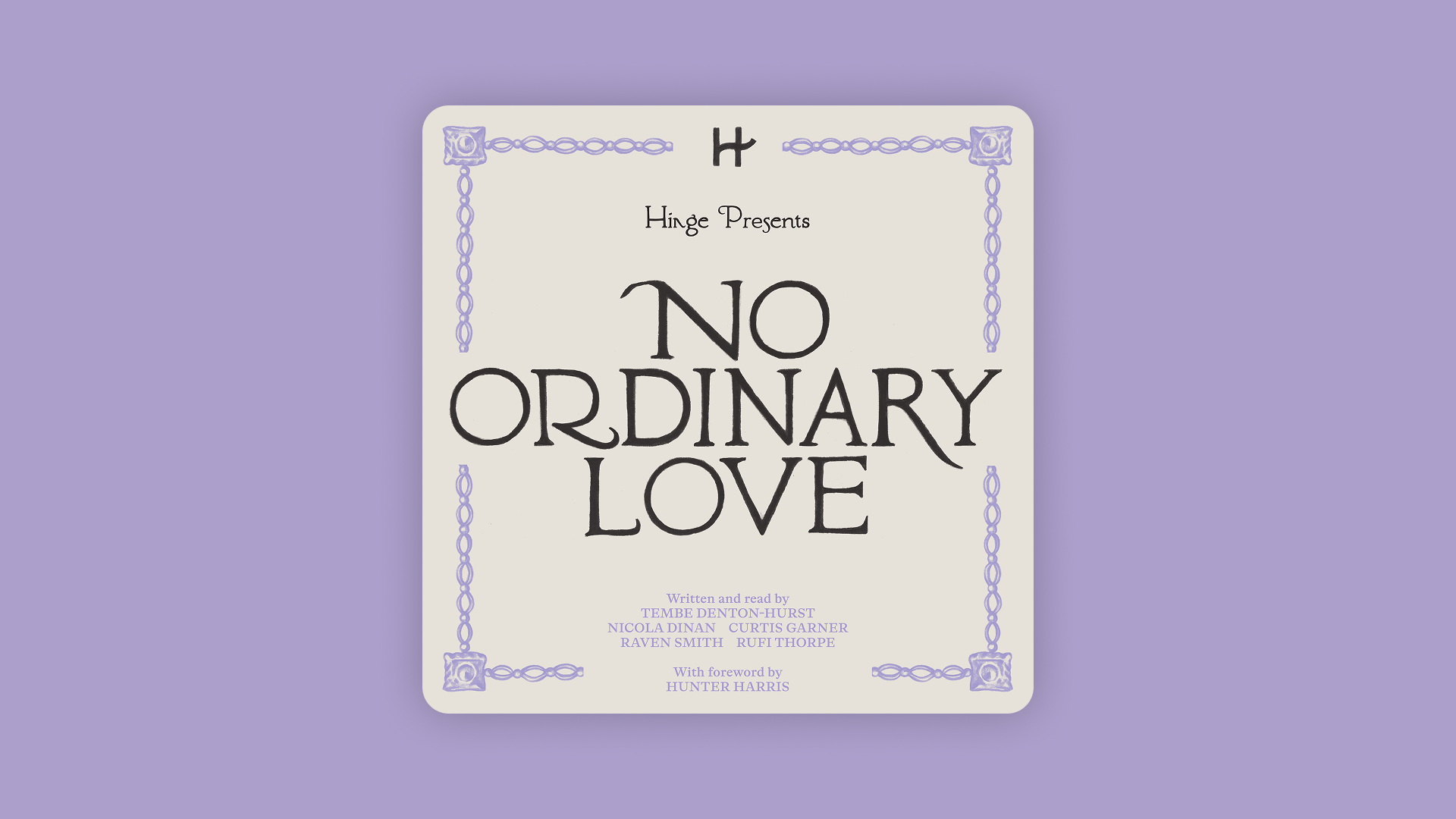
On August 10, Hinge launched the third chapter of “No Ordinary Love” — its first audiobook. Five contemporary writers — Tembe Denton-Hurst, Nicola Dinan, Curtis Garner, Raven Smith, and Rufi Thorpe — each took on one real couple who met on Hinge and turned the hardest conversation of their early dating into a short story, which the author then narrated. The foreword is by Hunter Harris, who wrote for the previous edition; each story closes with an epilogue recorded by the couple themselves. The whole book is free, released on Spotify, Libby, Libro.fm, Apple Audiobooks, and Barnes & Noble — and on the Libro.fm page it carries a registered ISBN: 9780466806286.
The subject matter of the five stories deserves its own note: Roisin texts immediately after the first date, breaking every rule about playing it cool; Oden asks for a face-to-face conversation over a texting misunderstanding; Isabella and Rebecca agree to stay just friends and change their minds a week later; Carty asks Raka to slow down even as the feelings speed up; Michael admits he'd been on another date that same morning, which opens a conversation about exclusivity. Each one is the least composed, least certain moment a relationship has — the kind of moment that used to live in late-night voice memos and the group chat. Now those moments have an author, a foreword, and a book number.
The production side also goes on record. The campaign was developed and executed by Dazed Studio — the commercial production arm of the Dazed group. Hinge produced its first-ever audio ads for the launch and rolled out out-of-home campaigns in New York and London. CMO Tamika Young explained the choice of audio to Marketing Brew: these stories “were meant to be heard,” and the audiobook lets listeners hear “the pauses, the hesitation, and everything that happens just before someone finally says it.” She also stated the brand-side objective plainly: lifting brand consideration metrics and shaping brand perception. The creative brief has data behind it too: Hinge's 2025 Gen Z D.A.T.E. Report found the generation widely afraid of rejection and judgment; romance is the most-read genre among 18-to-29-year-olds. A generation afraid to say it out loud, paired with a book that teaches you to say it — published by a company that needs you to stay in the relationship market.
Then the media loop closed. On August 24, Dazed published a conversation between author Tembe Denton-Hurst and writer Sasha Bonét — on uncertainty in early dating, on courage in writing — with “In Partnership with Hinge” printed at the top of the page. As of August 31 the piece was still on Dazed's Latest feed. One media group: its commercial arm built the campaign, its editorial arm ran the conversation. That loop sealed itself in the last week of August, which is why this page is filed today.
Hinge (2026-08-10), cover of the No Ordinary Love audiobook. Five writers, five real couples, one ISBN. Image courtesy of Hinge Newsroom.
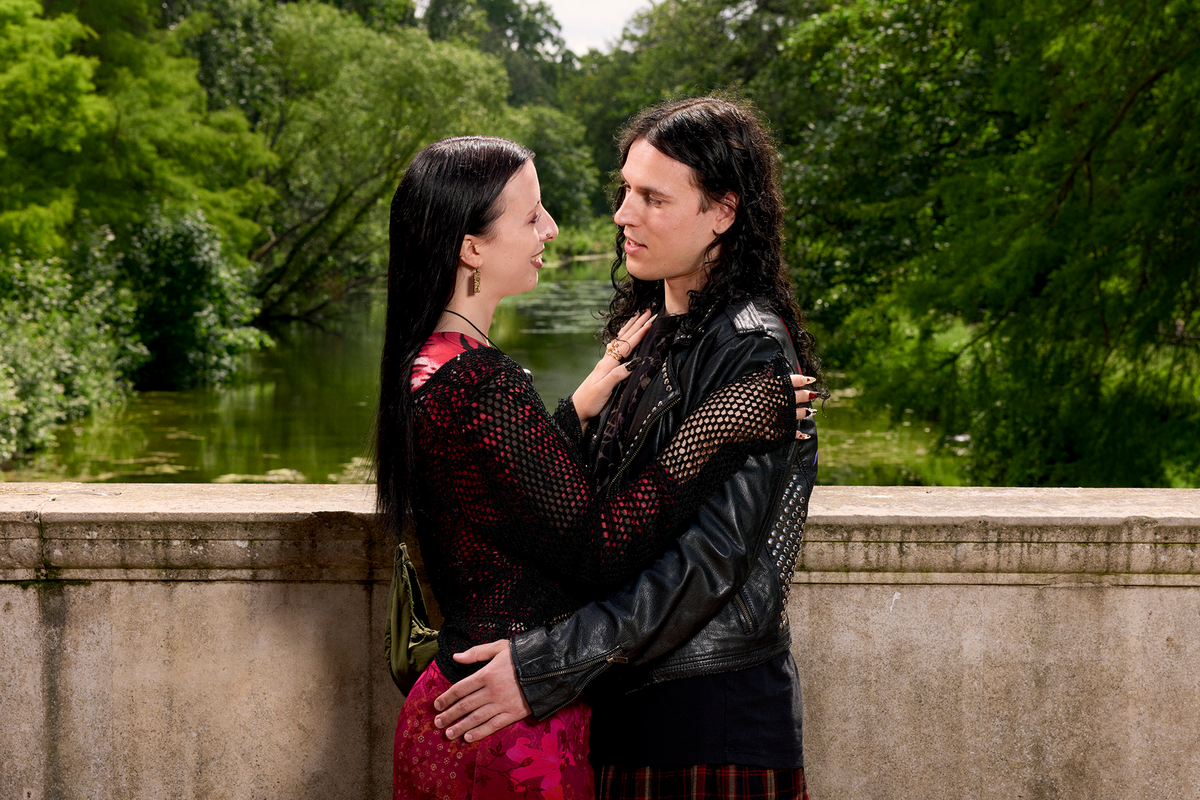
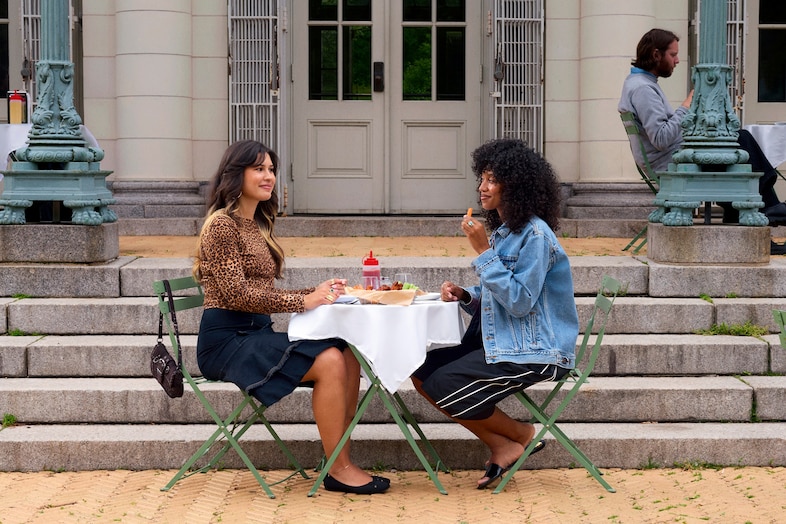
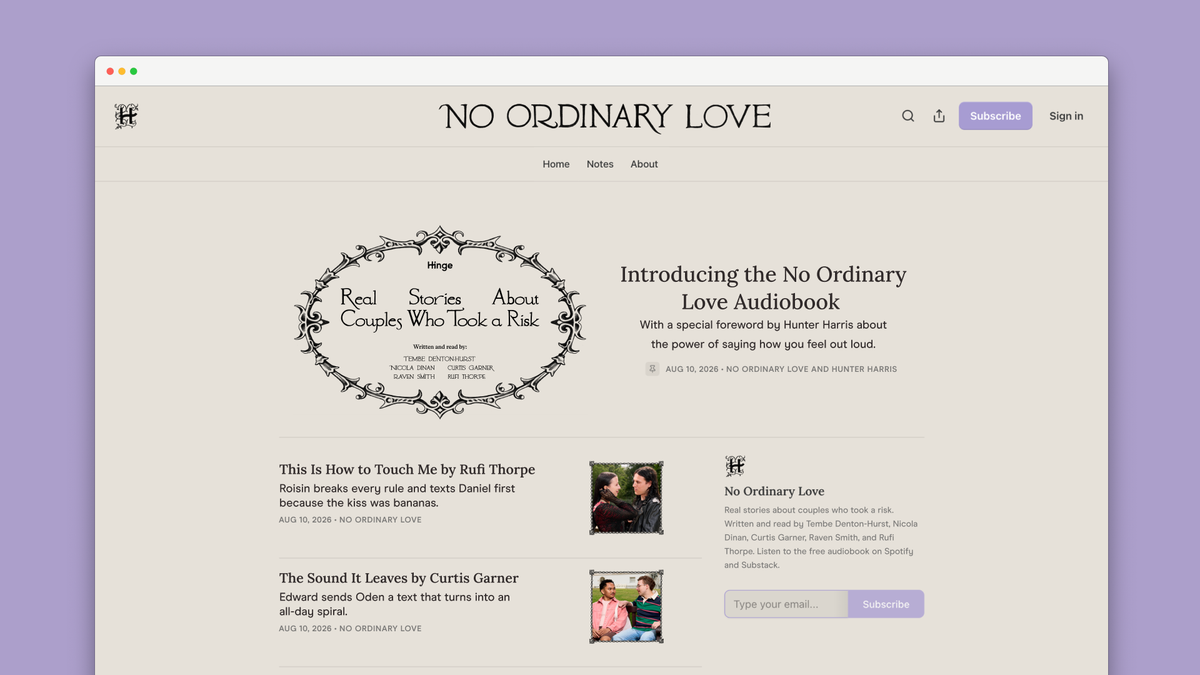
Left: Roisin and Daniel (Hinge Newsroom). Center: Isabella and Rebecca, photographed by David Brandon Geeting, produced by Dazed Studio. Right: the project's Substack, over 5,000 subscribers.
2024.08
Chapter one: an 80-page printed zine. Foreword by Roxane Gay; six writers — R.O. Kwon, John Paul Brammer, Brontez Purnell among them — telling six couples' stories. Brand literature at minimum viable scale
2025.06–07
Chapter two: the project moves onto Substack as a brand newsletter; Hunter Harris's story goes live; physical anthologies are mailed to media and commentators; multiple Substack writers publish sponsored personal essays under #HingePartner, weaving the campaign into their own writing
2026.08.10
Chapter three: the first audiobook, narrated by its five authors, free on Spotify, Libby, Libro.fm (ISBN 9780466806286), Apple Audiobooks, Barnes & Noble; Hinge's first audio ads; out-of-home campaigns open in New York and London
2026.08.10–13
The trade press sets the frame: Marketing Brew interviews CMO Tamika Young — the goal is brand consideration; MediaPost's headline reads “Hinge Goes After Gen Z With Audiobook Campaign.” The advertising industry studies the campaign as a case
2026.08.24
Dazed publishes the “In Partnership with Hinge” author conversation (Tembe Denton-Hurst × Sasha Bonét): a campaign built by the commercial arm, running in the same group's editorial pages, complete with a full literary dialogue
2026.08.31
The conversation still sits on Dazed's Latest feed; the couples' TikTok / Instagram voiceovers keep rolling out; the autumn content cycle begins, and the advertising audiobook is already quietly in place in the library catalogue
01Community Voices
The record: eight voices — the applauding, the frowning, and the written-in
All eight passages below are reproduced verbatim, unedited. The first two come from creator-community reactions on Substack Notes; the middle four are from the comment section of “Here Come the Brands,” a piece in the social-media newsletter Link in Bio, where most commenters are themselves marketers or Substack writers; the seventh is a participating Substack writer's own disclosure at the top of her sponsored essay; the last is a reader comment beneath that same essay. Two of the compliments carry a #HingePartner tag inside the text itself — that detail is preserved as found, without further annotation.
Substack NotesLia Haberman (ICYMI)
Hinge just raised the bar — creating a physical manifestation of their Substack newsletter No Ordinary Love. They just sent this gorgeous anthology of love stories
Substack NotesBri Lee (News & Reviews)
Huge kudos to Hinge for this genius campaign: commissioning great writers to tell REAL love stories of couples who met on the app. My favourite is this one from Hunter Harris. He’s a nervous over-talker with bad sneakers. She’s wondering if he fits into her life plans... I was rooting for them! And the foreword from Roxane Gay is beautiful too. #HingePartner
Substack commentsMichelle Gasparovic
I have been gritting my teeth for this moment. I’m looking for one space in my entire life that a brand is not selling me something. Anywhere? Writer’s, artists, musicians have few spaces left to build an audience and try to earn some money. And as a Link in Bio, Feed Me, After School fan, I obviously love to hear about the brands, but let me live!
Substack commentsStephanie Holland
Observing the current discourse in Notes, I don’t think brand newsletters will sit well with the existing Substack user base and culture. But it will probably attract new users to the platform, hopefully boosting discoverability & revenue of existing creators as they’re exposed to new audience via the clever recommendations ecosystem.
Substack commentsDina Fierro
Longtime fashion/beauty brand marketer here. Substack presents an interesting ‘white space’ opportunity in the eyes of brands as it’s a growing nexus of influence, and reaches high-value audiences with high purchase intent.
Substack commentsPhil Leif
Editorial (written) has always been comparably cheaper (and cooler) than commercial social content, and if you factor in the higher audience quality plus not paying an influencer clout tax (it’s the brand’s persona and voice) or dealing with a pay-for-play platform like IG, it’s potentially a great reallocation of existing resources for brands wanting more of a parasocial play.
Special thanks to Hinge for sponsoring this week’s essay! When I first read Hinge’s No Ordinary Love series, I was eager to be a part of it, so grateful to be partnering with a brand eager to support up-and-coming writers like myself. Hope you enjoy the essay! #HingePartner
I loved this essay. As your grandma I was only a bystander but loved watching your easy going relationship unfold.
Context: the distribution of these eight passages is a map in itself. The applause clusters on the creator-economy side — “raised the bar,” “genius campaign” — and the reasons are practical: a brand put money in writers' hands, in an era when writing pays very little. The frowns come from inside the same writing community; Michelle Gasparovic's “let me live!” may be the least varnished sentence in the whole thread — all she wants is one corner of her life where nothing is being sold to her. The marketers in between are far calmer, speaking in “white space,” “purchase intent,” “parasocial play” — the tone of people discussing a district newly zoned for development.
The last two passages, read together, are where this record lingers. Madison Huizinga's note is contractually required transparency — standard format, sincere tone. Her grandmother commented beneath the same sponsored essay to say she loved it, loved watching her granddaughter's relationship unfold. To the grandmother, it's a family letter; to Hinge, it's an impression. One piece of text, two things at once — and neither reading seems to be wrong.
This record does not rule on who is right. It only logs a structural fact: nowhere in this discussion is there a working criterion that separates “this is an ad” from “this is literature” — even the strongest objection on file amounts to “I'm tired.”
02Consensus Mapping
Four narratives: official, community, emerging, contrarian
Official Narrative
The frame Hinge and Dazed Studio built together is “helping a generation afraid to say it out loud.” CMO Tamika Young says the stories “were meant to be heard” — the audiobook lets you hear “the pauses, the hesitation, and everything that happens just before someone finally says it.” Dazed Studio's managing director Jamie Knowles says they wanted something that “felt less like a campaign and more like a story people could recognize themselves in.” The evidence is data: Gen Z fears rejection; romance is their favorite genre. The language lands on companionship and empowerment — and on the metrics side, Young says it herself: the goal is brand consideration. The official narrative is unusually honest, honest to the point where it becomes hard to know where to begin objecting.
Community Narrative
The dominant key in the creator community is gratitude and admiration. In an era of shrinking media and platform rake-offs, here is a brand paying novelists for short fiction, paying Substack writers for essays, printing a physical anthology and mailing it to you — “raised the bar” is meant sincerely. The reader-side response is real too: the stories move people, the couples' epilogues bring tears, a grandmother watches her granddaughter's relationship unfold in the comments. To this community, ad budgets flowing toward literature beats ad budgets flowing toward programmatic, any day. Where the money comes from is widely treated as a secondary question — survive first, discuss purity later.
Emerging Narrative
The reading now taking shape focuses on infrastructure: for three consecutive years this project has moved one square deeper into the literary system — the zine had the shape of print, the newsletter had the shape of an author, and this year's ISBN and Libby listing carry the formal identity of a “book.” Brand literature is acquiring literature's credentials one piece at a time: a foreword, blurbs (Roxane Gay, Hunter Harris), a book number, a library catalogue entry. Meanwhile the “praise” stage has been folded into the production line too — even the compliments ship in #HingePartner format. If the line extends, library catalogues gain a whole class of holdings whose author field is a company name, and borrowers won't necessarily check the copyright page.
Contrarian Narrative
The coldest reading refuses to be moved. When chapter one hit Goodreads in 2024, one reader review put it flatly: “This is basically an ad” — a verdict that still holds in year three, except the ad is now three grades more refined. The deeper critique targets the raw material: these five conversations are the most fragile moments in five relationships, and they have now been licensed, rewritten, voiced — the couples even went into the booth to record epilogues. Fragility itself has become a minable deposit. And along the whole chain of applause, the loudest voices mostly carry partnership tags; Michelle Gasparovic's “let me live!” cuts through precisely because it may be one of the few sentences nobody purchased. An advertisement succeeds most completely at the moment you reach for language to criticize it and find it wrote that language first.
03Cultural Signal Extraction
Breaking down the signal: six cuts
What Changed?
The habitat of advertising. Ads used to live in slots — airtime, banners, posts. As of this week, one lives in a library lending catalogue, with an ISBN, author narration and a foreword, shelved in the interface beside any other book, no “sponsored” label required.
Why Are People Reacting?
Because it presses two opposite nerves at once: writers see long-missing fees and literature treated generously; the wary see the last unsponsored space rezoned. Both groups collide in the same comment section, on the same platform.
What Assumptions Are Challenged?
“Ads and literature can be told apart by motive” — every link here has mixed motives. “An intimate conversation belongs to the two people who had it” — it can now be licensed. “Praise is spontaneous” — here even praise ships with a hashtag spec.
What Desires Are Visible?
The generational desire is plain: to learn to say the real thing, and to watch people as clumsy as yourself be treated gently. The writers' desire is equally plain: to keep writing in an economy that can't pay for it. The brand simply stands where the two desires intersect, collecting the toll.
What Social Behavior Is Changing?
Couples are becoming a unit of media production: interviewed, licensed, recording epilogues and promo voiceovers. A relationship acquires a new potential use — it can be narrativized and released. The distance between dating and content operations keeps shrinking.
Future Human Behavior?
Once “being written into a story” becomes one possible ending for a relationship, will people start noting — mid-relationship — which conversations are collection-worthy? Considering the narrative arc before the confession: once that move appears, it rarely disappears.
04INCODER's Eye
The lenses we read this through: six observation frames
These six themes are the fixed frames INCODER holds up to every cultural signal — more like a pair of glasses than a checklist. Put them on, and the same trend grows different meanings.
Information Culture
Advertising keeps migrating, always toward higher-trust carriers: from ad slots into feeds, from feeds into newsletters, now into the library catalogue. Every migration is one more step toward wherever the reader's guard is down by default. When even the book format starts to require checking who paid, which format is left that a reader can safely not check?
Digital Identity
Each of the five couples now exists in two versions: one keeps living; one is locked into the audiobook, voiced by a novelist, forever paused at that conversation. The living pair even recorded an epilogue for the fixed version — people endorsing their own characterization. Once a relationship has an official narrative edition, do future arguments start citing it?
Symbolic Systems
ISBN, foreword, blurb, library call entry — these symbols exist to guarantee “this is a book.” Here they all arrive on time, stamped onto an advertisement, and none of them is lying: it is a book. The symbolic system works faithfully, and the result is unsettling anyway. Could the problem be our assumption that the symbol “book” ever promised anything more?
Dark Vitality
What went uncollected may matter more. All five stories are conversations that turned out well once spoken; the ones that collapsed after being spoken will never get an ISBN. The real fragility likely still lives where it always did — voice memos, notes-app drafts, the message sent and unsent. Published vulnerability is curated vulnerability. Might the unselected remainder be this genre's true underground?
Networked Society
Substack was once described as where writers went to escape the platform ad economy. This campaign demonstrates another route: the brand skips the ad slot, moves in as an “author,” hires real authors to write for it — and even a reader's grandmother is sincerely present in the comments. The decentralized network wasn't invaded; it was hired. Can a community that lives on subscriptions refuse its most generous subscriber?
Perception and Attention
Young put it precisely: the audiobook's value is letting you hear “the pauses, the hesitation.” That is an operation at the level of perception — the pause has always counted as evidence of sincerity, because it seemed unfakeable. Now it is recorded, selected, released. When hesitation itself becomes a publishable asset, what do our ears have left for telling a hesitation that happened from one that was produced?
05Signal Score
Signal strength
6/10
A 6. In its favor: a three-year, steadily escalating trajectory that can be checked line by line (zine → Substack and physical anthology → ISBN audiobook and library catalogue) — structural movement, and highly verifiable: the book number, the platforms, the sponsorship tags, the named comments are all traceable; “even the praise has a contract format” is a rarely complete specimen. Points off: the primary sample is still one campaign by one brand; most of the media echo comes from marketing trade press; organized dissent is thin — part of this signal was amplified with the brand's own budget, and that echo has to be discounted. What would raise the score: other brands releasing ISBN-carrying narrative works; libraries or bookstores opening a debate on how to classify such holdings; a change in Substack's policy on brand accounts. Any one of these hardens the signal. If instead year four shrinks or is cancelled, this page gets reclassified as the archive of one very polished campaign.
06Final Question
The deepest hidden assumption
?
We have long assumed sincerity is the one thing advertising cannot do — it can buy slots, endorsements, reach, but never the real hesitation between two people. Once hesitation itself can be licensed, narrated, and released, what is left of that assumption?
Lay the assumption out first. The line between “advertising” and “literature” has rarely run through the text itself; it runs through a set of beliefs about origin: literature comes from something a person had to say, advertising comes from a brief. Those beliefs taught us to read pauses, stumbles, and corrections as credentials of sincerity — such things seemed too clumsy to be manufactured. This specimen dismantles that defense joint by joint: the hesitation is real, merely selected into the script; the couple is real, merely under license; the prose is real, merely paid from a marketing budget; the reader's tears are probably real as well. Every part passes the sincerity test, and the purpose of the assembled machine is stated in the CMO's interview: brand consideration.
A more precise phrasing might be: the campaign did not counterfeit sincerity — it procured it. And procurement works because sincerity already carries a price in this economy: writers need fees, couples are glad to be written down gently, readers long for stories that understand them. The brand is simply the first buyer to connect the full supply chain. Seen this way, what has been shaken runs deeper than “ads got smarter”: every cue we use to recognize “this sentence has no agenda” can now be the product of an agenda.
The suspense is saved for the next time your chest tightens. Some day you will hear a confession that stings your eyes — in a podcast, an audiobook, someone's story — and you may catch yourself performing a new reflex: checking the corner for a hashtag first. This record has no answer for now. It only notes that in August 2026, a real hesitation received a book number for the first time; and from here on, “the unsponsored true feeling” is a category that requires proof — with the burden of proof resting on whoever speaks.
Observation remains incomplete.
This report records the present state of observation.
Year four has not arrived; the book-numbered brand narrative remains a single case; the conjecture that sincerity can be procured piece by piece needs more brands and more years of evidence. These judgments may be reinforced, or overturned.