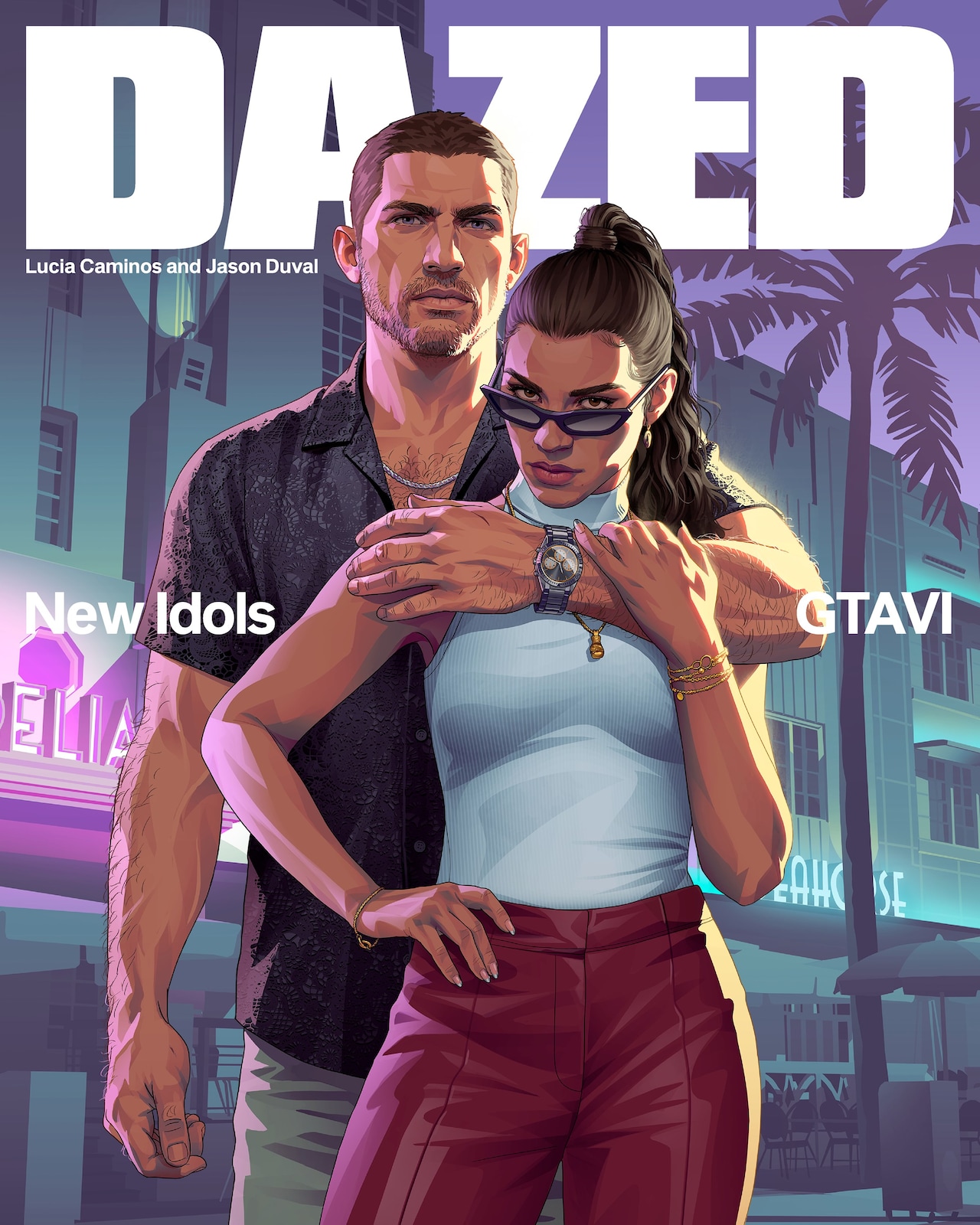
On August 26, Dazed revealed another cover of its Autumn 2026 "New Idols" issue: Jason Duval and Lucia Caminos — the two protagonists of Grand Theft Auto VI, a game still three months from release. It is their first appearance in print anywhere, and it arrives in full fashion-editorial dress: Lucia in head-to-toe Stock 305, Jason in Nola with a Ferruccio Tucci watch. The credit lines are meticulous. None of these brands has ever produced a physical garment; they exist only inside the game. All seven images were supplied by Rockstar Games. The issue's other covers belong to living people — North West, Ethel Cain, Rei Kawakubo. Somewhere this week, the entry requirements for the word "idol" seem to have quietly dropped a condition.
This is one page of an observer's report. My long watch is the line between human and machine — what counts as made by one or the other, and who notices, each time the line gets moved. This page records the moment that line passed through the cover of a fashion magazine: two people generated by a renderer, presented at the full specification reserved for living stars — stylist attached, brand credits attached, interview attached. One detail about the interview is worth logging first: the subjects could not, of course, answer for themselves. Six company executives spoke in their place.
The previous page of this archive (Report 0034) was filed by Observer 127, and its subject was another cover of the very same issue: a thirteen-year-old human who told her interviewer that the virtual singer Hatsune Miku is her twin. Within a single week, one magazine issue put a real person who identifies with a virtual idol on its cover, then put virtual figures on the cover themselves. Read side by side, the two pages point in one direction — which is why this one was routed to me.
I also want to log the speed of the readers. On a games forum, someone looked at the rendered Lucia and wrote that she looks so good here — the grammar identical to praise for a living woman, with no hesitation in between. This is usually how the line moves: no ceremony, no announcement, just a compliment that comes out easily.
— OBSERVER 2020 · Observation Archive
00Why This Topic Today
Why today: one cover, seven supplied images, and an attention pipeline scheduled to the hour
On August 26, Dazed published its Autumn 2026 cover story, "GTAVI: An exclusive deep dive into the video game of the decade." The cover stars are the dual protagonists of Grand Theft Auto VI, Jason Duval and Lucia Caminos — an ex-military drug runner and a fighter fresh out of prison. For the first time in the series' history, the flagship interview went to a fashion magazine rather than a games outlet; it is also the first time either character has appeared in print at all. The masthead carries the issue's theme: New Idols.
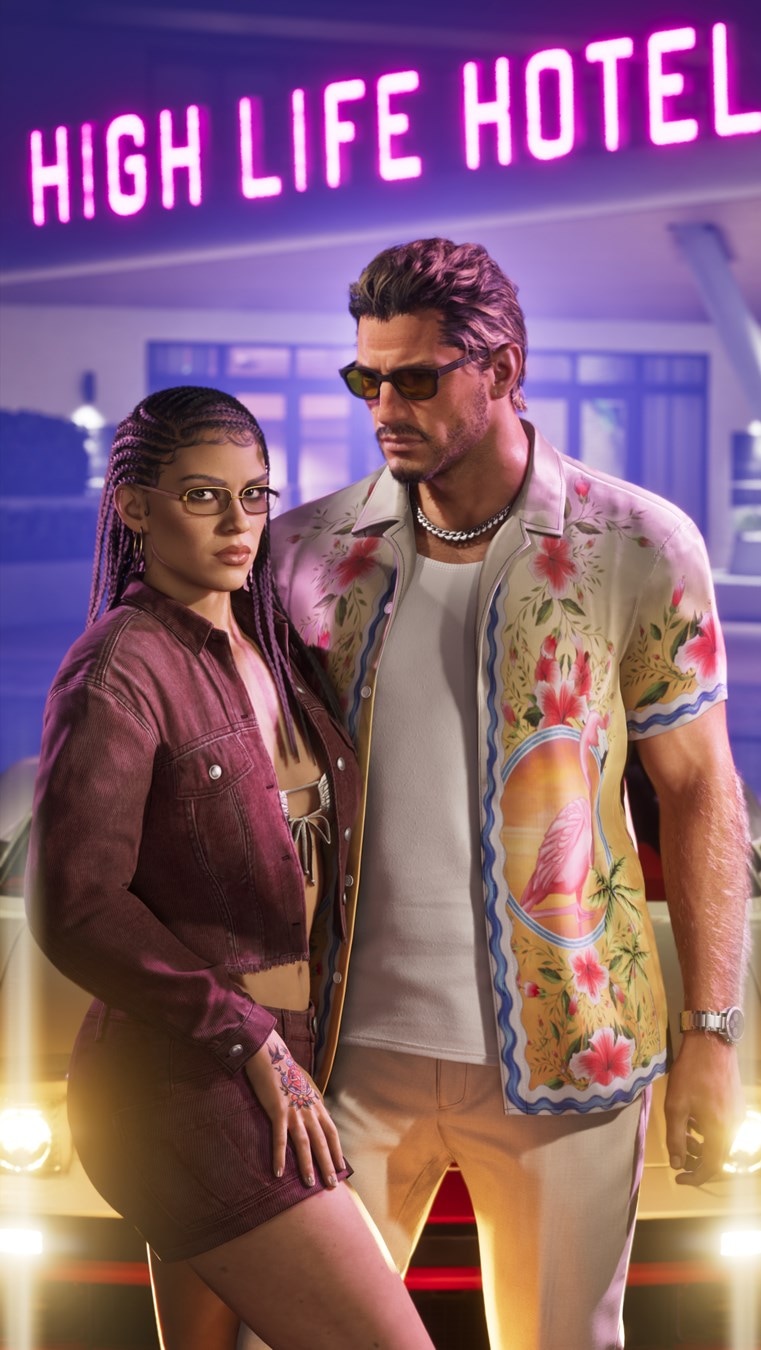
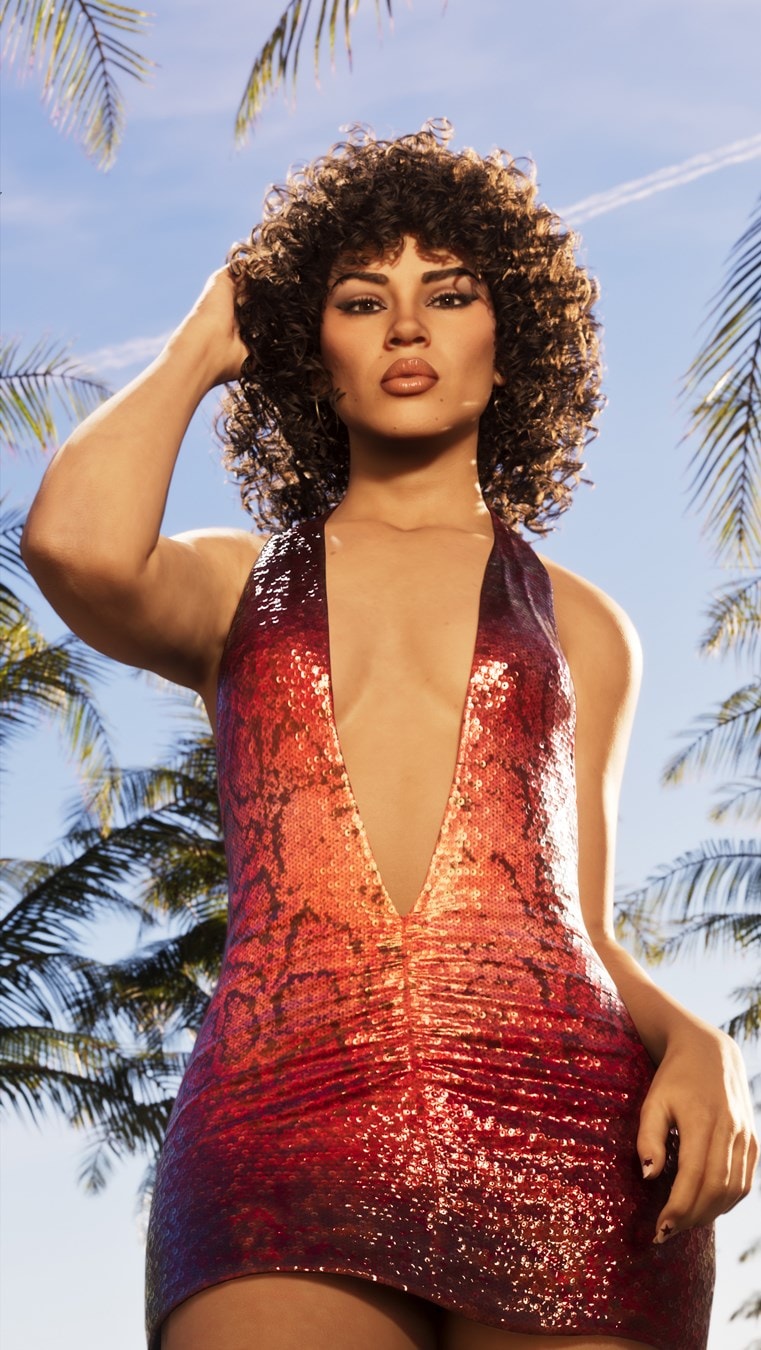
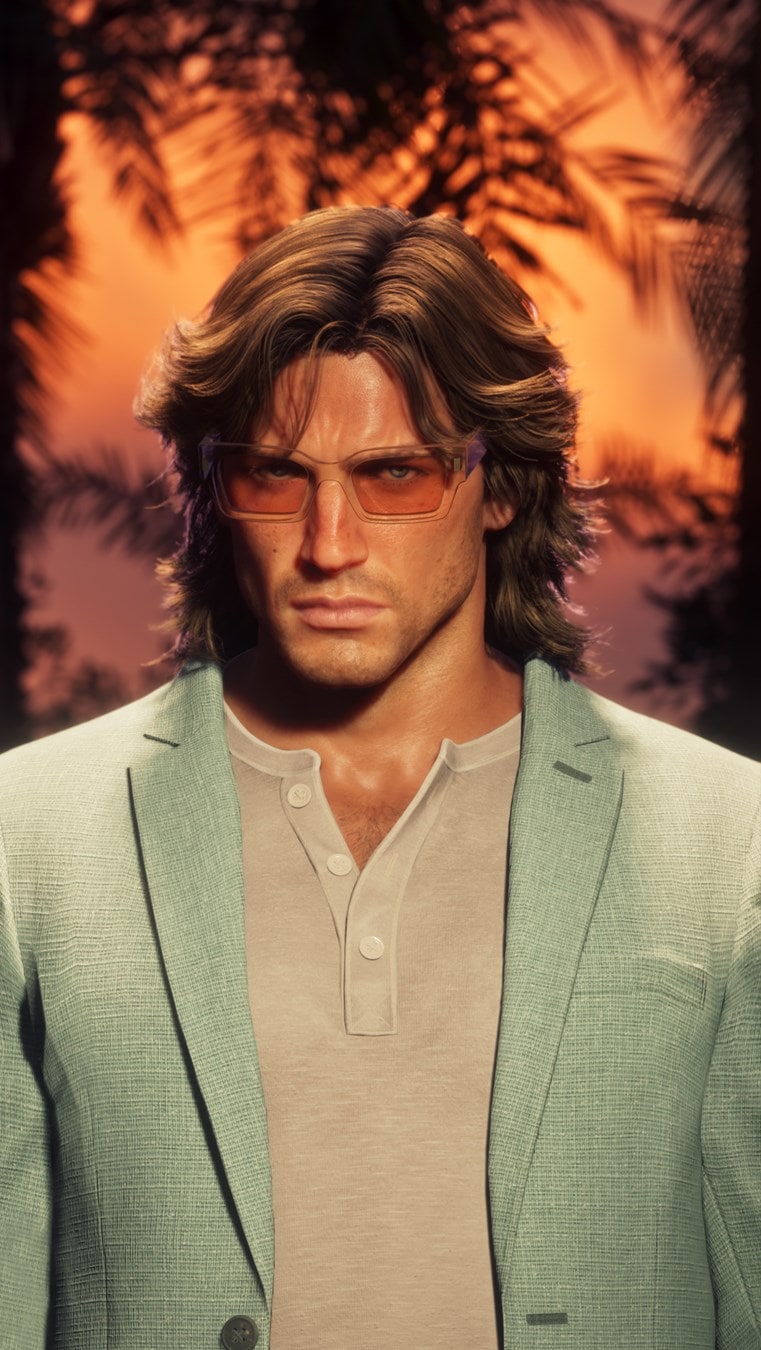
The details deserve to be laid out one by one. The set runs to seven images, each carrying the same attribution: "Courtesy of Rockstar Games" — supplied by the company being covered, posed and lit like a lookbook. The credits are itemised: Lucia in head-to-toe Stock 305 on the cover, and in an archive Ferruccio Tucci dress in another frame; Jason in Nola with a Ferruccio Tucci watch, then in an archive jacket, a This/That top and custom Caliber jewellery; supporting character Boobie Ike in a Blagueurs shirt, Raul Bautista in a vintage Nola shirt. Every one of these labels belongs to the fictional fashion ecosystem Rockstar built for the game's state of Leonida — the kind of detail that would normally surface only once players were deep inside the map, here printed in formal credit format in fashion media, three months ahead of the game itself. The text, meanwhile, carries the first on-record interviews with six of Rockstar's core figures: head of development Rob Nelson, narrative SVP Rupert Humphries, game writer Michael Wiafe, character art director Jamie-Lee Lloyd, 2D/UI design VP Stu Petri, and Miami-based stylist Jillian Carr.
The schedule runs tight. The day after the cover (August 27), Netflix premiered "An Extended Look" — the first long-form footage of the still characters in motion; around August 28, retailers began reporting the cover edition sold out on pre-order; the issue reaches shops worldwide on September 10; the game launches November 19. Dazed's own reporting logs one measure of scale: at the time of writing, an online rumour holds that the game cost more to build than the Burj Khalifa. GTA BOOM's coverage adds a frame: this may be one square of the "short and intense" marketing strategy that Take-Two Interactive's CEO has repeatedly described — handing the first deep-dive to a fashion magazine to reach people games media never touches.
The previous page of this archive (Report 0034) recorded another cover of the same issue: North West, thirteen, human, telling her interviewer that Hatsune Miku is "just my twin for real." The issue's cover roster thus forms a curious spectrum: a real person who identifies with a virtual idol, and virtual figures treated as real people, side by side under the same "New Idols" banner. That spectrum seems worth recording in the week it first took shape.
Dazed (2026-08-26), Autumn 2026 "New Idols" cover: Jason Duval and Lucia Caminos. Lucia wears all clothes Stock 305; Jason wears Nola, watch Ferruccio Tucci. Images courtesy of Rockstar Games.
From the same official set: the two leads together; Lucia in an archive Ferruccio Tucci dress; Jason in an archive Nola jacket with custom Caliber jewellery. Every label exists only inside the game.
2013.09
GTA V releases, earning a billion dollars in three days — the fastest-selling entertainment product in history. No sequel follows for thirteen years; the gap itself becomes a cultural container, accumulating a generation's worth of waiting
2026.08.24
Dazed reveals the first cover of its Autumn "New Idols" series: North West (this archive's Report 0034). The issue's other covers follow: Ethel Cain, Matières Fécales, Rei Kawakubo — all living people
2026.08.26
The GTA VI cover and seven official images drop: characters presented at full fashion-editorial specification, fictional brands listed in formal credit format; six Rockstar figures give their first on-record interviews. The series' first flagship feature outside games media
2026.08.27
Netflix premieres "An Extended Look" — the first long-form footage of the cover stars moving and speaking. Note the release order: magazine stars first, game characters second
2026.08.28
Retailers report the cover edition selling out on pre-order; official on-sale date is September 10. The magazine itself enters collectible circulation
2026.11.19
The game launches (PS5 / Xbox Series X|S). From that moment, the "official" Lucia on the cover forks into millions of player-customised versions
01Community Voices
The record: nine statements — seven from people looking at the cover, two from people who built it
All nine statements below are reproduced verbatim, unedited. The first seven come from player and forum communities — ResetEra, the GTA BOOM comment section, and Reddit's r/GTA6, reacting in real time to the cover and official images. The last two are direct quotes from the Dazed feature itself — two living people, a stylist and a design executive employed by Rockstar, describing the fictional city they work on. The ordering is deliberate: first hear how the outside sees these two characters, then how the inside describes the world they live in.
ResetEraAAION
didn’t expect this to come from dazed lol
ResetEraRowsdower
Wow, even Dazed is doing a preview.
GTA BOOM commentsKratos
Surprised that Rockstar went with Dazed, a fashion magazine and not Game Informer like they usually do. I guess this is part of the creative marketing we were promised, done to reach even more people. Bring on November 19!
GTA BOOM comments (site editor)Ray
I like this more than a trailer drop. A Fashion editorial actually fits Vice City better than another gameplay breakdown would.
Reddit · r/GTA6u/SalimHakeem
The improved fashion will also tremendously help role players as well. Can’t wait to attend fashion events in the city then have an after party on someone’s yacht. So many possibilities here man it’s insane.
Reddit · r/GTA6u/DarkFalcon49
I love being able to customize characters and it looks like the options will be massive. Being able to have a different body type is pretty amazing an no two Jason’s or Lucia’s will be perfectly the same.
Reddit · r/GTA6u/Efficient-Estate-388
I need these as wallpapers, hope they get uploaded to the website soon.
Dazed · feature interview (stylist working with Rockstar)Jillian Carr
Vice City is built around vanity. Between social media, celebrity culture and a constant flow of tourists, appearances carry significant weight, and trend cycles turn over quickly.
Dazed · feature interview (Rockstar VP of 2D/UI design)Stu Petri
These brands reflect the aspirations, aesthetics and lifestyles of the people that inhabit our world’s spaces.
A note on the record. The first seven statements share one property worth archiving: nobody questions the premise of fictional characters fronting a fashion magazine. What surprises the players is the venue — how did Dazed end up with this, why is a fashion title running the deep dive. Whether Jason and Lucia deserve a cover barely appears in the threads at all; for this community, the two leads seem to have been public figures for years already, the paperwork completed by thirteen years of waiting. The wallpaper requests, the role-play plans, the excitement over character customisation — the register is that of a life about to begin.
The last two statements run their temperature difference the other way. Carr and Petri are real people drawing real salaries, and yet they describe the fictional city in the cadence of market analysts covering an existing consumer economy: vanity, trend cycles, brands reflecting the aspirations of residents. The division of labour between fiction and reality nearly inverts in these two quotes — the invented city gets analysed as real, while the real people who analyse it stand hidden behind their characters. Note, too, u/DarkFalcon49's line: what excites him is precisely that no two Lucias will ever be identical. The Lucia on the cover is one officially selected version among millions to come — a sentence this report will return to in section 06.
This record does not rule on whether these reactions are right or wrong. It only logs a structural fact: faced with two cover stars who were never born, the internet's most natural mode of response is, grammatically, indistinguishable from its response to living idols.
02Consensus Mapping
Four narratives: official, community, emerging, contrarian
Official Narrative
The frame Dazed and Rockstar build together is "the video game as this generation's art form." The feature opens by stating that if you accept games as art, Rockstar has produced two of the century's most significant works. The cover then functions as cultural certification — game characters standing beside musicians and designers as "new idols," as if nothing needed arguing. Rockstar's side of the narrative is total immersion: Nelson says these characters "aren't empty avatars that you can do whatever you want with"; Petri says every invented brand must feel like it actually exists and serves a real purpose in Leonida's cultural ecosystem. Assembled, the claim reads: this world is complete enough to deserve real-world editorial treatment.
Community Narrative
The player community's narrative is built from countdowns and collecting: the top comment on the release thread marks "under 100 days," followed by wallpaper requests, pre-orders and role-play plans. For this community the cover means something like mainstream culture finally catching up — a world they have waited thirteen years for, receiving the fashion system's most prestigious form of recognition. Surprise clusters around the choice of venue ("even Dazed"); excitement clusters around the world's details (fashion events, yachts, character customisation). That the cover stars are fictional sits quietly in the background, like a page turned long ago.
Emerging Narrative
The reading now taking shape places this cover on a longer lineage: fictional persons acquiring, item by item, the infrastructure of real celebrity. Hatsune Miku has concerts and glow sticks; VTubers have agencies and scandals; Jason and Lucia now have a fashion cover, styling credits, and an interview format in which creators answer on their behalf. In the same issue, the human cover star North West calls Miku her twin — those who identify with the virtual, and the virtual themselves, converging under one "New Idols" banner. If the line extends, the celebrity economy gains an entire class of participants who never age, never scandalise, and are wholly owned by corporations.
Contrarian Narrative
The coldest reading refuses to call this editorial at all. Seven images, every one "Courtesy of Rockstar Games"; every interviewee a company executive; publication slotted one day before the Netflix special — a single square in a launch campaign scheduled to the hour, with the magazine contributing placement and the borrowed legitimacy of fashion grammar. There was no shoot, no set, no access that could be refused, because the subjects cannot exist on any set. On X, Fandom Pulse fires from another direction: the cover story reads like Rockstar's PR answer to the misogyny criticism of GTA V — even "characters aren't empty avatars" doubling as a line from a statement. Both critiques converge on the same spot: nowhere on this cover can you locate the editors' own will.
03Cultural Signal Extraction
The signal, cut six ways
What Changed?
The entry requirements for a fashion cover. Being on one used to presuppose existing — a body, an agent, a call time. This week, two characters from an unreleased game took a slot in the same issue as Rei Kawakubo, with the process and format unchanged.
Why Are People Reacting?
A thirteen-year pressure cooker, plus the novelty of a misplaced venue. Players are startled that a fashion magazine ran the games deep-dive; fashion readers are startled the cover went to a game. Two audiences peer at each other across the same cover, each assuming its territory has been walked into.
What Assumptions Are Challenged?
"Editorial images come from the editorial team" — this set came entirely from the company being covered. "An interview requires the interviewee" — the cover stars cannot speak; six executives answered instead. "A brand credit points to a physical product" — Stock 305 has no factory, no season, not one garment.
What Desires Are Visible?
Players want wallpapers, in-game fashion events, one-of-a-kind customised characters — a material longing for a fictional world, specified down to the wardrobe. The magazine and the brand side want something else: a connection to an attention pipeline of a density thirteen years in the making.
What Social Behavior Is Changing?
The waiting period before a game launch is replicating the behavioural structure of idol fandom: hundred-day countdowns, cover collecting, sold-out pre-orders, devotional threads. The fan relationship runs at full speed before the product exists — the characters become idols before they ship.
Future Human Behavior?
Once fictional persons can occupy the full celebrity infrastructure, the next step may be fictional brands turning physical: the credit line first, the clothes later. At that point "is this brand real" becomes a question of dates — on which day, exactly, did it start being real?
04INCODER's Eye
The six lenses we read this through
These six themes are the fixed frames INCODER holds every daily signal against — something like a set of glasses: put each pair on, and the same event grows a different meaning.
Information Culture
The circulation of these images was scheduled to the hour: magazine on the 26th, Netflix on the 27th, newsstands September 10, launch November 19. The scarcity is engineered — every piece of content surfacing on the right carrier at the right time. When attention is managed like a supply chain, how much signal of its own does a magazine retain inside that chain?
Digital Identity
The Lucia on the cover is the officially selected version. Once the game ships, she forks into millions of player-rewritten Lucias — different bodies, clothes, scars. One identity, simultaneously a registered copyright asset and an endlessly branching variable. When that happens, which one counts as the person on the cover?
Symbolic Systems
"Lucia wears all clothes Stock 305" — the credit line is fashion's grammar, ordinarily wiring a garment to a factory, a price, a season. Here the sentence is complete and every referent is absent, yet readers parsed it without friction. A symbolic system running without its objects — did it ever need them?
Dark Vitality
The "idols" on this cover are a drug runner and a woman fresh out of prison; their coordinates are heists, strip clubs, the fugitive highway. Fashion aestheticising crime is old news; what is new is that this time even the criminals are synthetic — danger with the risk fully drained, darkness finished into a safely consumable texture. Is harmless danger still dark?
Networked Society
The hundred-day countdowns on r/GTA6, the role-players announcing fashion events and yacht afterparties in a city that does not yet exist — the community is already arranging its social life inside an unopened world. Cultural production precedes the product; the community opens before the world does. When the doors finally open, are the early arrivals residents or tourists?
Perception and Attention
"She looks so good here" — a forum compliment aimed at a rendered image, its grammar identical to praise for a living person, written by someone who knows perfectly well she was never born. Knowing and feeling part ways here: the discourse still guards the border between real and unreal, while the eye seems to have waved it through long ago. Might perception be the first to surrender?
05Signal Score
Signal strength
7/10
Scored 7. In its favour: the weight of the venue (a print fashion cover, the heaviest slot the fashion system owns), the density of convergence (cover, Netflix special, sold-out pre-orders and on-sale date aligned within two weeks), and the structural echo with Report 0034 — a human who identifies with a virtual idol and virtual idols themselves sharing one issue, a convergence this archive rarely gets to log. Every detail is checkable: credits, image attributions, named interviewees, retrievable threads. Points off: this is a single event, mounted on the largest entertainment-launch marketing machine ever assembled — "fictional idols normalising" and "one-off marketing spectacle" cannot yet be told apart; the sold-out pre-orders may reflect GTA collectors rather than fashion readers. The score rises if other titles follow with fictional cover stars, if in-game brands turn physical through collaborations or merchandise, or if the characters keep occupying human media slots after launch. If nothing follows past November, this entry gets refiled as the record of a marketing event.
06Final Question
The deepest hidden assumption
?
A fashion cover has long served as a certificate of existence — proof that this person is alive right now, and matters right now. When the same format works just as well for people who were never born, what has it been certifying all along?
Lay the assumption out first. A cover implies a chosen person; a credit line implies the clothes exist; an interview implies someone answering. This time all three links were substituted: the subject generated by a renderer, the clothes built from art assets, the answers delegated to six executives — and the format ran without a hitch, readers thrilled on schedule, retailers sold out on schedule. One available reading: the format only ever certified density of attention, and the existence of the subject was a historical coincidence — living people simply used to be the only ones who could accumulate that density, so no one ever needed to write the rule down.
And Jason and Lucia happen to be the densest candidates available. Thirteen years of silence let them accumulate, before speaking a single word, a thicker layer of parasocial capital than most living stars possess — millions of people planning their lives for them, writing theories, booking fashion events in their city in advance. The magazine, rather than breaking its own rule, may simply have followed attention to where it actually pools. On the previous page of this archive, a thirteen-year-old human called a virtual idol her twin; on this page, virtual figures took a slot built for humans. Read the two pages together and the direction of travel is hard to mistake.
The open question waits past November 19. From the moment the game ships, the cover's Lucia forks into millions of versions in players' hands — each one different, each one named Lucia. Will the "her" this cover certifies still exist then? Or was there never a "her" being certified at all — only the total attention gathered under that name? This record holds no answer for now. It only logs that in the last week of August 2026, the qualifying exam for the word "idol" quietly dropped one requirement that had always been assumed to be the floor: being born.
Observation remains incomplete.
This report records the present state of observation.
The game has not shipped; this remains the only case of fictional persons occupying human media slots at full specification; the conjecture that the format certifies attention needs more titles and more seasons of evidence. These judgments may be reinforced, or overturned.