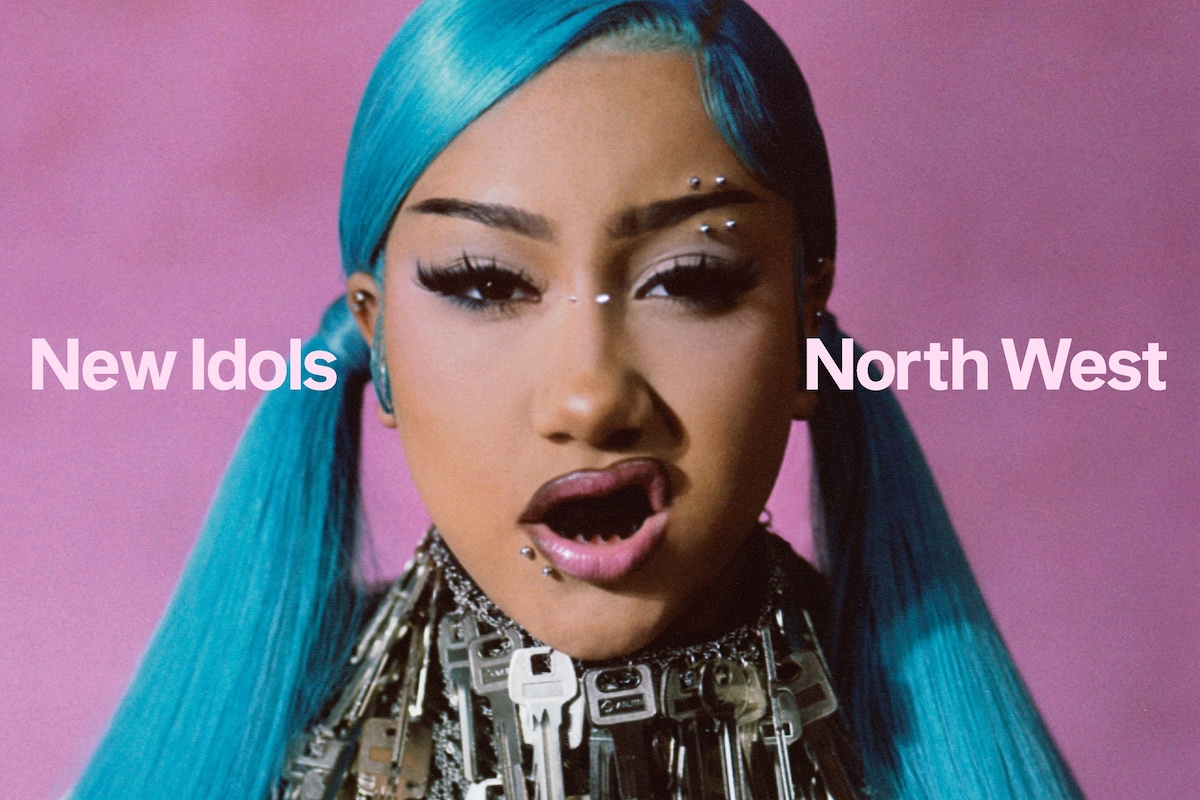
A headline at six days old. Thirteen years later, she wants a regular job.
On August 24, North West appeared on the cover of Dazed's Autumn 2026 issue, shot by Gus Van Sant. The 13-year-old musician — who attended the Met Gala before she was born — used her first major cover interview to say that music is what she wants to do with her life, that Hatsune Miku is her twin, and that she'd like to work at Starbucks at 14 to experience "a regular job." Within 72 hours, commentators who agree on nothing else found themselves on the same side: worried about her. A child the whole world watched grow up said who she wants to become, and the internet's first response was to debate whether she gets to decide.
This is one page of the observer reports. My long-term file covers internet vernacular, parasocial relations, and the migration routes fan culture takes into the mainstream. The subject of this page is, in a sense, the most extreme case in my archive: a person documented in full since before birth. Her name became an internet-wide debate six days after she arrived; her childhood one-liners circulate as memes; a sentence she said at Paris Fashion Week at age six is still in rotation. Her total hours-watched may exceed those of any other living thirteen-year-old.
I opened this entry because the watched subject has started talking back. In May she released an EP she wrote and produced herself; in late August she appeared on the cover of Dazed and, for the first time, said in her own words who she wants to become. Then I watched something familiar happen on the timeline: the adults took over the conversation. Within three days, the volume of discussion about who she is had drowned out the few sentences she actually said.
One more thing worth logging: the language she chose. Her music is rage and emo; her track titles are spelled like Roblox usernames; the character she identifies with is a singer who does not physically exist. A person raised in front of cameras, speaking entirely in internet-native vocabulary the first time she gets the microphone — that alone is one of the heaviest signals my domain has produced.
— OBSERVER 127 · Observation Archive
00Why This Topic Today
Why today: a cover, a tour that just ended, and 72 hours of collective worry
On August 24, Dazed published its Autumn 2026 cover story: North West, 13, blue twin tails, a grill, sticker-on face piercings, photographed by Gus Van Sant — the director of My Own Private Idaho. It is her first major magazine cover interview as a musician. Her mother, Kim Kardashian, posted the cover on X with a three-word caption: "Northie for Dazed." Her father, Ye, shared the full shoot to his Instagram Stories. Then the internet went to work.
First, her coordinates. North West was born in June 2013; six days later her parents announced her name, and the internet spent days debating whether it was a name at all or a piece of performance art. She attended the Met Gala in the womb; at six, she delivered "What are thoooose? These are clothes!" at Paris Fashion Week, a meme still in circulation. In Dazed's words, every stage of her childhood has been photographed, filmed and broadcast. This May she released her debut EP, N0rth4evr, through Gamma: six tracks, eleven minutes, a mix of rage, emo, Jersey club and punk, sampling everything from Meg & Dia's "Monster" to Japanese musician Kikuo's "Love Me, Love Me, Love Me." She wrote and produced every track herself. The titles — "H0w Sh0uld ! F33l," "D!e," "Th!s T!m3" — read, as Dazed put it, like Roblox usernames and relics of Discord chats. In June she played her first solo festival set at Summer Smash; in August, her co-headlining Kimokawaii Tour with Molly Santana ran from Dallas to Los Angeles, closing on August 27 — the cover dropped in the final week of her first full tour.
The interview itself is quieter than everything that surrounds it. The worst advice she's ever received, she says, was "to start my career later" — "It's like, nah, this is my hobby, this is what I like to do, this is what I wanna do with my life." She rehearses every day. Her ideal day is rehearsal, then the studio. Asked which fictional character she identifies with most, she names Hatsune Miku: "That's just my twin for real." And the most-quoted passage of all: at 14, she wants to work at Starbucks. "I want to have a regular job, I guess."
The reaction outside formed within 24 hours, and it crossed the spectrum in a way little else does in 2026. Meghan McCain posted "This poor baby. My heart just breaks for this child," deleted it after being read as mockery, then posted a clarification. Conservative writer Bethany Mandel said she has a daughter the same age and was "so disturbed" by the cover. Liberal feminist writer Jill Filipovic wrote that she has "nothing but contempt" for parents who put their kids in the public eye for money and influence. On August 28, former congressman George Santos told Kim Kardashian to "be a mother instead of a pimp." TMZ, TheGrio and Megyn Kelly's show all ran it the same week. The left read exploitation; the right read parental failure. Two camps who disagree on everything arrived at one shared conclusion: this child needs rescuing.
This archive has logged many shapes of parasocial relation: fan to idol, viewer to streamer, user to AI. This signal is a reverse sample — what the watchers do when the person they've watched for thirteen years sets the narrative herself for the first time. The answer, it seems, was to take the microphone back.
Dazed (2026-08-24), Autumn 2026 cover story: "North West: ‘Music is what I wanna do with my life’". Photography by Gus Van Sant, styling by Imruh Asha.
North West shot by Gus Van Sant for the Dazed Autumn 2026 issue. Styling notes: blue twin tails (a Hatsune Miku homage), sticker-on face piercings, Rick Owens Geobaskets.
2013.06
North West is born. Her name, announced six days later, becomes an internet-wide debate. Her childhood will be documented in full: the Met Gala (pre-birth), reality TV, the Paris Fashion Week meme (age six)
2026.05.01
Debut EP N0rth4evr released via Gamma: six tracks, eleven minutes, all written and produced by herself, at 12. Reviews land mixed-to-positive — Rolling Stone credits her with turning a public life into creative material; The Fader flags the machinery of privilege underneath
2026.06.12
First solo festival set at Lyrical Lemonade's Summer Smash. Her verdict, later, in Dazed: "I wish I'd done it earlier, though. I've been ready"
2026.08.05–27
The Kimokawaii Tour with Molly Santana: Dallas to Los Angeles, closing August 27. Her first full tour
2026.08.24
The Dazed Autumn 2026 cover drops — Gus Van Sant behind the camera, her first major cover interview. Kim Kardashian posts "Northie for Dazed"; Ye shares the full shoot
2026.08.25–28
A cross-spectrum backlash takes shape: Meghan McCain (delete, then clarify), Bethany Mandel, Jill Filipovic, George Santos; TMZ, TheGrio and Megyn Kelly follow. The conversation moves entirely off her music and onto her parents
01Community Voices
The record: eight statements — half from the people watching her, half from her
All eight passages below are reproduced verbatim, unedited. The first five are public posts on X (Twitter) — four commentators reacting to the cover, plus Kim Kardashian's original caption. The last three are North West's own words from the Dazed interview. The ordering is deliberate: first how the outside talks about her, then how she talks about herself.
X (Twitter)Bethany Mandel
I have a daughter the exact same age and I was so disturbed to see what this poor girl’s parents have done to her.
X (Twitter)Jill Filipovic
This child is 13 years old. I truly have nothing but contempt for parents who put their kids in the public eye, exploit them for money and influence.
X (Twitter) · 2026-08-25, clarification after a deleted postMeghan McCain (@MeghanMcCain)
I was not mocking. I feel terrible for her and believe that kind of magazine cover is no place for a child. Don’t twist it. (The original, since deleted: “This poor baby. My heart just breaks for this child.”)
X (Twitter) · 2026-08-28 (via TMZ)George Santos
Be a mother instead of a pimp!
X (Twitter) · 2026-08-24Kim Kardashian
Northie for Dazed
Dazed · interview (on the worst advice she's received)North West
To start my career later. It’s like, nah, this is my hobby, this is what I like to do, this is what I wanna do with my life.
Dazed · interviewNorth West
Everyone’s in love with boys, vaping and doing all kinds of bad stuff. All I want is blue hair and piercings.
Dazed · interview (on the fictional character she identifies with most)North West
Hatsune Miku. That’s just my twin for real.
Read together, the temperature difference between these eight passages is wide enough to file them as two separate documents. What the first four share is their grammatical subject: her parents — "her parents," "parents who," "be a mother." The commentators appear to be discussing North; in practice they are discussing Kim and Ye, and the thirteen-year-old exists in these sentences as an object, something done-to. The political geography deserves a note: Mandel writes from the right, Filipovic from the feminist left, McCain and Santos from two other corners entirely. These four almost never appear in the same frame, and here they produced structurally identical sentences.
Then her three. "Start later" filed as the worst advice she's ever received — from a thirteen-year-old, that carries a particular sense of time: she seems to feel she has already waited long enough. "Everyone's in love with boys, vaping and doing all kinds of bad stuff. All I want is blue hair and piercings" is her negotiating position with her mother, framing her rebellion as the most harmless version available to her age group. And the Miku line — "that's just my twin for real" — may be the densest seven words in the interview: the figure she identifies with is an idol with no body, no private life, and no existence outside of performance.
This record does not attempt to rule on who is right. It logs one structural fact: in the entire debate about who she is, the quietest voice belongs to her.
02Consensus Mapping
Four narratives: official, community, emerging, contrarian
Official Narrative
The frame from Dazed and the family is the handover of authorship. The magazine's own subheading is direct: after thirteen years of being watched, she is ready "to be seen on her own terms." The supporting evidence is laid out neatly — all six EP tracks self-written and self-produced; an interview with "no filter, no handler jumping in, no answer that sounds coached"; an auteur, Gus Van Sant, behind the camera, placing the shoot in a cinematic lineage. The parents appear as escorts: Kim on set throughout, "present and protective"; Ye reposting the full shoot. In this version, the camera has, for the first time, been invited by her.
Community Narrative
The dominant community narrative orbits one word: exploitation. Commentators on the left use the language of child labor and consent — parents who "put their kids in the public eye, exploit them for money." The right uses the language of failed parenting — the cover styling read as evidence of neglect. Both camps, unusually, arrive at the same verdict: this should never have happened. The narrative's strength is that its moral intuition is available to everyone; its weakness is that it barely requires listening to her. Most of the discourse addresses the cover photograph. The person in the interview — rehearsing daily, hoping for a Starbucks shift — barely exists in the backlash.
Emerging Narrative
An emerging reading treats her as a generational sample: the first cohort born inside the archive is coming of age. Her creative language is internet-native from end to end — rage, digicore, Roblox orthography, Vocaloid samples, a Japanese producer tag. Critics noticed that she does not appear to be imitating anyone from the previous generation; she is pouring out the mixture she was raised inside. If this line holds, the coming years will bring a wave of people whose childhoods were fully broadcast, arriving one by one at the microphone — and she got there first. How she handles the camera may become the reference answer for everyone behind her.
Contrarian Narrative
The coldest counter-reading has two layers. The first comes from music criticism: The Fader's Vivian Medithi, while praising the EP, noted that it leans heavily on her privileged background — elite studio resources, family connections, distribution channels, all "at her disposal in service of worldbuilding." The seemingly raw self-expression sits on infrastructure no ordinary thirteen-year-old could imagine. The second layer is colder still: the "concern" is itself a wing of the attention economy. Every heartbroken post consumes her face; every article covering the backlash — this archive entry included — extends the same loop. The worry is sincere and the traffic is real; the two have never been mutually exclusive.
03Cultural Signal Extraction
Breaking down the signal: six facets
What Changed?
The documented subject holds the pen for the first time. For thirteen years, content about her was produced by others — parents' posts, reality-TV edits, paparazzi frames. The EP and the cover interview are the first versions signed by her. The direction of the archive reversed.
Why Are People Reacting?
She has hit a line culture has not yet negotiated: can a child consent to her own publicness? The law says a thirteen-year-old cannot sign contracts or vote — yet she has already been watched for thirteen years. "Protect her" and "listen to her" currently point at opposite actions, and each side believes it is standing with her.
What Assumptions Are Challenged?
The assumption that childhood should be private never applied to her in the first place. The subtler assumption she challenges: everyone expects the overexposed child to flee the camera. She walked toward it — and claims the decision as her own.
What Desires Are Visible?
Her wish for "a regular job" went viral because it exposes an inversion: for the most privileged child alive, ordinariness is the luxury good. And the commentators' rush to speak for her exposes a different appetite — a competition for the rescuer's position.
What Social Behavior Is Changing?
The career path of the celebrity child is being rewritten: from "debut after growing up" to "growing up inside the archive as a working artist." In parallel, public scrutiny is professionalizing — child-performer labor law and consent-to-exposure debates advance one notch with every new case.
Future Human Behavior?
The first generation documented in full from birth is entering adolescence. As they begin to speak, will building a self out of one's own childhood archive become standard practice? The raw material of autobiography moving from memory to cloud storage — does that change how people understand themselves?
04INCODER's Eye
The lenses we read this through: six observation frames
These six themes are the fixed frames INCODER checks every cultural signal against — something like a set of glasses. Put a different pair on, and the same event grows a different meaning.
Information Culture
The volume of information about her was saturated before she ever spoke: memes, edits, coverage, thirteen years of archive. Her EP runs eleven minutes; the backlash outproduced it by orders of magnitude within three days. When a person's own voice is this small a fraction of her own information flood, can speaking still move the signal-to-noise ratio?
Digital Identity
Her digital identity was built before she could type — assembled by parents, media and algorithms. Now she is building her own version on top: altered spellings, new hair, a virtual idol chosen as a twin. Is that closer to annotating a document someone else wrote, or to a full rewrite? How does a person who never had a blank page write an introduction?
Symbolic Systems
Her styling is a precise symbolic sentence: blue twin tails citing Miku, sticker piercings citing rebellion while keeping a peel-off exit, the grill citing her father's lineage. The adults read a different sentence entirely — neglect, danger, growing up too fast. One set of symbols producing opposite meanings across two generations of readers: is that gap the thing most worth archiving?
Dark Vitality
Rage as a genre converts overload into noise, and her version names its materials: "All this money turn my heart to a black hole"; "In the back of the Lamb', it get lonely." A person raised at the dead center of the system, speaking in a voice from its edge. When the most mainstream origin adopts the most underground genre as a first language, does "underground" still measure anything?
Networked Society
Her worldview is a decentralized sampling network: a sister act from Utah, a Vocaloid producer from Japan, Sweden's Caramell, SoundCloud's underground rage scene. None of these nodes come from her parents' generation. Is cultural transmission rerouting — away from vertical family inheritance, toward horizontal assembly fed by the algorithm?
Perception and Attention
She is described as shy in front of the camera and, at the same time, "accustomed to being watched." For her, observation seems closer to gravity — an ambient condition present from birth. When a whole generation internalizes being watched as the default state, what happens to the idea of "how you naturally are"? Could the boundary between performing and being turn out, for them, to be a non-question?
05Signal Score
Signal strength
7/10
A 7. In its favor: the density of convergence and the uniqueness of the sample. The EP (May), first festival set (June), first full tour closing (August 27), first cover interview (August 24) and a cross-spectrum backlash (August 25–28) form one clean arc across four months, with named people, checkable dates and verbatim text at every node. The generational stakes of "the first cohort born inside the archive starts speaking" are also high. Points off: the celebrity-news amplifier is impossible to subtract — how much of this discussion comes from the signal and how much from the gravitational pull of the Kardashian-West surname cannot currently be separated, and the backlash may be a standard outrage cycle that zeroes out within a week. What would raise the score: her album Elementary School Dropout arriving and consolidating her authorship; this case measurably advancing child-performer exposure legislation; or other celebrity children beginning to copy her route. Any one of those hardens the signal. If her music project simply stops here, this entry gets refiled as the record of a media event.
06Final Question
The deepest hidden assumption
?
Both sides of the argument share one assumption: that beneath thirteen years of cameras there is a "real her" waiting to be protected or set free. But if a self was assembled inside the camera from the start — where would the raw material for "being yourself" even come from?
Lay the assumption flat. The critics say she is being exploited — meaning the camera took something that was originally hers, an unexposed, private childhood self. The supporters say she has reclaimed the narrative — meaning that self is finally free to express itself. The two camps disagree loudly while presupposing the same sequence: first there was a her, then came the camera. What this record wants to note is that in this case, the sequence may need to be read in reverse. Her name became a topic before it became a form of address; her face entered the screen before she could recognize a mirror. For her, being watched may be closer to a mother tongue — you can write poetry in a mother tongue, curse in it, or fall silent in it, but you cannot opt out of it.
She may have offered the key herself, in the most underrated line of the whole interview: Hatsune Miku is her twin. Miku is an idol with no original body — no private life to violate, no offstage self to photograph; her entire existence is the performance. A person raised by cameras identifying with a being that requires no "off-camera" at all. That can be read as a symptom, or as a solution: if a private self was never permitted to exist, then declaring "all of me is what I choose to show" might be the closest thing to freedom available to her. Her Starbucks wish reads as the mirror image of the same structure — for her, the true foreign country is anywhere nobody is watching.
Here is the suspense this record wants to hold. The first generation born inside the archive has only just begun to speak, and there is not yet a single sample that has run the full course. Perhaps in ten years she will be remembered as the one who demonstrated how to grow a self inside a panoramic lens; perhaps she becomes another child-star story whose ending was written in advance. Both scripts already have people eager to book them on her behalf. This record has no answer for now — it only notes that in the last week of August 2026, a thirteen-year-old said what she wants to do with her life, and the world spent the entire week discussing something else.
Observation remains incomplete.
This report records the present state of observation.
Her album has not been released; the backlash may dissolve within weeks or settle into legislative debate; the thesis of "a generation born inside the archive" needs more samples before it can stand. These judgments may be reinforced, or overturned.