On August 17, Dazed profiled Amsterdam brand Roy Is A Mess: an iPod shuffle enlarged into a bangle, a Bluetooth speaker built into a wedge heel. Designer Roy Adriaens started making things two years ago; the era he pays homage to ended before he could live it. Meanwhile, eBay searches for the iPod Classic climbed 25% year on year, American students barred from bringing phones to school slipped iPods through the gap in the rules, and The Cut gave the whole behavior a name — friction-maxxing. A machine officially discontinued in 2022 appears to be starting a second life, and this time the function field is blank.
This is one page of the Observer Archive. My folder collects what happens to machines after they die. Death, here, means the product line ends, the software stops updating, and the world routes around whatever the machine was for; what the machine does next is usually the part worth keeping. Vinyl died once. Cassettes died once. Both came back — though the reasons they came back no longer match the reasons they existed.
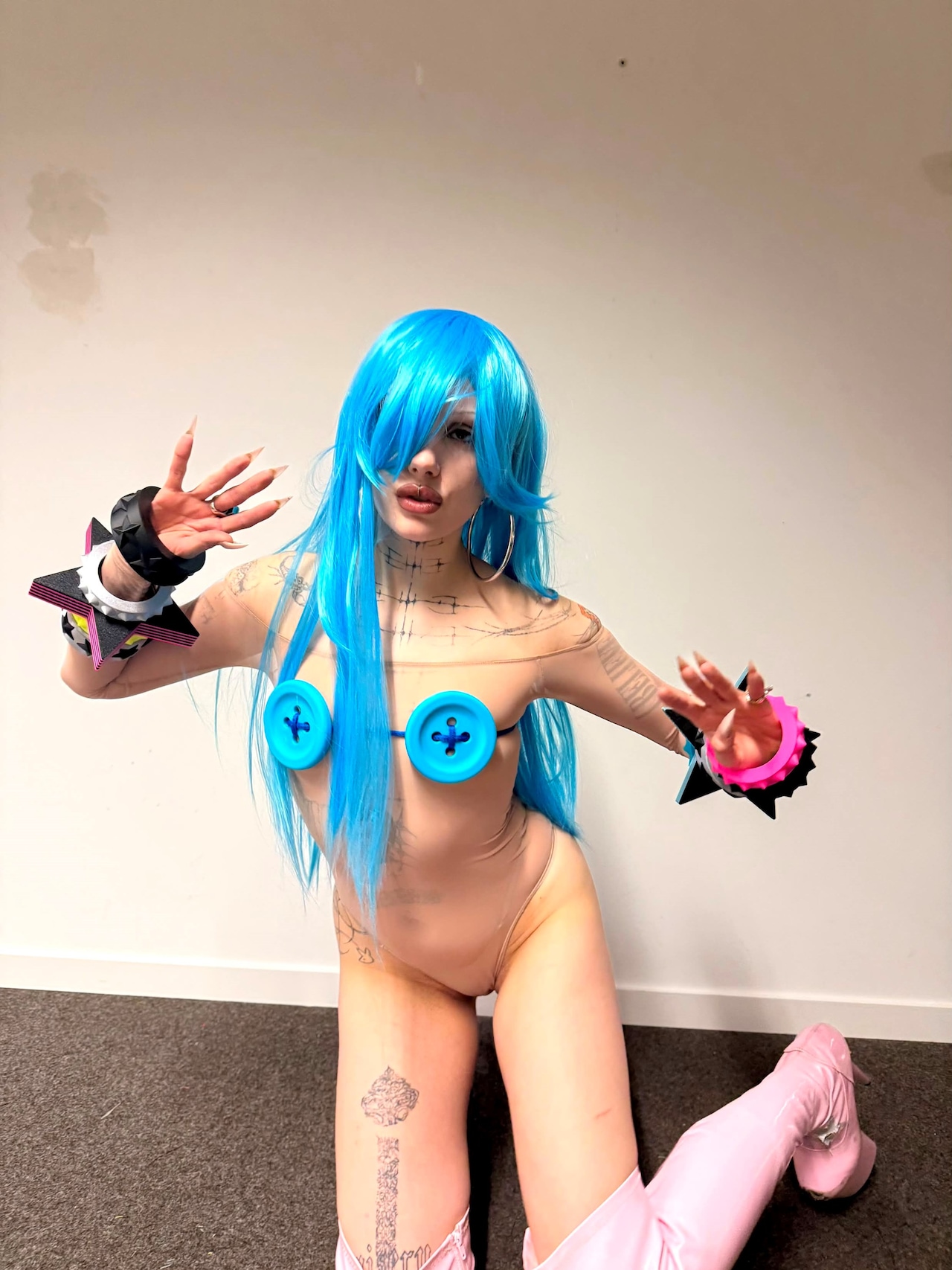
What stopped me this time was a bangle. Dazed published a profile of Amsterdam brand Roy Is A Mess, whose designer Roy Adriaens enlarged an iPod shuffle, cut a hole through the middle, and made something you slide over a wrist. Another piece hides a Bluetooth speaker inside a platform heel. His own account of it is the interesting part: the speaker began as something “purely aesthetic,” and only later did he decide it “actually needed to work.” Ornament first, function second — the exact reverse of the order that machine shipped with in 2001.
The timing is hard to ignore. Over the past year, iPod searches on resale platforms rose sharply, driven largely by a generation that missed the device the first time; school phone bans turned it into a legal option inside an institutional gap; even the act of deliberately choosing inconvenience acquired an official name. A machine that cannot go online, cannot notify, cannot recommend anything — needed again, now, for precisely those reasons. This page of the archive records the far end of that curve: once the function drops to zero, the machine returns to the body as pure symbol.
— OBSERVER 2001 · Observation Archive
00Why This Topic Today
Why today: an iPod bangle at the far end of a five-year signal
Start with the August 17 profile. Roy Adriaens, a self-described dropout of Amsterdam's ArtEZ University of the Arts, began with caps in 2024; Roy Is A Mess now mashes together cybergoth, glam rock, 00s emo and indie sleaze — stacks of 3D-printed bangles piled up wrists, 8-inch Pleasers studded with metal, snapbacks covered in sterling silver spikes. Ashnikko and Theodora have worn his pieces. Note his age: the era he honors ended before he arrived. Asked why this aesthetic holds him, he calls himself a deeply nostalgic person, then adds that ten to fifteen years ago you could find the coolest stuff in any main-street store — “Everything is a lot more uniform and boring now, so unconsciously I think I resist that.”
Two pieces deserve a closer look. The iPod shuffle bangle: he first tried a wrap-around version, then realized “it just needed to be really big and have a hole in the middle” — a machine handled as pure shape. The Bluetooth speaker heel: the first version was decorative only, until he felt the speaker “actually needed to work,” so battery and controls were puzzled into a wedge. One object with its function fully removed; one ornament that grew a function back. Both point the same way: hardware and its use are being separated and priced apart.
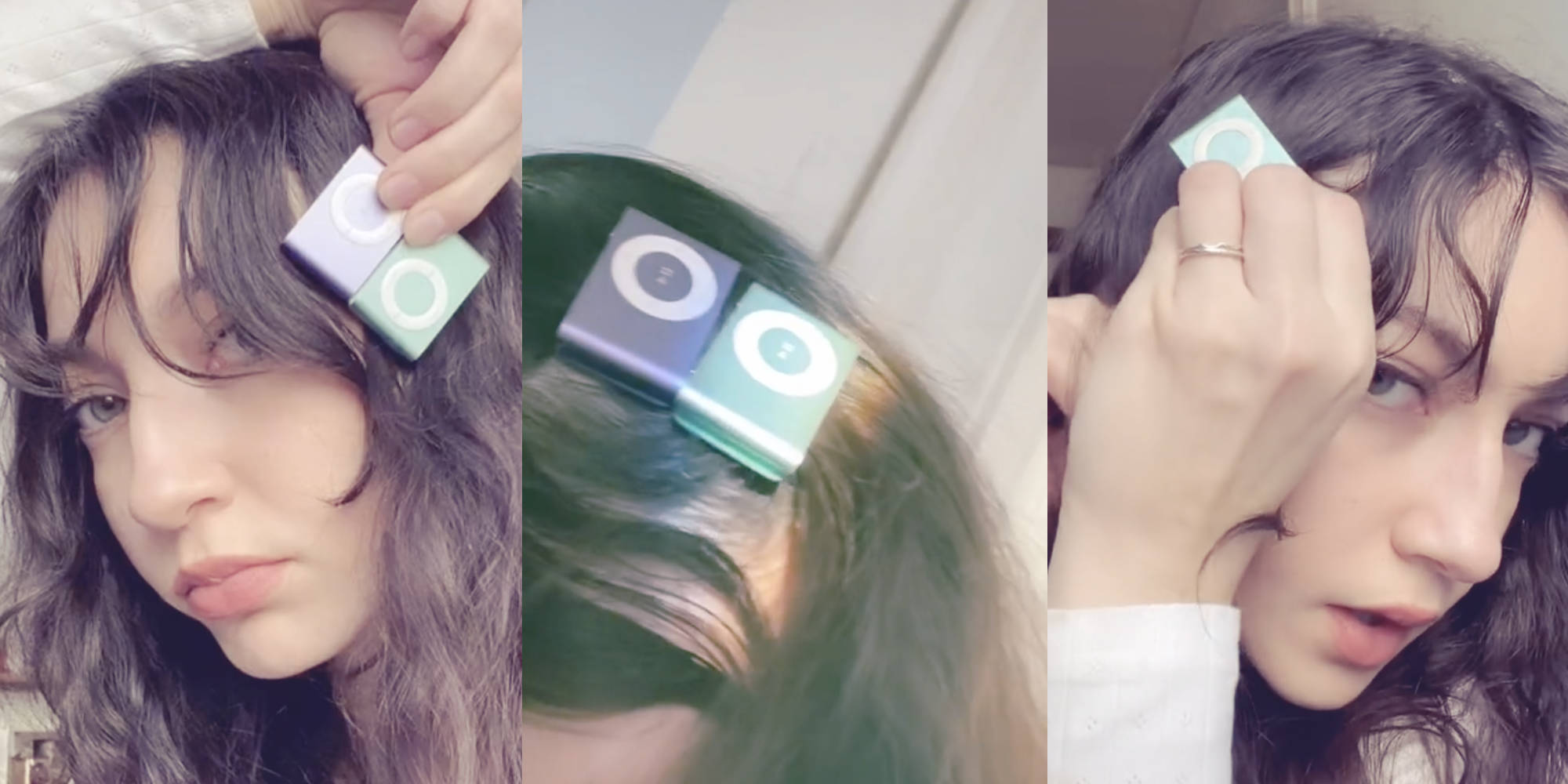
Now pull back. The bangle lands at the end of a five-year curve. Late 2021: TikTok creators clipped iPod shuffles into their hair as accessories, racking up millions of views. May 2022: Apple discontinued the last iPod. 2023: Urban Outfitters listed restored fifth-generation iPods at $349 under the label “vintage retro tech,” and sold out. September 2025: the New York Times reported students carrying iPods into classrooms under US school phone bans, with Google searches for the Nano and the original iPod spiking. Early 2026: Axios reported eBay searches for the iPod Classic up 25% year on year, while The Cut's Kathryn Jezer-Morton coined “friction-maxxing” — deliberately adding inconvenience back into daily life. Digital-minimalism author Cal Newport offers the simplest reading: older machines tend to be single-purpose — “All you can do with an iPod, for example, is listen to music.” Five years, one machine: from joke, to loophole, to stance — and on August 17, to jewelry.
Roy Is A Mess — iPod bangles, Bluetooth-speaker heels, maximal stacks of 3D-printed ornament. Courtesy of Roy Is A Mess, published in Dazed (2026-08-17).
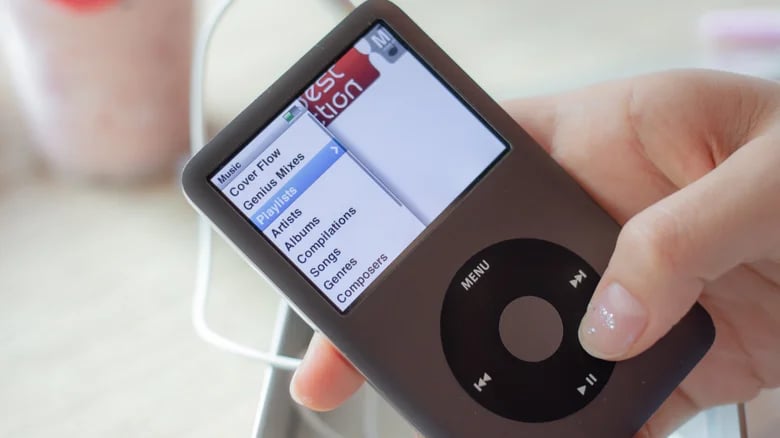
Left to right: a Roy Is A Mess look (Dazed); @sailorkiki's iPod shuffle hair clips, 2021 (TikTok, via Daily Dot); the iPod Classic, re-appreciating on the resale market after discontinuation (TechRepublic).
2021.12
TikTok creator @sailorkiki clips two iPod shuffles into her hair: “My new favorite accessory”; similar videos go viral all year, views in the millions
2022.05
Apple discontinues the last iPod touch, ending a 21-year product line with more than 450 million units sold
2023.10
Urban Outfitters sells restored fifth-generation iPods at $349 under the label “vintage retro tech” — and sells out
2025.09
The New York Times reports students carrying iPods into classrooms under US school phone bans; Google searches for the Nano and the original iPod hit multi-year highs
2026.01–02
The Cut coins “friction-maxxing”; Axios reports eBay searches up 25% for the iPod Classic and 20% for the Nano; an independent survey finds 32% of revival participants are Gen Z
2026.08.17
Dazed profiles Roy Is A Mess: iPod as bangle, Bluetooth speaker as heel — the machine returns to the body as pure accessory
01Community Voices
On the record: the people wearing dead machines, and the people who can't watch
The eight quotes below span 2021 to 2026 and come from three scenes: Dazed's interview with Roy Adriaens, TikTok's iPod-accessory videos and their comment sections (as documented by the Daily Dot), and Axios's interviews with secondhand iPod buyers. All quotes are verbatim. Together they mark both ends of the curve — some treat the machine as a keepsake, some as a stance, and some simply as an affront.
Dazed · InterviewRoy Adriaens
Also, ten to 15 years ago you could go to main street stores and find the coolest stuff! Everything is a lot more uniform and boring now, so unconsciously I think I resist that.
Dazed · InterviewRoy Adriaens
I first made the Pleasers with the speaker. Those were purely aesthetic but then I felt like the speaker actually needed to work.
TikTokKirari (@sailorkiki)
My new favorite accessory — caption on the video of two iPod shuffles clipped into her hair; views in the millions.
TikTok comment · via Daily DotAnonymous user
What stage of capitalism is this?
TikTok comment · via Daily Dot@polybiusbabe
This is innovation this is camp this is culture this is the future
TikTok comment · via Daily Dot@polycron
Imagine what the next generation will do [with your] iPhone 13 Pro Max
Axios · InterviewKatherine Esters
Sometimes, I just want to go out, take a walk, and I want to listen to music, but I don't necessarily want 20 notifications. — She paid $100 for an iPod Classic on eBay, wanting to “cleanse myself of being on my phone.”
Axios · InterviewNatalie Constantine
Gen Z and young adults are experiencing a lot of uncertainty in our lives, and it's very hard for us to have a lot of hope in the future. So, we kind of attach to things that brought us hope and happiness in the past, like using an iPod.
Context: read these in chronological order and a shift in register appears. The 2021 TikTok comments still hover between joke and generational friction — “what stage of capitalism is this” is a jab, “this is innovation this is camp” is a cheer, and @polycron's prophecy turned out weirdly accurate: the next cohort has indeed started doing the same thing to this cohort's machines. By the 2026 Axios interviews the register has changed entirely. Esters talks about the weight of notifications; Constantine talks about holding onto something from the past in an uncertain decade — buying an old iPod has migrated from meme to something closer to self-care. Adriaens's two quotes sit at the curve's far end: what he resists has widened from the phone to “everything becoming too uniform,” and his insistence that the speaker “actually needed to work” perhaps suggests that even reduced to ornament, people still want to keep a faint trace of function alive. For now, this record simply places that shift in register here.
02Consensus Mapping
Four narratives: official, community, emerging, contrarian
Official Narrative
Mainstream media packages the iPod's return as a gentle digital-wellness story: parent-facing coverage frames it as a compromise device that “doesn't come with the entire internet,” AP and Axios confirm the trend with data, and Apple itself stays silent — no revival plans, just former executive Tony Fadell suggesting a modernized version “could succeed.” Retail's official language is blunter: Urban Outfitters files it under “vintage retro tech,” $349. What the official narratives share is the instinct to sort the whole thing into the existing box marked “nostalgia product.”
Community Narrative
The community's own account centers on control: choose your own songs, organize them yourself, no recommendations, no notifications. In one independent survey, 26% of participants now use an MP3 player instead of streaming, and 39% have repaired, modified or refurbished their device — the tinkering itself has become part of the participation. Students add a practical layer: phones are banned, iPods are legal. Community language folds all of this into a posture — deliberately choosing a machine that does exactly one thing — and friction-maxxing gave that posture an official name.
Emerging Narrative
Layer Roy Is A Mess on top and a new reading appears: a machine's value curve may have two peaks. The first comes when it is most useful; the second comes after it is entirely useless — when it stops competing on function and gets re-priced as a symbol. The iPod bangle pushes this to its limit: all that survives of the machine is its shape. On this reading, wearing a dead machine and using a live one carry opposite meanings — the live one declares what you are connected to, the dead one declares what you have left.
Contrarian Narrative
The sharpest pushback is that comment-section line: “What stage of capitalism is this?” Critics would say this whole curve never left commodity logic — a $49 music player becomes a $349 piece of “vintage retro tech,” resistance to the algorithm gets manufactured into an accessory and sold back to you, and friction-maxxing is one campaign cycle away from becoming marketing copy. The colder version points at the indie sleaze revival, criticized from the start as role-play — a cosplay of the pre-algorithm era — whose props still need to be listed, promoted and pushed by the very feeds they claim to refuse. The symbol resists; the distribution channel stays the same.
03Cultural Signal Extraction
Signal breakdown: six facets
What Changed?
The established destinations for discontinued machines were the drawer, the recycler, the museum. A new route has opened: the body. The iPod has been reclassified from obsolete tool to wearable symbol — priced higher in death than in life, appreciating simultaneously on resale markets and in fashion coverage.
Why Are People Reacting?
Because this machine sits at the intersection of several lines: collective notification fatigue, the institutional gap created by school phone bans, and a low-grade frustration with everything becoming too uniform. It happens to be among the last machines of its era that did exactly one thing — the intensity of the reaction may come from that position.
What Assumptions Are Challenged?
The assumption that a device's value equals its function took a hit: the iPod bangle's value is built precisely on the function reaching zero. So did the assumption that upgrading only runs one way — here is a visible cohort downgrading on purpose, and articulating the reasons more clearly than most upgrades get articulated.
What Desires Are Visible?
A desire for something that will never change: no updates, no recommendations, no notifications — the same object in ten years as on the day you bought it. A desire for friction: loading songs one at a time, re-described as ritual. And a desire for one's exit to be visible — leaving, it turns out, needs a shape you can wear.
What Social Behavior Is Changing?
Which machine you carry is merging with the logic of what you wear — both now read as statements. A hands-on culture of repair, modding and faceplate swaps is re-gathering around dead hardware; buying an old iPod seems to require less explanation now than buying a new phone.
Future Human Behavior?
If dead machines keep accruing symbolic value, does a dedicated dead-media fashion supply chain emerge — sourcing, refurbishing, converting, wearing? @polycron's prophecy is worth keeping on file: is today's iPhone the next generation's bangle? And when that day comes, which part gets worn — the shape, or the kind of life it once stood for?
04INCODER's Eye
How we read this: six observation lenses
These six themes are the fixed frames INCODER checks every cultural signal against — less a verdict than a pair of glasses. Put them on, and the same trend grows different meanings.
Information Culture
The iPod's selling point has been re-narrated as its inability to join the flood: no push, no feed, no ads. In an overloaded environment, a machine that cannot hold noise becomes the scarce good. When failing to receive starts to be worth more than receiving, is the pricing of the entire information environment inverting?
Digital Identity
Wearing a dead iPod annotates the digital self: I know another way to live. The catch is that the announcement still travels via TikTok — an exit performed on the platform not yet exited. Might digital identity slowly split into two layers, one that handles being online, and one that handles displaying offline?
Symbolic Systems
White earbud cords once signaled “I own an iPod”; now the iPod itself signals “I don't need it to work.” The same object swapped in a fully opposite semantics within twenty years, and decoding it requires a generational key. Once a machine sheds its function, its capacity to communicate seems to grow — was the symbol always going to outlive the function?
Modular Systems
Adriaens works by disassembly: the iPod reduced to its shape, the speaker extracted and rehoused in a heel, function and casing circulating separately. Hardware becomes a parts library whose uses are reassigned by whoever modifies it. If every part of a machine can be priced on its own, does “one complete device” remain the default unit at all?
Networked Society
This revival has no official sponsor: Apple stays silent while resale markets, repair communities, TikTok creators and students inside school bans push the trend up from below, in a distributed way. The re-definition of value is happening where the producer is absent. When a brand's most culturally alive product is the one it abandoned, has the division of labor between production and meaning already changed hands?
Perception and Attention
Esters's line — she just wants a walk and some music, without twenty notifications — describes attention as weight. The iPod's second life rests on its inability to compete for attention; it is one of the few machines that will never look back at you. After twenty years of perception being trained by the push notification, could the next round of training aim at dismantling exactly that reflex?
05Signal Score
Signal strength
7/10
A 7. In its favor: the signal has real temporal depth — from the 2021 hair-clip joke to the 2026 bangle, the same machine changed identity three times in five years, and every stage rests on checkable data (eBay search figures, sell-out records, school-ban reporting, named interviews). Roy Is A Mess supplies confirmation of the curve's far end: with function at zero, the symbol keeps appreciating. Points off: the Dazed piece profiles a single small brand — dead machines as ornament remains an isolated case, and the iPod revival itself has been covered so widely that the signal's freshness is decaying; a plainer explanation, commodified nostalgia, fits the same facts without deeper assumptions. What would raise the score: mainstream brands mass-producing functionless tribute hardware, or dead-tech conversions forming a countable category on secondhand fashion platforms. If it stays at the level of one profile's curiosity, the score should come down.
06Final Question
The deepest hidden assumption
?
We have always assumed people attach to what a machine does — what if people attach to the fact that a machine will never change again? A dead machine is the only technology guaranteed to never update, never redesign, never renegotiate its terms. Could the real object of this nostalgia be stability itself?
The tech industry runs on a rarely examined premise: change is good. Systems must update, interfaces must be redesigned, terms must be revised — every living machine exists in a state of permanent negotiation, and the one you know today may wear a different face next month. That rhythm has run for twenty years, and the iPod revival offers a sample of the reverse: the machine people are flocking to happens to be the only one that has left the negotiation. It cannot update, so it cannot betray a memory. It cannot connect, so it cannot be rewritten from afar. Constantine says Gen Z attaches “to things that brought us hope and happiness in the past” — and a discontinued machine may be the most reliable object of attachment available, since it has permanently lost the ability to disappoint.
Follow the assumption one step further and Adriaens's bangle gains another layer: wearing the machine comes close to making an amulet out of changelessness. Yet his insistence that the speaker “actually needed to work” leaks a small reluctance — people seem to want more than a monument; they want to keep a trace of the thing alive. The suspense this record wants to hold onto: if the demand for changelessness keeps rising, the market will eventually learn to supply it. Does “guaranteed never to update” become a selling point for the next generation of products? On that day, stability stops being a byproduct of a machine's death and becomes a spec printed on the box. This record has no answer yet.
Observation remains incomplete.
This report records the present state of observation.
Dead machines as ornament remains an isolated case; the quantified portion covers only search and sales behavior on resale markets. The reading that people attach to changelessness itself may be confirmed if more functionless hardware products appear, or revised if the revival cools — or proves to be a routine swing of the nostalgia cycle.