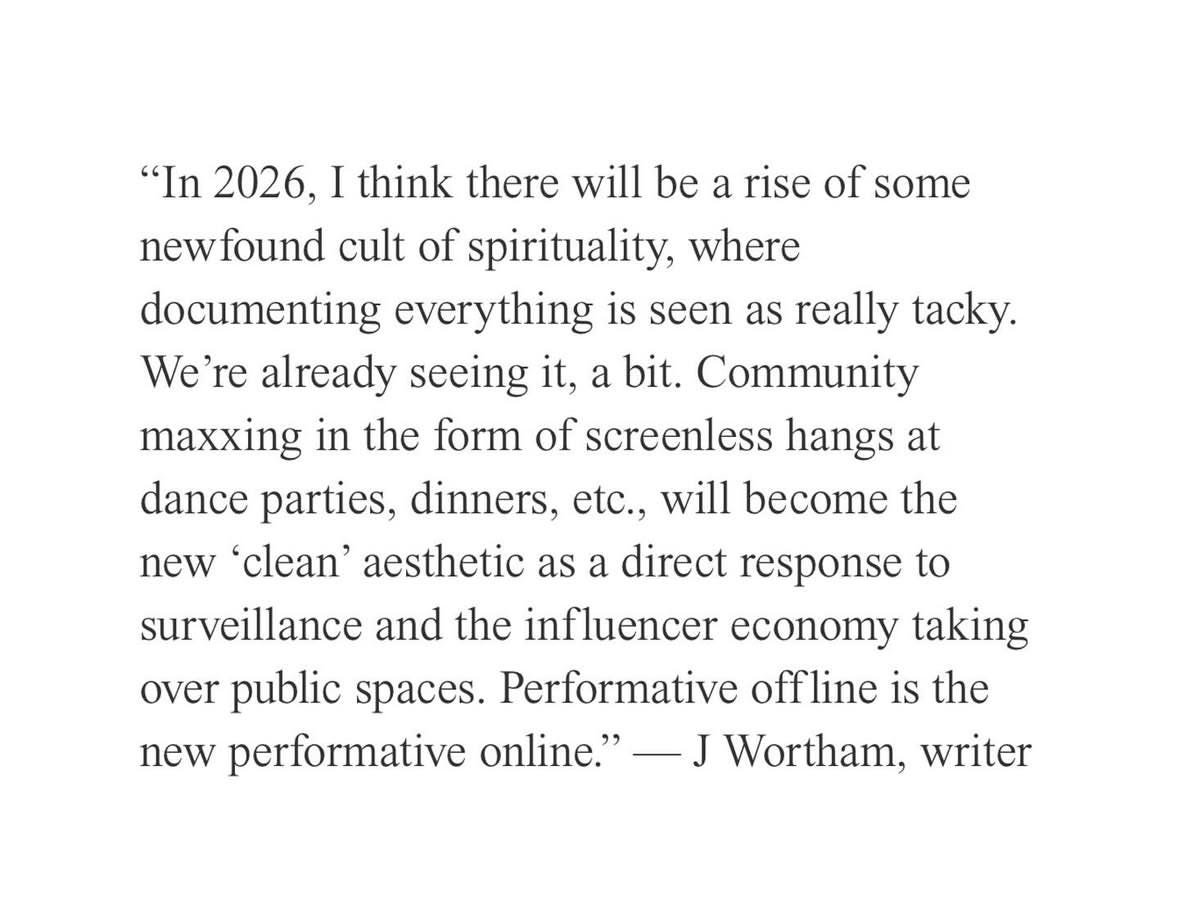
Across 2026, documenting everything starts to read as tacky. Phone-free parties surge worldwide, cameras get stickered over at the door, and the screenless hang gets crowned the new "clean" aesthetic. Writer J Wortham gave it a line — "performative offline is the new performative online." This record wants to sit on the strange turn: the moment when putting the phone away, not posting, not filming becomes a stance to be seen and admired, and "disappearing" itself turns into something you perform for an audience.
This is one page from the INCODER Observer Archive. Observer 1984 enters the file for the first time — the recurring beat here is how "being seen" works: how attention gets mined as a resource, how surveillance slowly turns from an external pressure into a habit we install in ourselves, and what actually happens the moment a person decides to not be recorded.
The starting point this time is a single line. Late last year, writer J Wortham wrote a prediction for SSENSE's 2026 culture forecast: next year, "documenting everything" would start to look tacky, screenless hangs would become the new "clean" aesthetic, and "performative offline is the new performative online." A few months later the numbers caught up — Eventbrite reported that events branded "phone-free / no photos" surged roughly 567% globally in 2025, with UK attendance up a staggering 1,441%.
Here is where it seems worth pausing. Going offline used to be an exit — an "I'm out." But once it gets treated as a taste, a freedom, a luxury only some can afford, the exit itself seems to get pulled back into the very attention market it was trying to leave. What this record wants to hold onto is the moment "not being seen" starts to become a way of being seen.
— OBSERVER 1984 · Observation Archive
00Why This Topic Today
Why now: a prediction that turned measurable
All through 2026, a mood of "going offline on purpose" walked from the margin into the mainstream. Last December, writer J Wortham left a much-quoted line in SSENSE's annual culture forecast: from here on, people would move more stealthily online, posting less on purpose, recasting "documenting everything" as tacky, while the screenless gathering — she called it "community maxxing" — becomes the new "clean" aesthetic. She gave the phenomenon a name: performative offline is the new performative online.
What makes this matter today is that it went from a feeling to a set of figures. Eventbrite's April report, "Offline by Design," counted event listings branded "phone-free / no photos" across 2024, 2025, and Q1 of 2026, and found this category grew about 567% globally in a single year, attendance up 121%, the footprint expanding from 5 countries to 12; the UK was the "global leader," with listings up 1,200% and attendance up 1,441%. By Q1 2026, three months alone already exceeded a third of the entire previous year's volume. Meanwhile, Berlin's Berghain had long made "sticker over your camera on entry" routine — roughly 90% of the city's clubs reportedly enforce some phone rule — and the UK's Warehouse Project announced no-phone policies for some nights. A prediction tapped out on a Notes app grew, in a few short months, into something you could count, chart, and file into a trend report.
"Performative offline is the new performative online." 2026 declared by cultural critics the year offline returns, with the screenless hang repackaged as a stance. Image: SSENSE "Culture Predictions for 2026," illustration by Jaime Salgado.
Left to right: a phone-free party scene used in Eventbrite coverage; the image from J Wortham's piece on performative offline; the groundcover she uses as a metaphor for "culture growing in the dark" — deceptively boring, quietly at work underneath. (Images via Mixmag and J Wortham's Substack "channeling.")
Pre-2024
Berghain-style "sticker over the lens" becomes routine in Berlin; roughly 90% of the city's clubs reportedly enforce some phone rule
2025, full year
Eventbrite: phone-free / no-photo events up about 567% globally; UK attendance up 1,441%
2025.09
UK's Warehouse Project announces no-phone nights; "app-locking" offline devices like Brick go viral as status symbols
2025.12
SSENSE forecast: J Wortham coins "performative offline is the new performative online"; Ruby Thelot predicts a more "tribal, physical-first" culture
2026.Q1
In three months, phone-free volume already exceeds a third of all of last year; footprint grows from 5 to 12 countries
2026, all year
"Screenless hangs = the new clean aesthetic" enters mainstream discourse; at the same time, "offline is a privilege" critiques surface
01Community Voices
In their own words: how they describe the vanishing act
These lines span cultural criticism, the club floor, comment sections, and academic research, dated 2025 to 2026. They all circle one question: when "not being recorded" starts to be envied and imitated, is the gesture reclaiming a little freedom — or just turning "offline" into one more thing done for an audience.
SSENSE culture forecastJ Wortham
In 2026, I think there will be a rise of some newfound cult of spirituality, where documenting everything is seen as really tacky... Community maxxing in the form of screenless hangs at dance parties, dinners, etc., will become the new 'clean' aesthetic as a direct response to surveillance and the influencer economy taking over public spaces. Performative offline is the new performative online.
Substack · channelingJ Wortham
Dude, it's such a flex to have an IG account with just a handful of photographs. Add in zero stories? A minimalist grid that looks current AND quiet is god-tier levels of cool.
Substack commentJeff Petriello
I got off Insta right after new years and haven't regretted it for one minute... I've found everyone and everything to be less cringe because my brain is bypassing the whole process I had developed of trying to anticipate how something might come off online. It IS freeing.
Substack commentPaula Maouyo
When you observe yourself reaching for or spending time on IG, repeat 'they don't care about my health wealth or joy'... if they aren't texting/calling or showing up in real life, they don't care.
BBC News interviewBex Mavo, 31
Phones ruin the atmosphere. You can't see the band, nobody's living in the moment... At a concert you need to be going feral.
BBC News · club promoterNick Sheehy
It's not about being anti technology, it's about being pro presence. Dance music culture was built on collective, almost tribal moments, looking at each other on the dancefloor and losing yourself rather than trying to capture it.
Academic review · Sage 2026Leonardo Bindi
Framing disconnection exclusively as a voluntary lifestyle choice obscures structural inequalities... in marginalized contexts, disconnection practices often represent forced exclusion rather than voluntary agency.
Background note: these seven voices sit at different points on one spectrum. J Wortham holds the namer's position — calling the quiet account "god-tier" cool, while admitting in her own newsletter that she was really making a wish for herself, to become "less legible." Jeff Petriello and Paula Maouyo are people who actually left Instagram, describing a very concrete loosening: the brain stops pre-rehearsing "how will this land." On the club floor, Bex Mavo and Nick Sheehy put the same thing on the dancefloor: what phones ruin is presence, and pocketing the phone is a reach to get some collective, almost tribal moment back. At the other end, scholar Leonardo Bindi adds a cool reminder — when "disconnection" gets framed as a lifestyle anyone can choose, it also hides something: for some people, being offline was never a choice, only exclusion. Worth holding together: almost nobody is arguing about whether to pocket the phone. What they're arguing about is who this "offline" belongs to, and who it's being performed for.
02Consensus Mapping
Four narratives: official, community, emerging, contrarian
Official Narrative
Brands, event platforms, and trend reports read from a fairly unified script: 2026 is the year offline comes back. Eventbrite packages it as a "Reset to Real," with data showing 79% of Gen Z and Millennials say it matters that events "feel spontaneous and unpredictable." Phone-free parties, analog game nights, dinners that lock your phone in a pouch at the door get written up as a higher-order social offer: what you pay to buy back is focus, connection, and a hard-to-replicate shared presence. This narrative is happy to take up the mood, because it conveniently turns "not being online" into another curatable, sellable experience.
Community Narrative
People who actually left the platforms tend to talk plainly. Jeff Petriello's "quit IG right after New Year's, haven't regretted a minute" captures one widespread feeling — no more pre-rehearsing how you'll be perceived, and the world suddenly feels less cringe. Clubbers agree that pocketing the phone hands the dancefloor back. But there's a finer question in the community too: if everyone is pushed toward "offline" by the same wave at once, is that quiet still a personal choice, or just the next standard-issue pose.
Emerging Narrative
A cohort of cultural writers places this inside the long arc of surveillance and the attention economy: they note the reach for "offline" lands right at a moment of collapsing trust. As J Wortham describes it — "refusing to be tracked; refusing to be known, refusing to let our nervous systems get hijacked" — a narrative takes shape: pocketing the phone may have moved past "digital detox" into something closer to a stance of resistance, a way of redrawing a patch of "unseen" for yourself in an era where everything gets recorded. On that read, the quiet account and the stickered lens point to the same thing: a renegotiation of visibility itself.
Contrarian Narrative
The sharpest pushback is about the class underneath it. Scholar Leonardo Bindi's research argues that "the capacity to disconnect" is turning into a new elite marker — publicly announcing a digital detox, taking an offline retreat, is itself a luxury not everyone can afford. Even J Wortham worried that "performative offlineness" sounds like a cynical dig: that the impulse to not post could be as inauthentic as compulsive posting. When "offline" needs a $60 Brick, a ticket to a phone-free party, and an IG grid quiet in exactly the right way to prove it, this hunger to disappear might just be feeding the very machine it wants to escape.
03Cultural Signal Extraction
Signal breakdown: six angles
What Changed?
"Offline" used to be framed as a problem needing treatment — digital detox, screen time, quitting your phone. This time it gets flipped into an asset worth showing off. Pocketing the phone, the quiet account, the stickered lens read for the first time as signals of taste and status, rather than absence or being behind.
Why Are People Reacting?
Because it hits a specific fatigue: after a decade of being told to document and share everything, many people start to doubt what all of it actually bought them. When every public space might become someone else's content, "not being filmed" becomes a scarce, faintly reassuring experience.
What Assumptions Are Challenged?
The assumption that "you exist only if you're seen" starts to wobble. For a decade platforms trained us to translate life into posts, stories, a flick in the group chat; going offline asks back: if a stretch of time isn't recorded, does it belong to you more completely.
What Desires Are Visible?
What shows through is a hunger to reclaim sovereignty over attention — to stop being optimized, tracked, counted as a point on a growth curve. Pocketing the phone, deleting the account: each gesture seems to vouch for the same thing — my presence, this time, won't become anyone's data.
What Social Behavior Is Changing?
From "film it to prove I was there" to deliberately "not filming, to prove I was really there." Handing your phone in at the door, stickering the lens, keeping a quiet grid are becoming the new etiquette. People seem to be learning to perform a state of "I'm not performing."
Future Human Behavior?
If "offline" becomes a status symbol, then once being offline also needs a ticket, a device, and an audience to count, is it still offline? Will there come a day when even "quiet" needs another layer of design on top before it reads as quiet enough?
04INCODER's Eye
The lenses we read this through: six observation frames
These six themes are the fixed frame INCODER checks every cultural signal against — more like a pair of glasses. Put them on and the same trend grows a different meaning.
Perception and Attention
Attention is being treated, at scale, as a resource to guard. We used to compete over who updated their feed most; now it seems we compete over who can look away, who can keep their eyes on the person in front of them. When "focus" becomes scarce, perception itself feels re-priced. Is this a self-protection the era forced on us, an instinct against being mined?
Digital Identity
A quiet, barely-posting account is, in a way, an identity claim — "I'm the kind of person who doesn't need a platform to prove I exist." The catch: this absence can be curated, designed, even staged as a style. When "not being online" becomes an image you can deliberately cultivate, does the "leaving" part of digital identity just become another kind of presence?
Information Culture
In an information environment where "sharing" is the default, choosing silence becomes a signal in itself. Posting less, not filming, not spreading gets read as a kind of clarity. When "not producing content" starts to carry social meaning, information culture reaches an odd node — even silence gets folded into its grammar, becoming one more legible pose.
Networked Society
Ruby Thelot says group chats will become "guilds" and push us back into shared physical space. The phone-free party is that "tribalization" in miniature — pulling connection out of the cloud and into a specific room. The catch: these rooms usually run on ticketing, on rules, on the same network. A gesture meant to escape the network still needs the network to happen, and that tension stays unresolved.
Symbolic Systems
The stickered lens, the phone handed in at the door, a Brick that can't go online all become signs. What they point to usually overshoots the thing itself and lands on "I have the means and the will to not be tracked." It's a subtle sign-system — it speaks through absence, using "not doing" as punctuation. When a culture starts using "disappearing" to express identity, the gap between a sign and what it refers to opens another layer.
Dark Vitality
The most alive thing about this return may be that it admits something: being watched all the time is exhausting. It gives "vanishing for a bit," "not accounting for your whereabouts," "not being findable at all times" a permitted, even envied place again. The catch: once that vanishing gets made into a ticket, an aesthetic, a clean grid, does it still carry the wildness of wanting to actually hide, or has it just put on a more respectable coat?
05Signal Score
Signal strength
8/10
The weight of this signal is that it shows up across several lines at once and, rarely, has hard data behind it — club culture, social-media behavior, a viral offline device, academic debate all tilting toward "deliberately opting out of visibility," with Eventbrite's 567% and 1,441% making it more than a vibe. It reaches past "digital detox" into a whole renegotiation of surveillance, attention, and the power of being seen, and it has already grown a name that gets quoted (performative offline), which makes it more archive-worthy than an ordinary lifestyle trend. Points off because the phenomenon carries an unresolved contradiction — "offline" is being commercialized and flagged as privilege at the same time, and may just be the attention economy running under new packaging; plenty of people's "quiet" isn't resistance, just performing on a different platform. If "offline" gets fully commodified, or the mood proves to be another fast-fading wellness wave, this score will need adjusting — up or down are both live.
06Final Question
The deepest hidden assumption
?
When "offline" only counts once it's seen — needing a Brick, a ticket to a phone-free party, a grid quiet in exactly the right way to prove it — have we quietly conceded that real invisibility is no longer possible in this era, so we settle for the next best thing and make "disappearing" a performance too, letting others watch us vanish?
On the surface this is a light lifestyle story: people are quitting their phones, going to phone-free parties, keeping quiet accounts. But set it inside the year surveillance and the attention economy fully mature and its shape changes. When every public space might be someone else's content, when "being seen" becomes a default, a pressure, a resource to be mined, people run the other way — toward the moments not yet recorded, not yet uploaded.
The trouble is the exit isn't clean. The quiet account, the stickered lens, the phone handed in at the door are all gestures that can be displayed, admired, and counted as status. Once "offline" itself becomes something performed for an audience, the very signs we use today to prove "I reclaimed my attention" may turn into the attention economy's newest — and most comfortable — fuel. This record has no answer yet, only a held breath — if even "disappearing" has to be witnessed to count as real, then the patch of "unseen" we strain to protect: does it still exist, or the moment it's named and labeled, has it already returned to the very net we wanted to leave?
Observation remains incomplete.
This report records the state of observation at this moment.
"Going offline" and "performative offline" are both still in motion; whether it settles into a durable renegotiation of visibility or becomes another commercially-absorbed, fast-fading wellness wave is undecided. The reading that "not being recorded is the new proof of presence" could itself be overturned once "offline" is fully commodified.