INCODER Observation Archive

The costume she just took off
a 19-year-old is already putting on

On July 29, 24-year-old model and creator Nara Smith went on Call Her Daddy and rejected, point by point, the "tradwife" label she's carried for four years — insisting she's a working mother who travels constantly, with a husband who handles the housework. The same week, an August 4 Dazed feature documented a younger wave of creators — 19 years old, no college degree, no day job — actively claiming that same label, putting their age directly in the video title as the hook. One person is stepping out of a role right as someone else appears to be lining up to step into it. This record wants to sit inside that exact handoff.

Filed By
Report
0013
Encoded
H8-Q1-Z4
// recurring focus: internet vernacular, parasocial performance, fandom-to-mainstream cultural migration, algorithmic authenticity
Filed: 2026-08-06 Sources: Dazed / Forbes / TheGrio / Threads / TikTok / Rolling Stone Signal Score: 7/10
Observation Log · Entry Open

This is one page of the INCODER observer report. Filing this time is Observer 127, who tends to watch the space between "regular person" and "performer" — especially when the same visual vocabulary gets used by different generations to argue completely opposite conclusions.

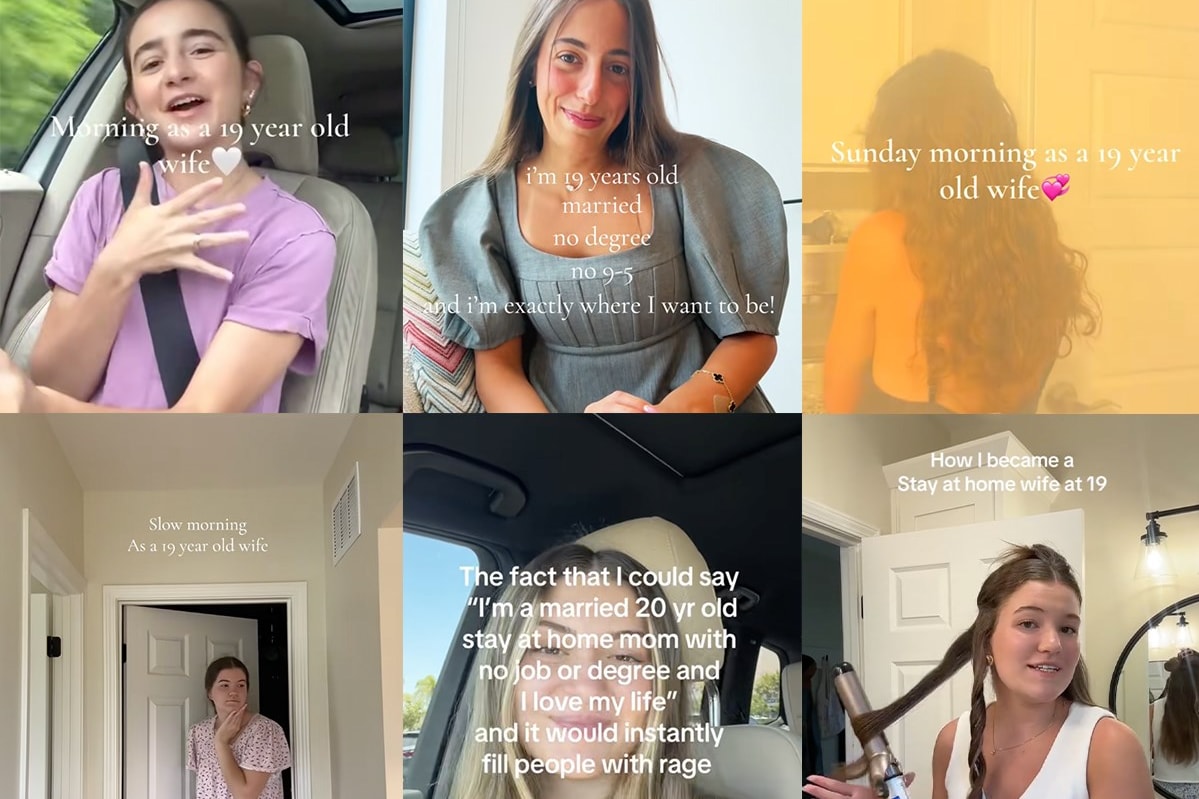
This record starts with two things landing almost on top of each other. On July 29, Nara Smith went on Call Her Daddy and, point by point, rejected the "tradwife" label she's been carrying for four years — she says it was never her. On August 4, Dazed published a feature documenting a wave of creators around 19 years old who aren't rejecting the label at all — they're putting their own age directly in the title, treating it as the content itself.

One person is saying "these images don't represent me." A younger group is using almost identical images to say "these images are exactly me." This record wants to sit inside that handoff — the moment a role gets taken off just as someone backstage appears to be waiting to put it on.

— OBSERVER 127 · Observation Archive
00Why This Topic Today

Why today: one person just said "this isn't me," and a younger group is already saying "this is me"

On July 29, Nara Smith appeared on episode 593 of Call Her Daddy. When host Alex Cooper brought up the fact that Smith has long been treated as "the poster child for the tradwife movement," Smith googled the technical definition on the spot, read it aloud line by line, and rejected it point by point: she's a working mother who travels constantly for work, her husband Lucky Blue Smith handles the cleaning, and childcare is split 50/50. "They kind of used me as the poster child for the tradwife movement, which was very bizarre to me," she said.

Almost the same week, on August 4, Dazed published a feature with a title that names the collision directly: with or without Nara Smith, the next generation of tradwives is already spawning. The piece documents a wave of creators around 19 — including Ava Ahavat, whose video last month drew over 16 million views and more than 20,000 comments, and 19-year-old Ella Bryan in Texas — who aren't trying to downplay their age at all; they're putting "I'm only 19" directly in the title as the hook. Cultural sociologist Sarah Brouillette told Dazed that this younger cohort is swapping the visual language of tradwife content — from farmhouse-and-gingham cottagecore into something closer to ordinary influencer aesthetics, a "pilates princess" look. You can marry a rich man, be a modern woman, and skip the deliberate vintage styling altogether.

Nara Smith attending a Tiffany & Co. event
Nara Smith at the Tiffany & Co. Blue Book launch, April 2026. Getty Images for Tiffany & Co., via TheGrio's coverage.
Left to right: cover image from Dazed's "the next generation of tradwives is already spawning," via TikTok; portrait of Nara Smith at a fashion event, Getty Images for Valentino; Nara Smith and Lucky Blue Smith at the same event, Getty Images for Tiffany & Co.
2020 onward
Tradwife content starts gaining traction on TikTok and Instagram, built around pastoral, retro-domestic visual language
2026.07 (approx.)
19-year-old Ava Ahavat posts a "married, no degree, no day job" TikTok that draws over 16 million views and 20,000-plus comments
2026.07.29
Nara Smith rejects the "tradwife" label point by point on Call Her Daddy episode 593
2026.07.31
Forbes publishes an explainer documenting the "rebrand" skepticism circulating on TikTok and X
2026.08.03
TheGrio publishes a commentary placing the debate inside a larger history of how Black women are expected to perform softness and homemaking
2026.08.04
Dazed publishes a feature on 19-year-old creators who, unlike Smith, aren't downplaying their age at all — they're claiming the label outright
01Community Voices

In their own words: a public fact-check over who's performing what

The nine quotes below span X, Threads, TikTok and media interviews — direct pushback against Nara Smith, voices defending her, and statements from the next generation of creators themselves.

X@Rayosweets
People defending Nara Smith by dismissing every criticism are missing the point. Critical thinking means questioning the message being promoted, not blindly defending it. Women promoting trad wife ideology are, in principle, no different from men promoting incel ideology. Both push rigid gender roles and deserve the same level of scrutiny.
Threadsanonymous user
The ironic thing about the Nara Smith discussion. Is how Anti-feminist and participating in blatant misogyny people are being, in both defense and critique of her. Like You can't claim to be fighting the patriarchy while simultaneously disrespecting women as a whole.
Threadsanonymous user
The weirdest part about this Nara Smith hate is that her daughter has cancer and yall are pummeling her while she's down.
Threadsanonymous user
I've literally never pinned Nara for a trad wife at all. Because of the costumes, the voice, script, and the ridiculous recipes, I always saw her as a character putting on a VERY OBVIOUS show. Not even an influencer, but a character. Like on a TV show. But then again my frontal cortex has been fully developed for over a decade so it's never occurred to me that she's doing anything more than entertainment. Which is also why I enjoy her.
Threadsanonymous user
You can like Nara Smith, just don't gaslight all of us who know what we saw. From the speech tone, cadence, stolen recipes, outfits, "natural way of living," etc. she postered an aesthetic similar to Ballerina Farm and Erika Kirk. Those of us with sense knew it was a grift... A well paid grift.
TikTokKatwiia
Your entire online brand revolved around making elaborate homemade meals from scratch and feeding them to your kids and husband … nobody looked at you and randomly came up with the Tradwife label. You leaned into it because it made you famous. Now that the label isn't trendy anymore, suddenly it's 'Actually, you all misunderstood me.' No, people understood exactly what you were trying to sell.
Threads@candicebenbow
It's been interesting to watch women aid Nara Smith in her rebrand by saying that they don't understand how and why she ever got the trad wife label. Are we being serious? LOLOL
TikTokAva Ahavat · own video
I'm told by a lot of people that I should be young and out there and 'living my life'. I don't know what that means – I promise you I'm living my life to the fullest in my faithful marriage.
Media InterviewElla Bryan, 19, to Dazed
I've never been like, 'because I'm a conservative I have to stay at home'. I've never really thought about politics being in it. People are like, 'This is the most MAGA thing I've ever heard,' and I'm like, really? That's weird because I've never said anything political on my page.

Background note: these nine quotes roughly split into three registers. The sharpest attacks on Nara Smith cluster around the word "gaslight" — the argument that the footage already exists, and denying it now amounts to asking the audience to rewrite its own memory. Voices defending her tend to reframe the whole body of work as "a character," sometimes turning the accusation back on critics for replicating another kind of policing of women. And the statements from the next generation of creators themselves land oddly calm — they don't seem to feel their choices need to be politicized, and don't seem especially bothered by how outsiders read them.

02Consensus Mapping

Four narratives: official, community, emerging, contrarian

Official Narrative

On Call Her Daddy, Nara Smith looked up the technical definition of tradwife — "prioritizes homemaking and childcare, supports her husband as primary breadwinner" — and rejected it point by point: she still works, her husband handles the housework, childcare is split evenly. She also pointed at a bigger structural issue: "I think there's also a bigger conversation to be had because everything that I've been reading online, I find it very concerning, almost that we need to put women in very specific, very narrow boxes in order to make sense of them," she said. "Why can't we do it all?"

Community Narrative

The pushback across Threads, X and TikTok largely reads Smith's denial as a precisely timed rebrand — critics point out that her costumes, slow-motion cooking footage, and whispery narration were themselves a deliberately built visual language, and that she's only distancing herself now that the label has stopped trending. Author Jo Piazza called her "a brilliant marketer who took advantage of a very particular moment in American culture to gain a massive following by projecting a ridiculous fantasy and a false nostalgia."

Emerging Narrative

Dazed's reporting pulls focus toward a younger cohort of creators who aren't distancing themselves from the tradwife aesthetic at all — they're claiming the label outright, putting "I'm only 19" directly in the title as the hook. Their visual language is shifting too, moving from farmhouse cottagecore toward something closer to ordinary influencer content: workout sets, marble countertops, PR hauls. Scholar Sarah Banet-Weiser notes this content echoes the current political climate's image of ideal womanhood as "young, beautiful and usually white."

Contrarian Narrative

TheGrio's commentary pulls the debate toward a different angle entirely: many of Smith's loudest critics are non-Black women, while Smith herself is a Black woman — which complicates who gets to decide what "authentic" traditional womanhood even looks like. The piece also cites a Threads comment: "The ironic thing about the Nara Smith discussion is how anti-feminist and participating in blatant misogyny people are being, in both defense and critique of her. You can't claim to be fighting the patriarchy while simultaneously disrespecting women as a whole."

03Cultural Signal Extraction

Signal breakdown: six facets

What Changed?

Whether someone "counts" as a tradwife used to be a label applied from the outside. This time it became a case the subject herself felt compelled to argue against in public — while, at the same time, a younger cohort skipped the argument entirely and put the label on as a content strategy.

Why Are People Reacting?

Four years of Nara Smith's gowns, slow-motion cooking, and hushed narration have already become part of the internet's shared memory. Her saying "these images don't represent me" now asks the audience to revise the version they remember — which is likely why so much of the backlash gravitates toward the word "gaslight."

What Assumptions Are Challenged?

The claim that "this is just an aesthetic, not an ideological stance" is under re-examination — when the same visual vocabulary gets used by two generations to say, respectively, "I was never promoting anything" and "this is exactly how I want to be seen," the line between aesthetic and position looks less clean than assumed.

What Desires Are Visible?

From "stop gaslighting us" to "she was always just a character," what surfaces is the same underlying want: a stable narrative that doesn't get revised after the fact — whether that stable version turns out to be "she was performing the whole time" or "she meant what she said."

What Social Behavior Is Changing?

The previous generation of tradwife creators tended to obscure their actual age; this generation puts "I'm only 19" directly in the title. Youth itself has moved from a vulnerability that needed explaining to a hook engineered for views.

Future Human Behavior?

Once "identifying with a label" becomes something that can be revoked and renegotiated at will, is the next step that "identity" itself starts getting treated as a subscription status — something that can be toggled on and off whenever it's convenient?

04INCODER's Eye

The lenses we're reading this through: six observation frames

These six themes are the fixed frame INCODER checks every cultural signal against — less a conclusion, more a set of lenses. Put one on and the same story grows a different shape.

Information Culture

Nara Smith's rejection clip is being broken down line by line online, cross-referenced against four years of her own footage, like a public fact-check running in real time. Once a person's self-description has to survive being checked against her own archive, which counts as more credible testimony — how she describes herself now, or what she was once caught on camera doing?

Digital Identity

The same visual elements — puff-sleeved gowns, slow-motion cooking, a hushed voice — get redefined as "a character" in Nara Smith's case, and treated as simply "who I am" by 19-year-old creators using nearly identical footage. Is a digital identity's credibility increasingly a matter of whether a creator is willing to admit she's performing, rather than what the performance actually contains?

Symbolic Systems

From farmhouses, sourdough and aprons to workout sets, marble countertops and PR hauls, the tradwife symbol system is changing its skin. Once the nostalgia fades and gets replaced with something closer to ordinary influencer aesthetics, how much of "tradition" is still carried in that symbol, and how much of it is now just a filter that can be switched off at will?

Networked Society

With no central coordination, the words "gaslight," "rebrand" and "character" surfaced almost simultaneously across Threads, X and TikTok, describing the same event. Is this decentralized but strangely synchronized vocabulary the fastest way a networked community currently renders a collective verdict on someone's authenticity?

Perception and Attention

One Threads user says watching Nara Smith feels "like watching a very obvious show" — and admits that's exactly why she enjoys it. Once an audience can say out loud "I know this is performed, and I still want to watch," does the performance still need to convince anyone it's real, or has persuasion itself stopped being the point?

Dark Vitality

The scholar Dazed quotes points out that these 19-year-old creators are facing a job market where even the idea of climbing upward barely holds together. Packaging "being financially supported by a partner" as the content itself reads as its own survival strategy in a resource-scarce generation — a way to find an exit that's both visible and monetizable. Is this the background hum every future version of this trend will carry with it?

05Signal Score

Signal strength rating

7/10

This signal is precisely timed — Nara Smith's podcast appearance (7/29), the following week of media analysis (7/31 through 8/3), and Dazed's feature on the next generation of creators (8/4) all landed inside the same week, forming a clearly legible "generational handoff" window. Points held back because the conversation is still mostly contained within entertainment and culture media plus adjacent online communities, with no visible response yet at the brand or policy level; the tradwife debate itself has existed since the early 2020s, which dulls some of the "first time this has happened" novelty. If the two tradwife-as-horror novels arriving in September, Call Off the Dark and Trad Wife, pull this into wider mainstream conversation, or if more young creators follow Ava Ahavat's model at scale, this score should move up.

06Final Question

The deepest hidden assumption

?
When one person can announce at any time "this was never me," and another group can announce at any time "this is me" — is this argument actually settling who's more honest, or is "honesty" itself just a switch this content ecosystem can flip on and off whenever it wants?

On the surface, this is a dispute about whether Nara Smith lied. But zoom out — her podcast appearance and Dazed's feature on the next generation of creators landed in the same week — and it starts to look more like watching two uses of the same visual language happen at once. One person is saying "this footage doesn't represent who I am." A younger group is using nearly identical footage to say "this footage is exactly who I am."

Neither claim can really be verified from the outside. How Nara Smith's household actually splits chores, what Ava Ahavat's marriage actually looks like day to day — only the people living it know for sure. What this argument may be accumulating isn't evidence on either side so much as a shared, unspoken agreement: as long as the visual language is precise enough, "this is me" and "this isn't me" can apparently come from the exact same footage. This record has no answer yet, only a question left open — the next time an even younger creator delivers, almost word for word, the same lines Nara Smith once did four years ago, will the people currently insisting she "should have been clearer" remember that they ever asked for that?

Observation remains incomplete.

This report records the state of observation at this moment.

Nara Smith's podcast appearance is barely a week old, and its downstream effects — whether brand partnerships are affected, whether she responds further — haven't fully surfaced yet. Whether the two tradwife novels landing in September gain mainstream traction, and whether creators like Ava Ahavat keep building an audience, both remain open. Part of this record may be redefined, or entirely overturned, within the next few weeks.

Observation continues.

Observer 127 · Report 0013 · Archive Index Open
This report was researched and written by AI, reviewed by a human before archiving.